Your quarterly reminder that I have a Patreon, where you can support me and my blog, and find nice things like Adunaic pattern blocks, high-res comic pages, reward art, and more! ❤
I have done, but only once before, with a close friend of mine who had a compatible muse. (It was a ways back in the blog timeline).
In theory I wouldn’t mind RPing with a non-Tolkien muse, but I’m going to be very selective for two reasons: firstly, most of my world building and character development is exclusive to Tolkienverse, and secondly– i’m a poor sheltered peanut who isn’t nearly as familiar with 90% of games, novels, comics, or TV shows as I pretend to be. And I like to be familiar with muses I RP with!
That said, with proper introduction, a suitably compelling premise, and the right mun-chemistry, I could probably make it work.
Being the die-hard classical fencer that I am (er….was) I always turned up my nose at the historical fencers in college who were all avid D&Ders with a lot of enthusiasm and no finesse. SO I HAVE MY BIASES but obviously there are more and less authentic ways of going about recreating historical combat.
Not having the convenient circle of SCA buddies on hand that I used to, I have turned to the blessed font of Youtube to get me familiar with long swords.
I always need to have visual references for my art and writing. I need to see a thing in action before I can describe it or imagine its use, so this stuff is basically priceless to me.
Anyway, here’s some good fodder for imagining your favorite first-age elves beating the holy living snot out of each other.
Intermediate SCA Greatsword Technique – The first one shows some of the basic parries and thrusts for longsword, which was a great refresher for my fencer’s brain. All the same basic principles of parrying and getting inside the opponent’s guard are there, just adapted for a wide swinging, heavier weapon. It’s surprisingly precise! Also the instruction is very slow and clear so it’s easy to follow.
Claymore vs. Longsword – The second one shows the same moves in action, with the additional bonus of hotties in black body armor.
Longsword Techniques–Another great longsword parry and thrust video, slightly more advanced than the first one.
Two-Handers / Blade “Horns”/ Sword Guard Proportions– The history and development of your big fuckoff two-handed great swords, followed by an explanation and theory about those iconic “horns” on the blades of great swords, and an explanation about the proportions of these swords.
Two-hander vs Six Rapiers–In the above videos, a technique was mentioned of using the momentum of the two-handed sword to achieve a defensive windmill effect. Here’s that in action against six opponents. Rad as heck.
Monante vs… – In a similar vein, an interesting playlist of a great sword user whittling down a group of opponents. This one is quicker paced.
I’m pretty in love with half-swording. The idea behind half-swording is basically that, when faced with an opponent in full armor, it’s useful to use Every Part of The Sword; including the pommel and cross-guard. With half-swording you grab the blade mid-way in order to get better leverage and precision in a stab. The technique’s purpose is basically to dent armor, stun your opponent, and then deliver precision stabs to weak points in their armor with extra leverage– essentially turning your sword into a makeshift percussive weapon like a war-hammer or mace.
Unfortunately I’m having trouble finding good videos of this technique in use. Most of them are a bit…. flail-y?
Half-swording demo – Same fellow as before, giving a thorough demonstration of how one can effectively use half-sword techniques without hurting one’s self. –He does not mention that many swords were only sharpened at the tip specifically to facilitate this technique, sometimes adding a ricasso or sub-hilt for the same purpose. (Though to really get the right leverage on a stabbing blow, you’d have to hold your sword a lot closer to tip).
Armor and Halfswording Lessons– This is part of a series of parrying and grappling half-sword technique instruction. Slow and easy to follow; shiny armor; sexy accent.
Bashing vs. Halfswording– This is the best demo I can find of this technique in use. Doesn’t this look fucking vicious? I love this. Kudos to these guys!!
Armored Longsword Demo– Another great demo, this time in full armor with live steel. These guys go in and out of half-swording throughout the duel.
Armor Mobility and Grappling– A quick series of demonstrations concerning maneuverability in full plate, with some bonus take-down methods for messing up other people in full plate.
Here’s a general rule: People in the past were ignorant about a lot of things, but they weren’t stupid. If they used something, chances are they had a good reason. There are exceptions, but plate armor is not one of them.
Long Answer:
For a type of armor, no matter what it is, to be considered effective, it has to meet three criteria.
The three criteria are: Economic Efficiency, Protectiveness, and Mobility.
1. Is it Economically Efficient?
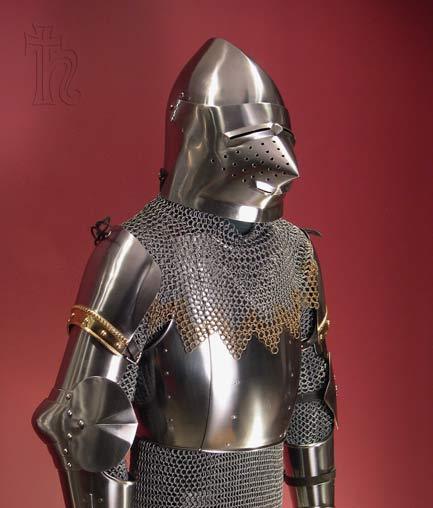
Because of the nature of society in the Middle Ages, what with equipment being largely bring-it-yourself when it came to anybody besides arrowfodder infantry who’d been given one week of training, economic efficiency was a problem for the first couple of decades after plate armor was introduced in France in the 1360s. It wasn’t easy to make, and there wasn’t really a ‘science’ to it yet, so only the wealthiest of French soldiers, meaning knights and above, had it; unless of course somebody stole it off a dead French noble. The Hundred Years War was in full swing at the time, and the French were losing badly to the English and their powerful longbows, so there were plenty of dead French nobles and knights to go around. That plate armor was not very economically efficient for you unless you were a rich man, though, it also was not exactly what we would call “full” plate armor.
Above: Early plate armor, like that used by knights and above during the later 1300s and early 1400s.
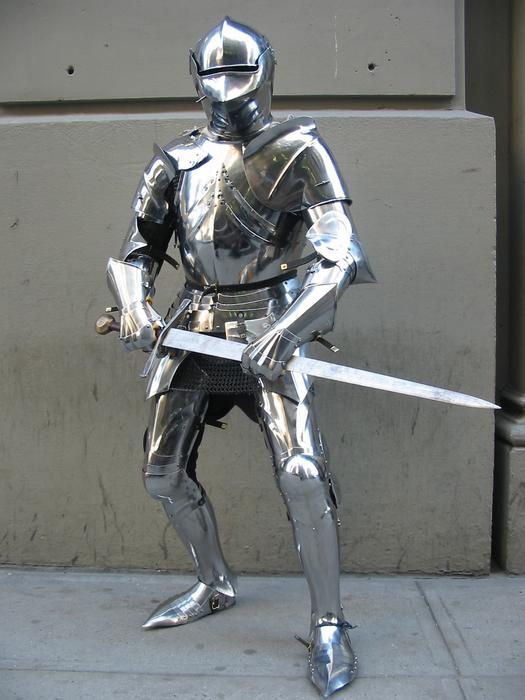
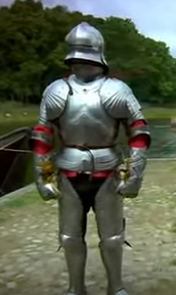
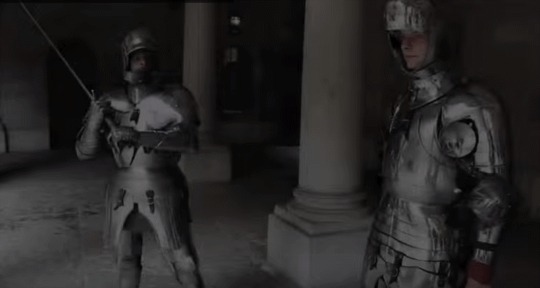
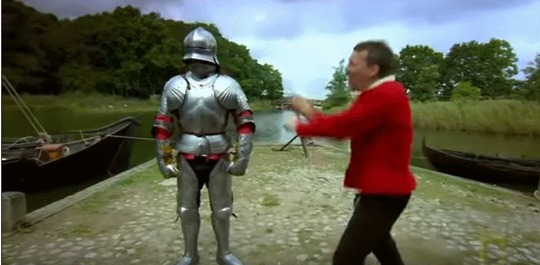
Above: Two examples of what most people mean when they say “full” plate armor, which would have been seen in the mid to late 1400s and early 1500s.
Disclaimer: These are just examples. No two suits of armor were the same because they weren’t mass-produced, and there was not really a year when everybody decided to all switch to the next evolution of plate armor. In fact it would not be improbably to see all three of these suits on the same battlefield, as expensive armor was often passed down from father to son and used for many decades.
Just like any new technology, however, as production methods improved, the product got cheaper.
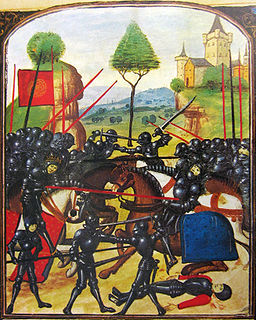
Above: The Battle of Barnet, 1471, in which everybody had plate armor because it’s affordable by then.
So if we’re talking about the mid to late 1400s, which is when our modern image of the “knight in shining armor” sort of comes from, then yes, “full” plate armor is economically efficient. It still wasn’t cheap, but neither are modern day cars, and yet they’re everywhere. Also similar to cars, plate armor is durable enough to be passed down in families for generations, and after the Hundred Years War ended in 1453, there was a lot of used military equipment on sale for cheap.
2. Is it Protective?
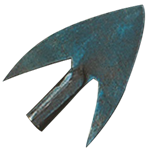
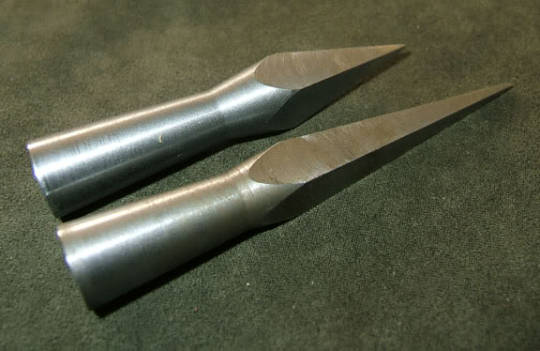
This is a hard question to answer, particularly because no armor is perfect, and as soon as a new, seemingly ‘perfect’ type of armor appears, weapons and techniques adapt to kill the wearer anyway, and the other way around. Early plate armor was invented as a response to the extreme armor-piercing ability of the English longbow, the armor-piercing ability of a new kind of crossbow, and advancements in arrowhead technology.
Above: The old kind of arrowhead, ineffective against most armor.
Above: The new kind of arrowhead, very effective at piercing chainmaille and able to pierce plate armor if launched with enough power.
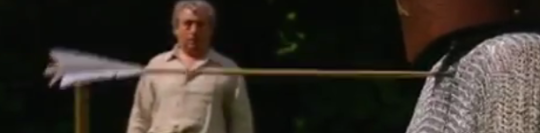
Above: An arrow shot from a “short” bow with the armor-piercing tip(I think it’s called a bodkin tip) piercing a shirt of chainmaille. However, the target likely would have survived since soldiers wore protective layers of padding underneath their armor, so if the arrow penetrated skin at all, it wasn’t deep. That’s Terry Jones in the background.
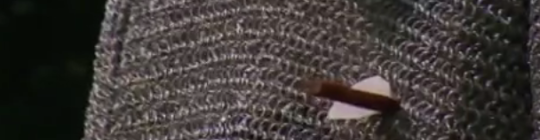
Above: A crossbow bolt with the armor piercing tip penetrating deep through the same shirt of chainmaille. The target would likely not survive.
Above: A crossbow bolt from the same crossbow glancing off a breastplate, demonstrating that it was in fact an improvement over wearing just chainmaille.
Unfortunately it didn’t help at all against the powerful English longbows at close range, but credit to the French for trying. It did at least help against weaker bows.
Now for melee weapons.
It didn’t take long for weapons to evolve to fight this new armor, but rarely was it by way of piercing through it. It was really more so that the same weapons were now being used in new ways to get around the armor.
Above: It’s a popular myth that Medieval swords were dull, but they still couldn’t cut through plate armor, nor could they thrust through it. Your weapon would break before the armor would. Most straight swords could, however, thrust through chainmaille and anything weaker.
There were three general answers to this problem:
1. Be more precise, and thrust through the weak points.
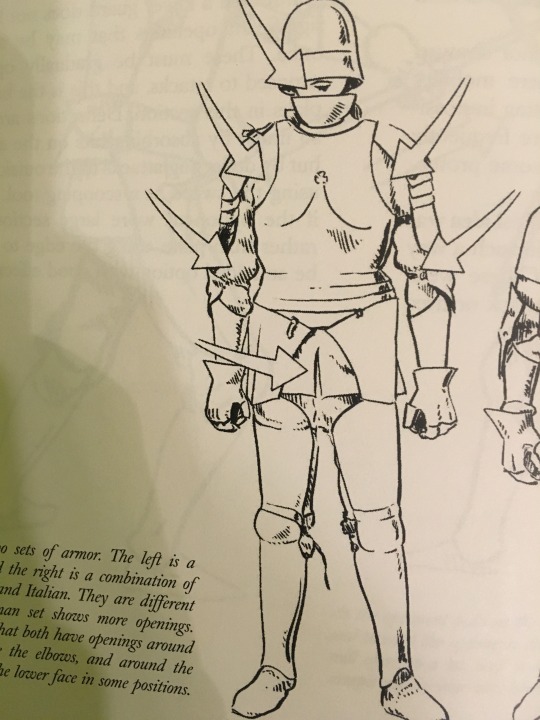
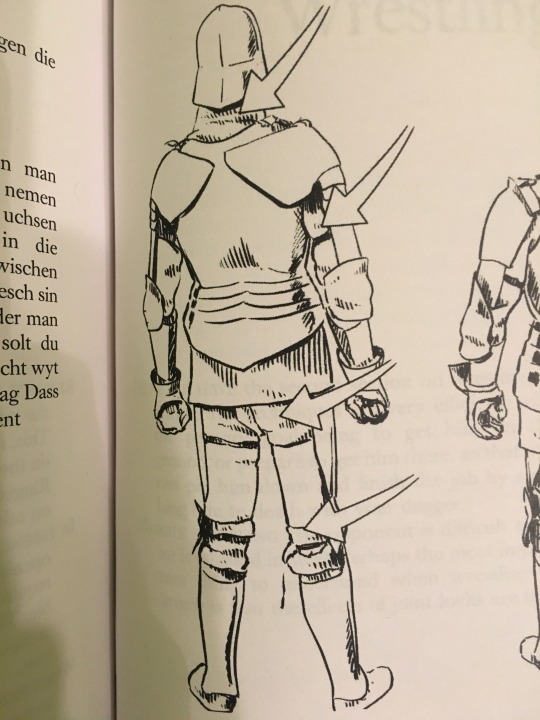
Above: The weak points of a suit of armor. Most of these points would have been covered by chainmaille, leather, thick cloth, or all three, but a sword can thrust through all three so it doesn’t matter.
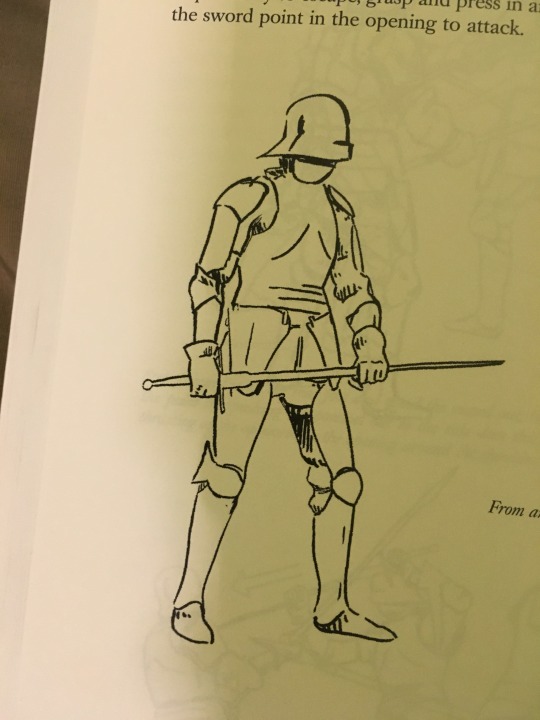
To achieve the kind of thrusting accuracy needed to penetrate these small gaps, knights would often grip the blade of their sword with one hand and keep the other hand on the grip. This technique was called “half-swording”, and you could lose a finger if you don’t do it right, so don’t try it at home unless you have a thick leather glove to protect you, as most knights did, but it can also be done bare-handed.
Above: Examples of half-swording.
2.Just hit the armor so fucking hard that the force carries through and potentially breaks bones underneath.
Specialty weapons were made for this, but we’ll get to them in a minute. For now I’m still focusing on swords because I like how versatile the European longsword is.
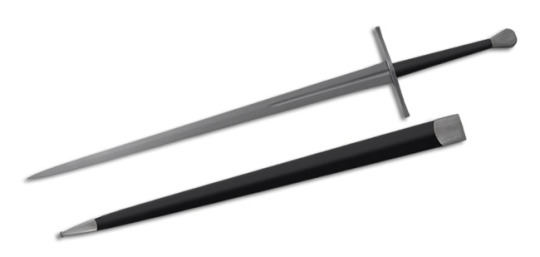
Above: A longsword. They’re made for two-handed use, but they’re light enough to be used effectively in one hand if you’d like to have a shield or your other arm has been injured. Longswords are typically about 75% of the height of their wielders.
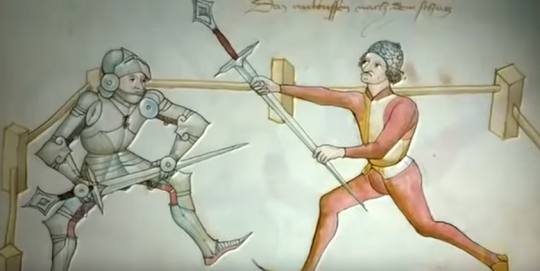
Assuming you’re holding the sword pointing towards the sky, the part just above the grip is called the crossguard, and the part just below the grip is called the pommel. If you hold the sword upside-down by the blade, using the same careful gripping techniques as with half-swording, you can strike with either the crossguard or the pommel, effectively turning the sword into a warhammer. This technique was called the Murder Stroke, and direct hits could easily dent plate armor, and leave the man inside bruised, concussed, or with a broken bone.
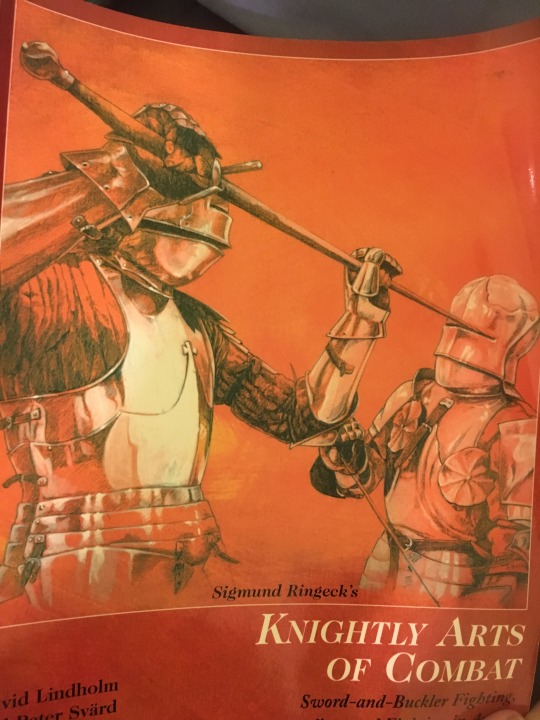
Above: The Murder Stroke as seen in a Medieval swordfighting manual.
Regular maces, hammers, and other blunt weapons were equally effective if you could get a hard enough hit in without leaving yourself open, but they all suffered from part of the plate armor’s intelligent design. Nearly every part of it was smooth and/or rounded, meaning that it’s very easy for blows to ‘slide’ off, which wastes a lot of their power. This makes it very hard to get a ‘direct’ hit.
Here come the specialized weapons to save the day.
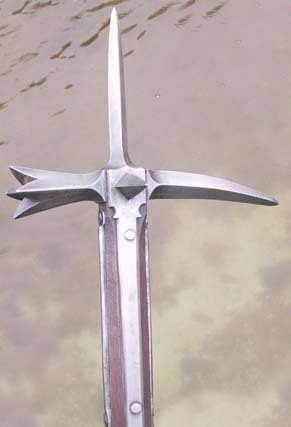
Above: A lucerne, or claw hammer. It’s just one of the specialized weapons, but it encompasses all their shared traits so I’m going to only list it.
These could be one-handed, two-handed, or long polearms, but the general idea was the same. Either crack bones beneath armor with the left part, or penetrate plate armor with the right part. The left part has four ‘prongs’ so that it can ‘grip’ smooth plate armor and keep its force when it hits without glancing off. On the right side it as a super sturdy ‘pick’, which is about the only thing that can penetrate the plate armor itself. On top it has a sharp tip that’s useful for fighting more lightly armored opponents.
3. Force them to the ground and stab them through the visor with a dagger.
This one is pretty self-explanatory. Many conflicts between two armored knights would turn into a wrestling match. Whoever could get the other on the ground had a huge advantage, and could finish his opponent, or force him to surrender, with a dagger.
By now you might be thinking “Dang, full plate armor has a lot of weaknesses, so how can it be called good armor?”
The answer is because, like all armor is supposed to do, it minimizes your target area. If armor is such that your enemy either needs to risk cutting their fingers to target extremely small weak points, bring a specialized weapons designed specifically for your armor, or wrestle you to the ground to defeat you, that’s some damn good armor. So yes, it will protect you pretty well.
Above: The red areas represent the weak points of a man not wearing armor.
Also, before I move on to Mobility, I’m going to talk briefly about a pet-peeve of mine: Boob-plates.
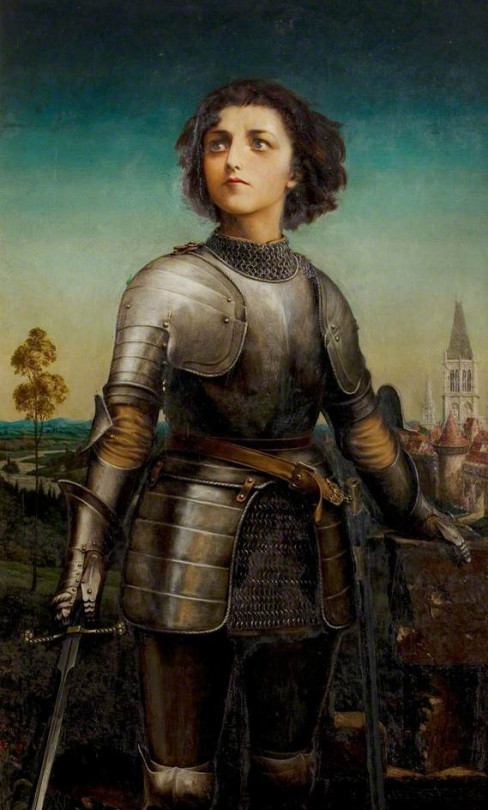
If you’re writing a fantasy book, movie, or video game, and you want it to be realistically themed, don’t give the women boob-shaped armor. It wasn’t done historically even in the few cases when women wore plate armor, and that’s because it isn’t as protective as a smooth, rounded breastplate like you see men wearing. A hit with any weapon between the two ‘boobs’ will hit with its full force rather than glancing off, and that’ll hurt. If you’re not going for a realistic feel, then do whatever you want. Just my advice.
Above: Joan of Arc, wearing properly protective armor.
An exception to this is in ancient times. Female gladiators sometimes wore boob-shaped armor because that was for entertainment and nobody cared if they lived or died. Same with male gladiators. There was also armor shaped like male chests in ancient times, but because men are more flat-chested than women, this caused less of a problem. Smooth, rounded breastplates are still superior, though.
3. Does it allow the wearer to keep his or her freedom of movement?
Okay, I’ve been writing this for like four hours, so thankfully this is the simplest question to answer. There’s a modern myth that plate armor weighed like 700 lbs, and that knights could barely move in it at all, but that isn’t true. On a suit of plate armor from the mid to late 1400s or early 1500s, all the joints are hinged in such a way that they don’t impede your movement very much at all.
The whole suit, including every individual plate, the chainmaille underneath the plates, the thick cloth or leather underneath the chainmaille, and your clothes and underwear all together usually weighed about 45-55 lbs, and because the weight was distributed evenly across your whole body, you’d hardly feel the weight at all. Much heavier suits of armor that did effectively ‘lock’ the wearer in place did exist, but they never saw battlefield use. Instead, they were for showing off at parades and for jousting. Jousting armor was always heavier, thicker, and more stiffly jointed than battlefield armor because the knight only needed to move certain parts of his body, plus being thrown off a horse by a lance–even a wooden one that’s not meant to kill–has a very, very high risk of injury.
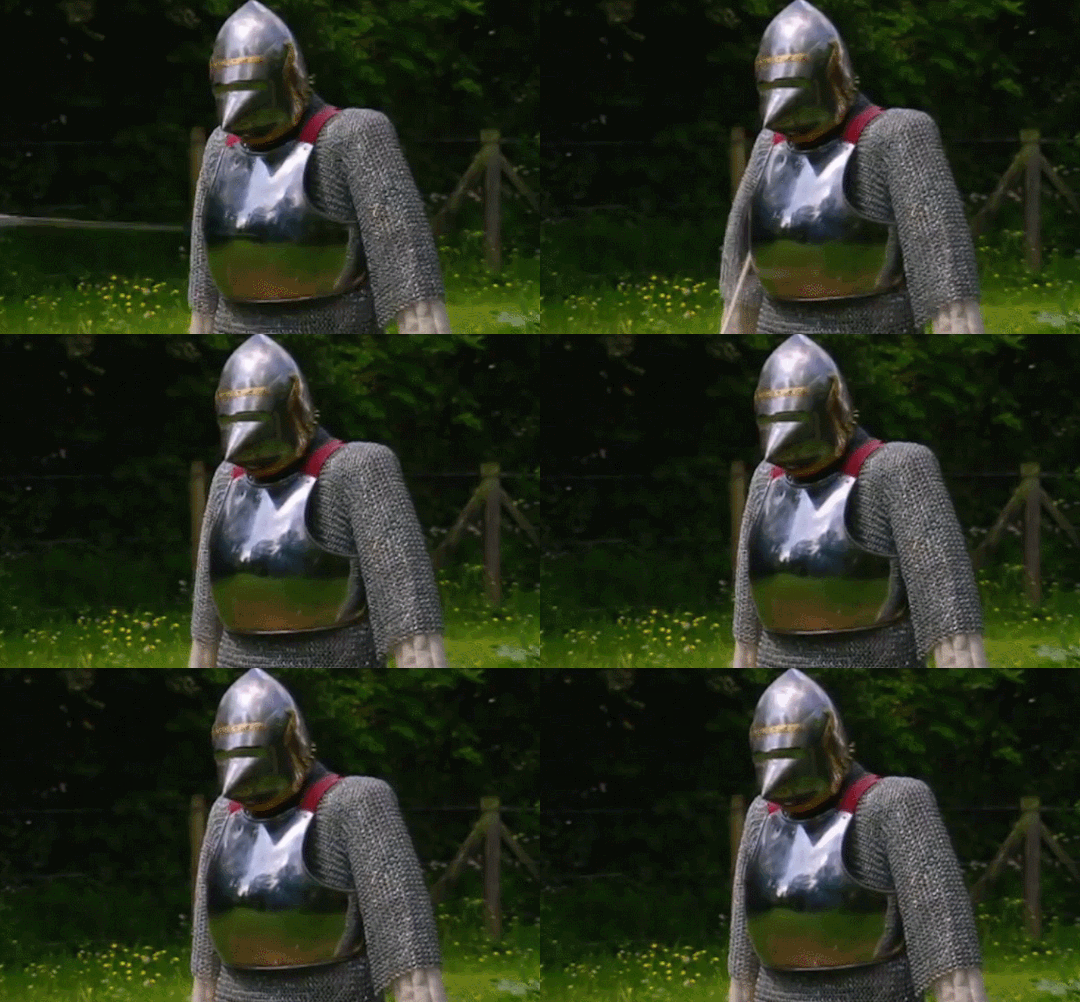
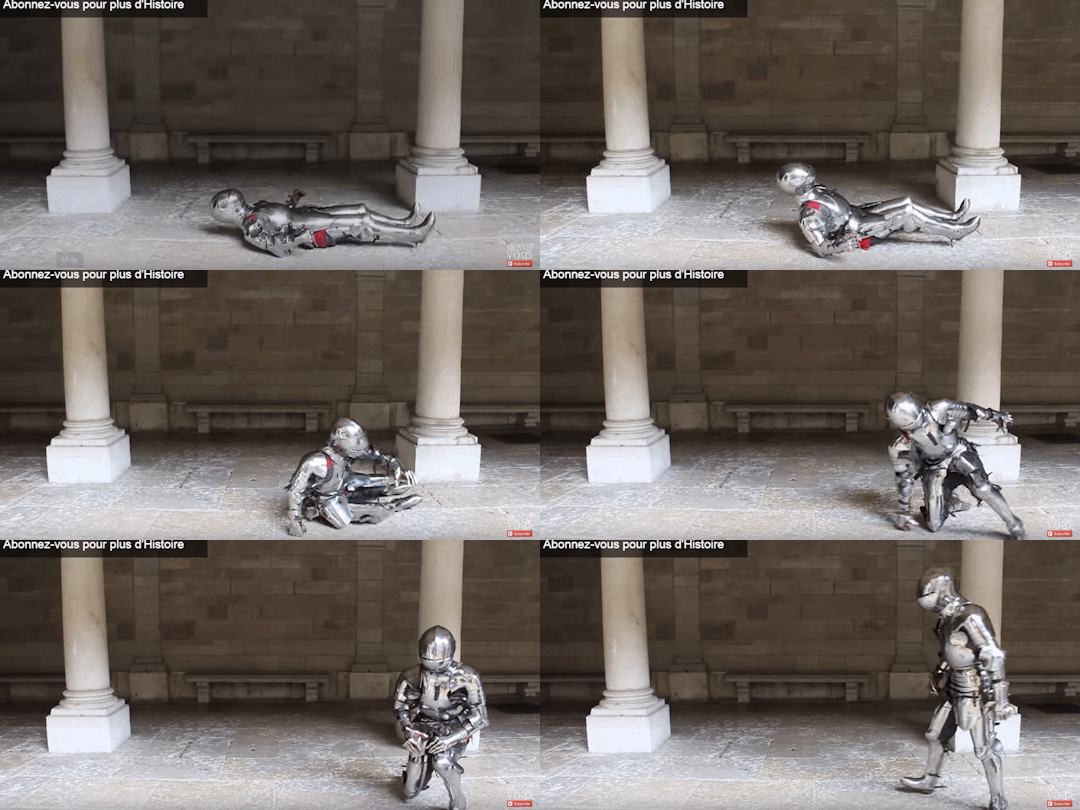
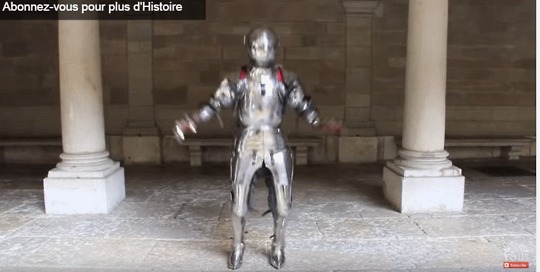
Here’s a bunch of .gifs of a guy demonstrating that you can move pretty freely in plate armor.
Above: Can you move in it? Yes.
Here are links to the videos that I made these .gifs from:
concerning weight and mobility: keep in mind the modern body armor worn by united states army soldiers weighs 30 lbs. even granting that modern soldiers, even the women, are larger than most medieval knights, it’s still significant that the state of the art in 2016 is only ten or fifteen pounds lighter than full plate.
and they march long distances in it, which knights generally did not have to do in their armor. conclusion: plate armor was not too heavy to fight in.
as for mobility, i think the myth that knights couldn’t move in their armor mainly comes from jousting armor, which was designed to lock in place and be absurdly heavy, simply because it was the car in a medieval demolition derby. you weren’t fighting in it, you were simply being carried toward a pointy log at high speeds.
This is such a good post! Also I’m happy to see the murder stroke has shown up in more and more films of late – I think even the Nic Cage film Season of the Witch shows it.
For anyone who went through that reference video masterpost of greatswords and half-swording stuff: this is the other side of the equation, the armor! 🙂
There was no shuffle of feet to announce his entrance, no entourage of Orcish guards to mark the arrival of an officer. When he came, he merely appeared, stepping from the lamp-black shadows into the furnace light of the volcanic cell.
“You.” The somber voice curled with disdain. “You’re the one He wanted so badly?” Sauron came forward, thrusting a hand between the bars of the cell to clamp the elf’s bruised jaw between his fingers. He seemed to be appraising a cut of meat, finding it inadequate. “So many sent to die, for this? You look nothing like him.” This was not addressed to Maedhros, and the lieutenant did not bother to clarify who or what he meant as he relinquished his grasp.
“Such a waste.”
The great maia’s back was turned as he examined structures obscured by the darkness of the chamber. Soft metallic sounds echoed amidst the rumbling of the subterranean pit; quiet clinks and clacks of some device turned in the hand, the creak and slither of leather, chilling in their ambiguity. A spray of distant magma illuminated briefly the walls lined with what seemed workman’s tools; racks and rows of hanging instruments, long empty tables, vials and troughs of liquid. He hummed a low note of satisfaction, selecting at last a tool that met with his approval.
“You are… Maedhros. First and eldest of the sons of Fëanor. Yes?” The maia asked, unhurried. He knelt, huge and graceful, before the iron cage, red-gold eyes searching out the prisoner’s. “I am Sauron, first lieutenant and forgemaster of Angband. My Master has given you to me for the purposes of breaking.” He unfurled the whip that had been coiled lazily in his hands, all black braid with many silver-tipped tails. “If you choose to be forthcoming with information that is useful to my Master, we may forgo many painful formalities, but not all. I myself hold no personal grudge against you… if it were in my power to break Lord Melkor’s fascination with those of your house, I would happily do so. To me, you are an enemy soldier, an irritant, worthy of no more attention or special effort than any other. But to my Master…” The maia blinked slowly, lips touched with an expression of irony; “To my Master, you a most sought and toothsome prize.”
As he spoke, he unlocked the mechanism keeping shut the cage, springing it open. He looked not at all distressed that his prisoner might escape. With one hand he pulled the captive’s chain, forcing him out of the cell at the behest of his neck.
“I do as my Master bids– happily, unhesitatingly, exhaustively. And what He bids is that you shall have the memory of Him burned onto you forever, that His unsatisfied desires, His wrath, shall find satisfaction.”
Sauron tilted his head, eyes flashing in the gloom like an animal’s. “You are to be your father’s whipping boy, Noldo. You can thank Fëanor for what you will endure here; it was he my Master wanted, but He has you instead.”
Awareness had not been born
until the other’s voice has burst into existence. Maedhros was
startled though all he did to show it was a mere widening of his
eyes. No, he wast still and silent as the other grasped his face.
There was no room to flee his foul touch and flinching would have
only served to hurt the weak remains of his pride. (He had a feeling
it wouldn’t remain in tact soon so he clung to it like he had once
clung to Nerdanel’s skirts under a different name.)
His eyes did not lift, did
not take in the room around him at the brief glint of light. It hurt
his eyes after hours spent in darkness more so than the other’s
bruising touch. He did not answer, did not not speak in a long time
nor showed interest in Sauron’s words. He half sought out something
to spite the other, to throw him into a rage that would crush him.
Maedhros had no desire to live if it meant being used as a banner of
betrayal. Nay- he would rather have his throat slit now and be
haunted in Mando’s halls by all who he had killed on the path to get
here.
In turn, he almost welcomed
the sound of the whip unfurling-
he would deserve such things
after all. How much
blood had he spilled in Alqualondë?
He made to wet his lips though his tongue was dry and finally lifted his gaze as the
cell door was opened. He gingerly took a breath of what would be his
last moment of peace then locked his muscles, resisting as a collar
‘round his neck was pulled, his body soon following against his want.
Maedhros wanted to snarl,
to claim- Feanor has already done the damage you can not deal. What
was a whip, what was pain? His own father had led them away from home
permanently. Their own father had decided not to turn back ships
for their loyal love one who would follow them. His own father had
set their youngest brother ablaze, his pyre burning around him as he
choked to death on the ash he would become.
Instead he smiled, weary
and bitter “- Do your best then, for a dog gets no satisfaction
unless they earn their master’s affections. I am gladdened by the
sight of the pet and not the owner. Tell me, how sharp are your
teeth?” Kill me, kill me.
The maia laughed, the echo of it reverberating throughout the cavern. His lips pulled back, revealing vicious and curving fangs.
“Very,” he grinned. “But you’ll not tempt me into killing you just yet, Noldo. Not so early in our acquaintance.” The prisoner’s mind slipped open to him, unguarded as it was in a moment of nihilism and despair; he’d heard a whisper of his name on a prayer, begging for death, and that was all he needed to cross the threshold.
So deep was the mire of that mind, the bitterness it held pulled inward all hope and drowned it preemptively in uncaring death. Yet at the center of that sand-trap of apathy lay what remained of a beautiful thing; a bright red-winged bird of free spirit and song, buried deep in the tar.
And that was all he saw before the doors closed on him.
“Sad little thing, aren’t you? Giving in so soon.” He slid a hand through the Noldo’s rust red hair; a mockery of comfort. “Tell me, who was the master who withheld their affection from you, pup? Could it be you’re still following their command, o oft-kicked hound?” He clucked his tongue. “One wonders why.”
Three Rings for the Elven-kings under the sky, Seven for the Dwarf-lords in halls of stone, Nine for Mortal Men, doomed to die, One for the Dark Lord on his dark throne Four for you, Glenn Coco! You go, Glenn Coco. And none for Gretchen Wieners, bye
true. although i took a great deal of joy running up behind the bloodborne bosses and sticking various pointy and shooty things up their eldritch butts. and then running away screaming when it turns around to get revenge.
Immunity to eldritch charm is why you play Turambar m’dear X’D
he sounds like a bloodborne boss fight on crack. no, scratch that – he’s the Nameless King from Dark Souls 3, only without the dragon and absolutely not optional.
Ooh, that’s a good size-ref *o*
….also there’s something in that good ol’ Bloodborne feeling of fighting an ancient eldritch god that was never meant to die, who draws its powers from something unnamable and fathomless and beyond your understanding, born of corruption and massacre, and totally at odds with your species’s survival, but still unspeakably beautiful in a way that stirs the part of your brain that whispers “worship, be in awe”, and yet you must kill them or perish.





 MisbehavingMaiar: Tumblr Archive