Try: Ungoliant or Orome

Oromë is another one I’m having to write for a project, so I’ll hit up that UUUUUNNNNNGLLLLEEEEESSSSSSS *bew bew bewwwww*

I fucking love Ungles and I’m happy to report that I have some Bonafide Eldritch Headcanons™ about her. 

Canon wants us to believe that she’s a corrupted spirit from Ëa who joined Melkor but then fucked off because that’s how spiders do.  I AM NOT CONVINCED. You can’t have your “Melkor is the mightiest of the Valar and Valar are exponentially greater in power than Maiar” cake and …. have….a  spider eat that cake. 

So, in so much as Ainur are beings derived from Eru’s thought, Ungoliant is not a Maia. She’s not a Vala. She’s not one of the Ainur at all. Ungoliant is something Melkor ran into when he was searching the outer darkness for the Secret Fire, which only Illuvatar has. The Void is at least as old as Eru, being timeless. It is vaster than He (if one can even use size as a metric for measuring infinite cosmic entities), though empty. It is the birthplace of all potential, the void that must be in order for things other than it to exist. It is ready to quicken around any particle of matter and form pearls of chaos that expand infinitely and succumb to entropy just as quickly as they form. It is a writhing, frothing, sightless, soundless, Nothing that devours itself in perpetuity.  

Melkor was not made of matter when he ventured into the depths of the Void in the beginning, and did not stir the ancient darkness when he passed through it. But he did speak to it– told it about the world that was to be made, of his part in the making of it. And the Void listened in its own fashion, forming around the Idea that had been planted into it and growing. All the Nothing in the universe can fit into the back pocket of a quark, so the resulting consciousness was both very small and very big; just a grain of sand that could expand as much as anything that was put into it. And that Thing waited around in the deeps of the void until Melkor came into the outer darkness a second time–this time pissed off, and nursing a sore cheek from where Tulkas punched him, and he said “hey, want to come fuck things up?” And it said “ssssssss” and crawled up his sleeve. 

Now, it may seem irresponsible to bring the sentient equivalent of a black hole into the realm of matter and just let it go hog wild, but Ungles is only as powerful as what you put in her. She devours light and matter and energy and creates darkness and sticky void-webs that eventually sort of clog up her ability to intake more of those things; this is why her dens are isolated wastelands of Scary Shit and darkness, because once she’s devoured everything in the area, nothing else can easily get in, and going OUT takes too much energy for her when she’s starving. So she’s not too much to handle if you’re the mightiest of the Valar, or even a sufficiently powerful Maia or Eruhini.  

However, when you let her drink two full trees’ worth of Vala Juice, you’re in for a bad time. 

–Just for kicks, here’s a crusty old unfinished story-board experiment of the Tree Incident– 

image
image

In terms of personality, she’s pretty straightforward; she knows what she wants, she can never have ENOUGH of what she wants, and she doesn’t trust Melkor any more than Melkor trusts her. She’s not especially malicious (except when someone Wrongs Her and then gives her a chance to get even)– just predatory by nature and aware of her own otherness. She’s very intelligent; I imagine she picks things up from whatever she eats, and she’s been around a very long time and eaten a LOT of things. She can feel amusement, anger, anticipation, greed, hunger, interest, wariness, hatred, fear, and possibly even a distant affection for any of her daughters that are strong and clever enough to avoid being eaten by her long enough to grow up and spread to Middle Earth. She’d still eat them if given the chance, and they’d probably eat her if they could figure out how– but that’s just how the spider do. 

She also diminishes with time; the more she eats, the more personality and self-awareness she has, and the longer she starves the more she reverts to being a mindless consuming force. She acknowledges a certain affiliation with Melkor– he was the one that facilitated her coming to earth where she could Eat Things in the first place, giving her awareness of the world. But spiders are fairly self sufficient from the get go; she doesn’t need anyone to nurture her or teach her anything, and she doesn’t feel obliged to show continued loyalty to someone just because they seeded her into the universe. Especially not Melkor, who would be the first to say they didn’t owe each other shit for just existing.

She views Melkor as the hand that feeds, and also the hand that forgets to feed her, and sometimes denies food to her even though it promised to feed her, and also the hand that would probably taste ssSSsssooo good if it ever got accidentally stuck in a web.   

Try: Finrod or Ecthelion.

Since I’m still figuring out Finrod in a fic, I’ll go with Ecthelion. 🙂

Ecthelion I imagine is a fairly serious and campaign-hardened soldier with a very dedicated battalion serving under him. He is well-liked because he is straightforward, practical, and conscientious of the needs of both his people and their objectives. He has a reputation for bringing back everyone alive, and not elevating himself above the means of his soldiers even though he is a lord.   

As warden of the gate he is in a unique position to deal with matters outside and inside of Gondolin, a position demanding discretion as well as unwavering loyalty to the laws of the city; his scouts report all who come near the gate whether they seem innocent or no. He has seen his fair share of spies with friendly faces, and he does not budge for whim or sympathy. He has earned the utmost confidence of king Turgon, and can be trusted with the well-being of Gondolin and its continued secrecy. 

He has a somewhat stoic demeanor but he is not without good humor or levity; the reason his folk march to the music of flutes and pipes is because Ecthelion took up the instrument as a hobby (professing himself to be of modest talent even for a beginner) and when his friends and subordinates found this out, they decided to join him with woodwinds of their own as a show of support. Soon they had the equivalent of a marching band that met and practiced in their free time, becoming a beloved mascot for the House of the Fountain. 

He is fond of indulging Eärendil, who likes his glittering armor and tasseled cape, but does not let him play with the sword even though Baby Ear promises to keep it in the sheath. He likewise has a warm disposition towards Tuor, who he remembers always as the earnest-faced youth with the touch of Ulmo upon him, standing proudly before him at the gate despite his shackles and road-worn cloak. 

He takes a cold but professional stance with Maeglin, who he frequently encounters on the outskirts of the city and the exploring the mountains. The young elf’s propensity for straying dangerously into unprotected territory is a constant source of tension between them– the perimeter is under Ecthelion’s sole authority, but he cannot forbid another Lord to do anything without the approval of the king, and the king is often more lenient with his nephew than perhaps he deserves. He is sympathetic to Maeglin’s troubled circumstances, but is always swift to remind him of the law. 

He has a gruff, soldierly friendship with Rog, who he feels a certain solidarity with as another “working” lord. They’ve both seen and experienced the worst of the enemy, and their politics are similar because of it. 

And since guarding the retreat of Turgon from the Nirnaeth Arnoediad together, he has had a ~*close*~ friendship with Glorfindel– a captain with perhaps more academic knowledge and less field experience than he at the time of the battle, but no less valor. Glorfindel demonstrated impeccable form, steely discipline, and unexpected hardiness despite his youth that impressed and earned Ecthelion’s loyalty (they are both of balrog-slaying mettle, after all). 

A magpie drops a message capsule into Lindethiel’s lap: “Involving the Watcher is too risky a gambit. Lord Elrond controls the river. Do not raise their suspicions needlessly. Since removing the mechanism is not an option, I will instruct you in its use. There is no reason it ought be guarded, but if its use is not free to all, then feign curiosity on the topic and gain access to it however you can. Find the mechanism, and report its condition to me exactly. Be wary of Glorfindel.”

lindethiel:

She startles, completely off-guard in the safety of Imladris. Swiveling to give a bewildered look at the bird taking a rest in the tree behind her, she pauses to also make a slow check of her surroundings. Nobody is around, though, and while there are plenty of open windows in the House, she doesn’t see any silhouettes lingering as though awaiting a response to something.

Confused and curious, then, she twists and snaps open the capsule, shaking out the note within to read. She tenses immediately, breath catching. You fucking nosy– how the hell did you even-? Reading through the note and chewing on the inside of her cheek, she exhales noisily. Fine.

Glancing up at the magpie uncertainly, she tucks the note and capsule away, hiding them in the water-pouch-turned-alcohol-pouch at her hip. A waste of perfectly decent wine, but it is the only place she can think to hide the evidence until she gets back to her quarters.

Pausing as she turns to wander down a path further from the waterfall, she looks up and whistles a short little melody at the magpie. “I’ll sing for you when I have a reply,” she whispers to it, then quickly makes her way among the trees.

@goldenglorfindel

“WHE-EN? WH-EN? WH-EN?“ 

The Red Star, the Great Eye, and the Third-Age Astronomer:  Theories and Headcanons

The world is bent, the morning star of Eärendil guards the Door of Night, and a red star on the southern horizon shines brighter as the October moon wanes…  What happens to the stars of Varda’s heaven now that the earth is globed? 

At the top of Barad-dûr, both in its original and reconstructed state, there is an astronomical observatory. The “Great Eye” of Sauron can be two things: it can refer to the power of Sauron’s intense concentration upon the lands of Mordor, sometimes merely the sensation of being watched, and other times manifesting as a physically oppressive or compelling force; and less frequently, when the the winds are right and the smog and volcanic ash clear to allow a rare view of very top of Barad-dûr above the clouds, it can refer to the glinting lens of an enormous telescope. 

When his shade is not busy micromanaging the troops, or searching for the One Ring, or haunting the palantir, Sauron is charting stars. Specifically, he is interested in the one red star that is only visible when the light of the star of Eärendil is on the far horizon. The red star is much dimmer than Rothinzil, and when the two share the sky it is scarcely visible. It is considered a bad omen in the western lands, though only the Edain know why– the star of Eärendil and the red star became visible in the heavens at the same moment at the closing of the First Age, one set to guard the other in an asynchronous orbit. They do not call the red star by any other name, but it is written in the annals of old Numenor that this is the last ember of Morgoth, imprisoned in beyond the walls of the world in the timeless Void. 

Sauron’s monitoring of the star began in the Second Age. During his reign as god-king of Mordor and Harad, the first citadel of Barad-dûr was not merely a fortress but a grand palace, the seat of power and a repository of wealth and knowledge. A great observatory was built upon its highest tower, accessible to the scholars and astronomers of Harad, whose knowledge of mathematics and astronomy was rivaled only by the star-charters of Numenor. During the Second Age, it seemed to Sauron that there might be a direct path from Numenor into the uttermost West, and beyond it the Door of Night through which his master was banished. Though impossible for one such as him to pass undisturbed into Aman, there might yet be a way to distract the powers that be long enough for a spirit to examine the portal… 

But whatever his plans had been for the invasion, the outcome was inconclusive. Numenor and the direct route to the West was destroyed along with Sauron’s body, and shortly after, the observatory at Barad-dûr. 

The Third Age progressed for many slow and frustrating centuries before Sauron was able to rebuild some semblance of what was lost to him. Lacking all but a shade of his physical body and much of his native power in his missing Ring, he sulks and plots a long campaign from his tower, alone. 

It is during this isolated period of observation and tracking, that he determines there are actually two sets of stars: one set that represents physical suns and planets that appeared after the world was globed, and those of Varda’s heaven as it was in the beginning. These two spheres have a complex, subtle interaction that represents the alignment of the Old Arda and the New. The stars of Varda’s heaven drift and grow dimmer as the Third Age progresses, perhaps due to the waning of the elves.

When the last of the Elves sail into the West, and the Age of Men truly begins, the Straight Road will likely dwindle from existence entirely, untethering Middle Earth from Aman completely. As much as he looks forward to the departure of the Elves, Sauron fears this eventuality; the Elves are the sands in an hourglass that marks the end of his ability to send aid to his Master– if the Straight Road vanishes, so too does his access to the Door of Night. 

The celestial spheres do not frequently intersect in his favor; the red star only rarely appears without its guarding satellite while positioned where the Straight Road points to it like the needle of a compass. He does not have his Ring, which he needs in order to have the strength to make a final assault on the West, and there are foes at his very doorstep causing an endless barrage of distractions. But if he could just find his Ring, there might still be a way forward. If he could just focus without interruption for a moment, he could finally thread the eye of the needle, before it shuts closed forever. 

An elf looked out over a balcony, deep in thought and his mind drifted beyond the confines of what he could see. He was old in the count of the years of even his own kin and wanted nothing more than to leave. However, he could not and now he was being dragged, yet again, into a fight with one that had been the cause of the suffering of his people and all free beings on Arda, for long ages of the world. He cursed bitterly. “Know this. Whilst there is still breath in my body. You shall not win.”

The vast majority of people who talk to themselves on balconies do not receive a reply. However on this night, perhaps because there was a warm easterly wind blowing, or perhaps again because there was a red star rising in the south, peering over the mountains like a furtive spy, there came a sort of answer in the form of fluttering wings and a clever little hooded face alighting on a branch adjacent the occupied balcony. Just a magpie, nothing more sinister; late though it was for a magpie to be out. 

The bird flicked its long tail, beetle-black eyes fixed on the elf with more comprehension than was comforting, and let out a shrill avian laugh– each long cry lilting upward like a taunting question. 

skyeventide:

adzolotl:

adzolotl:

glumshoe:

Why are blacksmiths so stigmatized in folklore? What about the profession gave them such a bad name and caused them to be closely associated with the Devil?

¯_(ツ)_/¯

https://en.wikipedia.org/wiki/The_Smith_and_the_Devil “may be one of the oldest European folk tales […] possibly being first told in Indo-European 6,000 years ago”

https://en.wikipedia.org/wiki/Blacksmiths_of_western_Africa “feared in some societies for their skill in metalworking, considered a form of magic“

http://journals.sagepub.com/doi/pdf/10.1177/039219216801606202 Maybe because traditional smelting techniques involve, human sacrifice? Allegedly?? Or maybe “Molten metal that flows is associated with flowing blood because
of its color, heat and the danger that arises from it”

okay now i’m Invested

https://irishfolklore.wordpress.com/2017/03/13/blacksmiths-and-the-supernatural/ “Their ability to turn raw materials such as iron ore or bog iron into usable tools and weapons made them seem like they were in possession of magic.“ … “8thcentury hymn to protect people from the ‘spells of women, smiths and druids’”

http://akkadium.com/fire-forge-glimpsing-craft-ethiopian-blacksmith/ “traditional beliefs that the earth is sacred, and fire (heat) is potentially polluting”

My third link concludes:

Those who are only slightly familiar with anthropology are aware
of the many explanations that have been proposed to account for the “blacksmith complex". He is impure because he is in contact
with iron (a loathsome and repulsive element), or with fire (from
which demons are born), or because he forges murderous weapons; or because he is endogamous, or is not independent, or because
blacksmiths are the dregs of conquered peoples, do not produce
their own food, do not go to war, and break some unknown divine
interdict. They are respected because they have dared to break
a divine interdict, because they make useful instruments, because
they are rich, because they are initiators, educators, religious chiefs,
peace-makers, sacrificers, civilising heroes, and even, according to
the embryological theory of M. Eliade, because they help the Earth
to give birth to minerals and in so doing are a substitute for Time etc. Their powers issue from their tools, from spirits hidden in
the bellows of their smithies, from fire, from the “numinous” force
of iron, from the ornaments they forge for shamans; or from the
celestial origins of their techniques, from their novelty, from the
fact that these secret techniques are hereditary, or simply because
they are in their possession; or again from the “ambivalent magic
of weapons made of stone,” which, by emitting sparks when
struck, are likened to lightning, a magic that is transmitted into
the metal; or from the fact that they forge flashes of lightning
for the gods, etc… 

One can see that, even when they contain elements of truth,
all these explanations are one-sided and often in need to be
explained themselves. The only valid explanation is one that can
show the inner reason for the different manifestations of the
“blacksmith complex” and their coexistence, and attain to the
structure that determines their interconnection and renders them
interdependent. 

An interpretation that coordinates the various elements of the
problem, on the basis of the blacksmith’s violation of taboo, should
satisfy these conditions. It would form part of a wider interpretation
of magical violations of taboo in general, based on an
analysis of the nature and function of taboos.

I remember reading that, in the Middle Ages, Muslims had a restricted number of professions available to them in Christian lands, among these blacksmithing, which may have come from the association of the blacksmith with the devil or may have fed into it, or both.

I can’t find an actual source for this right now, a brief google search isn’t helping me, but it seemed worth noting.

(also @theotherwesley)

Here’s a great bit from the BBC documentary Secrets of the Castle where they talk about how blacksmiths were seen as being able to participate in black magic but were also paradoxically immune to its corrupting effects, able to “tweak the devil’s nose” and get away with it. 

Also since this is my Tolkien blog, it’s interesting to note that technology, particularly metalworking, is viewed as a powerful corruptive force in Tolkien’s work. Metal and wheels pitted against trees and water; it’s all very much based on this trope in mythology. Aulë’s forces are the only ones amongst the Valar that are capable of being corrupted to evil; Sauron and Saruman are both maiar of Aulë, Aulë dared to create the semblance of life before Eru’s children had awoken on earth when he made the dwarves, and the dwarves in turn are suspect because they can be corrupted by their love of metals and gems; the Noldor are beloved of Aulë and it is the Noldor who first use his teachings to forge weapons and bring violence to Aman. We’re told that Aulë is the closest in temperament to Melkor, but his works are not inherently evil because he still submits to the divine authority. 

we-are-knight:

petermorwood:

we-are-knight:

pyrogothnerd:

just-shower-thoughts:

A Knight in shining armor is a man whose metal has never been tested.

Or one who regularly cleans it…but yeah, “Black Knights” were called so because their armor was in terrible condition, and they were usually much more experienced, so they usually won tournaments.

@we-are-knight Am I correct? Anything to add?

I’m curious mainly where you got this concept from…

“Black Knights” need to be distinguished by context. I’m on my phone right now so I can’t link you all the sources I’d like to use, so please pardon me for that.

So, the concept of “knight in shining armour” comes from the idea of the knight-errant in medieval fiction, the sort of person who is on a quest, is all shiny and new, ready to test themselves. It also is a nod to the maintenance of equipment, or the wealth of a Knight; in the late medieval and Renaissance periods, well-off knights might have a suit of armour for warfare, a suit for tournaments, and a suit for formal occasions. These being used for different things, they were meant to be maintained well and show status and wealth.

So, where does the concept of a black Knight actually come from?

Surprisingly, most cases come from the idea of the tournament. Knights were meant to display who they were, “show their colours” (ie, heraldry), and show off their skills in combat. But if course you had some knights who didn’t want to show who they were, who they were fighting for, or which lady they favoured, etc. This sounds like a chivalric fantasy, and honestly, that’s what tournaments really became as time went by and the events became more formal.

Now, early “black Knights” , were those who did not wear dark or black armour, but in fact those who did not use their own heraldry, disguising themselves. Again, they may do this for various reasons, but the concept is they hide their identity. Occasionally, they might actually paint their shields black.

We also have the examples from the hundred years war where French and English knights painted their armour different colours: black for the French, Red for the English.

Some knights actually WOULD favour black armour or heraldry to the point they got called “black Knights”, and not as a derogative. The Polish Knight, Zawisza Czarny (pronounced “Zah-vu-shah Shar-ny”, approximately) become known for his feats of arms, and by his dark armour.

Linking back to the original quote, a Knight in shining armour could well be a black knight, as such. But more commonly, it meant he was either wealthy, or highly skilled at arms.

Or both. 😛

I’ve seen enough period art to convince me that “shining armour” was often a lot darker than the chrome-plated image which the term suggests.

I’ve also long thought that the whole business of “knights in shining armour” wasn’t a medieval concept at all, certainly not the default one, but was a Regency / early Victorian fictional conceit from Romance poets and Sir Walter Scott’s historical fiction. (About 10 years ago an actual expert said more or less the same thing, leaving actual amateur me feeling rather smug…) :->

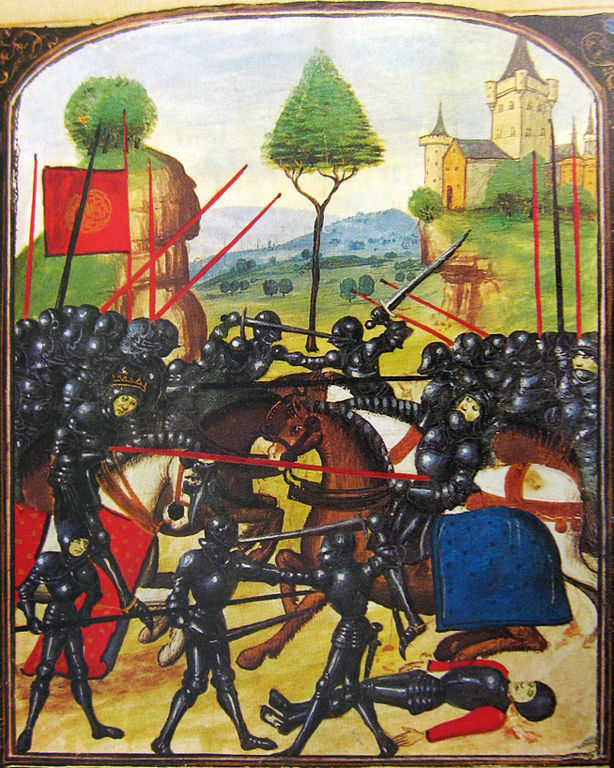
This illumination features armour that’s black or dark blue in colour, but with
the carefully-delineated highlights

of a shiny surface. There are many other like it.

image

Armour was coloured for both decorative and practical purposes; chemical blueing with acid produces a very dark, lustrous and effectively rust-resistant finish like the one in the medieval illustration. I once had an Arms & Armor rapier with that finish on the hilt: it looked like this…

Heat-blueing, which was more blue than black, was a popular treatment for Greenwich armour of the Elizabethan period, as was browning and russetting (all of which were and are used on firearms), processes which used heat, chemicals or controlled “good rust” to create colour and also prevent uncontrolled “bad rust”.

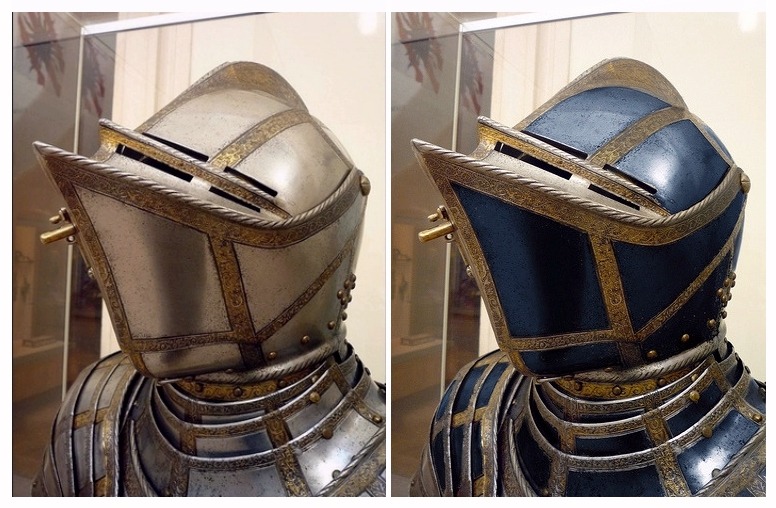
Here’s the helmet of Sir James Scudamore’s Greenwich harness, which was once blued and gilt.

image

The image on the left is how it looks now, after being thoroughly scrubbed with wire wool, sand or other abrasives at some stage in the 19th century to make  it “shining armour”. The image on the right is a CGI restoration of its original appearance, based on still-visible traces of colour in the grooves beside the gold strapwork.

Here’s the browned and gilt “garniture” (armour with extra bits for different styles of combat, like a life-size action figure) of George Clifford, Earl of Cumberland. I don’t think grinding this beauty down to bright metal would be an improvement…

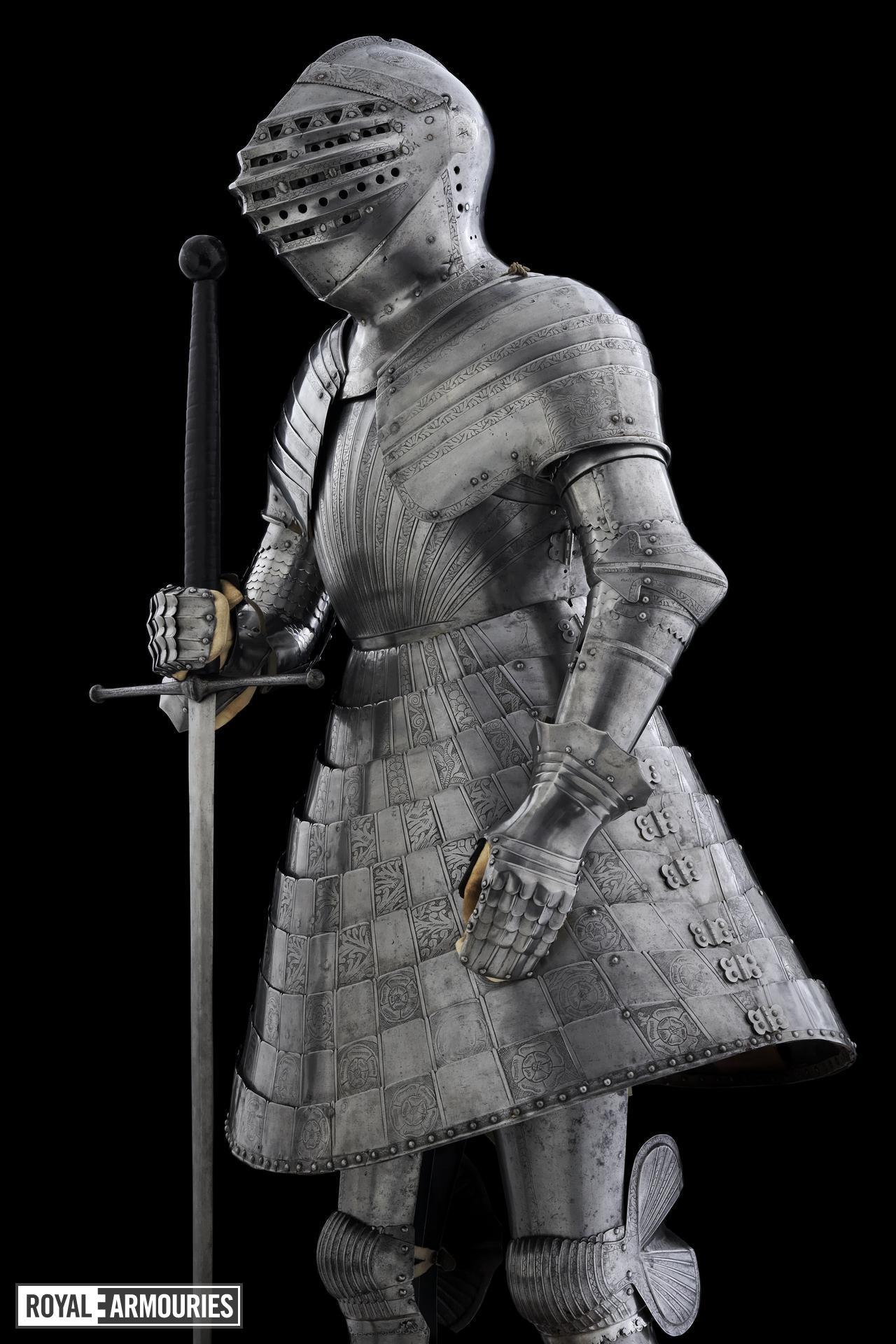
Henry VIII’s tonlet (skirted) armour for foot combat at the Field of the Cloth of Gold now looks like this:

image

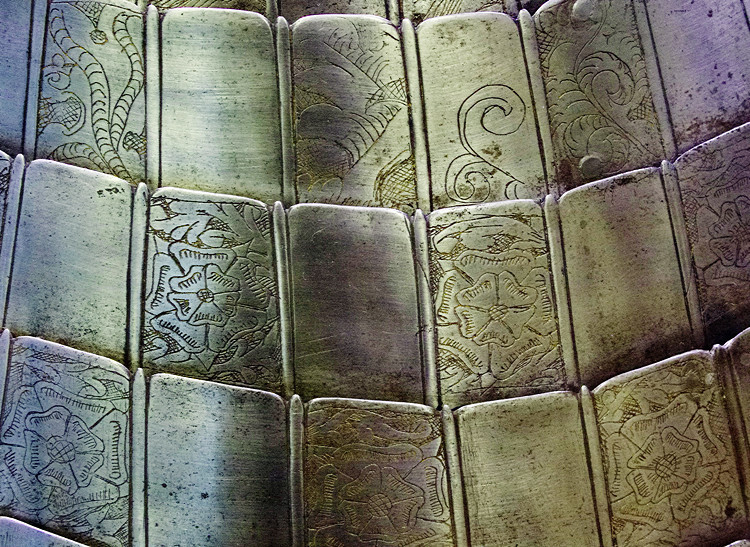
Originally it would have been shiny black or dark blue with gilt details and the engraved panels picked out in coloured paint or enamelling – red Tudor Roses, green leaves etc., but that wasn’t “shining armour”, so…

This detail shot shows the fine score-marks left after it was sanded “clean”, with dark pigmentation in the grooves as a memorial of how it once looked.

image

This Renaissance painting, “Portrait of Warrior with Squire”, shows black armour on the warrior and bare-metal armour on his squire, so it’s clear that armour in art wasn’t painted black simply because artists couldn’t properly represent burnished steel.

In this article, Thom Richardson, Keeper of Armour at the Tower of London and Royal Armouries in Leeds (the actual expert I mentioned at the beginning) comes straight out and calls Scott responsible for “shining armour” vandalism:

The sets of armour are not in their original black and gold because of
over-aggressive polishing in the 19th century when, said Richardson,
“they were polished with brick dust and rangoon oil to within an inch of
their life” to fit the aesthetic of what armour should look like, all
shiny and silvery. “Walter Scott is to blame,” Richardson added
ruefully.

Scott can also be blamed, according to the Oxford English
Dictionary, for creating or at least popularising that clunky, inaccurate term
“chain-mail”. It cites the first appearance in 1822 (recent when talking about mail) when a
character
in “The Fortunes of Nigel

says:

“…the
deil a thing’s broken but my head. It’s not made of iron, I wot, nor my
claithes of
chenzie-mail; so a club smashed the tane, and a claucht damaged the tither.”

Plate armour was also painted, either crudely…

image

…or with much more care (this style is actually called black-and-white armour); since the paint was oil-based, it also had a rust-proofing effect…

image

I have a notion that the more white there was on black-and-white armour, and thus the more work (by servants, of course!) needed to keep it looking good, may have been an indication of rank, status or success. Just a guess…

Armour left rough from the hammer – therefore cheaper than armour polished smooth, since every stage of the process had to be paid for – was also treated with hot oil in the same way cast-iron cookware is seasoned, again to prevent rust.

There were terms for bright-metal armour – “alwyte harness” and “white
armour” – but the existence of such terms suggests to me that they arose
from a need to describe an armour finish which needed a tiresome amount of maintenance to keep it that way. I’m betting that the last stage of a clean-and-polish was a good layer of grease, or even a beeswax sealant like the coatings used by museums today.

White armour may have been a demonstration of wealth or conspicuous consumption in the same way as black or white clothes: one needed servants constantly busy with polishing-cloths, the others needed really good colour-fast dye or lots of laundering, and all of those cost money.

One thing is certain: a knight in shining armour wasn’t the one who sweated to keep it shining. That’s what squires were for…

I am a simple man: when Peter speaks, I listen.

Design a site like this with WordPress.com
Get started