The vast majority of people who talk to themselves on balconies do not receive a reply. However on this night, perhaps because there was a warm easterly wind blowing, or perhaps again because there was a red star rising in the south, peering over the mountains like a furtive spy, there came a sort of answer in the form of fluttering wings and a clever little hooded face alighting on a branch adjacent the occupied balcony. Just a magpie, nothing more sinister; late though it was for a magpie to be out.
The bird flicked its long tail, beetle-black eyes fixed on the elf with more comprehension than was comforting, and let out a shrill avian laugh– each long cry lilting upward like a taunting question.
Inktober time is here ! I’m doing Tolkien characters this year.
Day 1. Maedhros and Fingon, princes of the Ñoldor
Day 2. Thuringwethil, vampire messenger of Sauron Day 3. Uinen, protector of sea creatures and mariners Day 4. Glorfindel, captain of Gondolin Day 5. Nienna, Lady of Pity and Mourning, and her disciple Olorin
Why are blacksmiths so stigmatized in folklore? What about the profession gave them such a bad name and caused them to be closely associated with the Devil?
http://journals.sagepub.com/doi/pdf/10.1177/039219216801606202 Maybe because traditional smelting techniques involve, human sacrifice? Allegedly?? Or maybe “Molten metal that flows is associated with flowing blood because
of its color, heat and the danger that arises from it”
Those who are only slightly familiar with anthropology are aware
of the many explanations that have been proposed to account for the “blacksmith complex". He is impure because he is in contact
with iron (a loathsome and repulsive element), or with fire (from
which demons are born), or because he forges murderous weapons; or because he is endogamous, or is not independent, or because
blacksmiths are the dregs of conquered peoples, do not produce
their own food, do not go to war, and break some unknown divine
interdict. They are respected because they have dared to break
a divine interdict, because they make useful instruments, because
they are rich, because they are initiators, educators, religious chiefs,
peace-makers, sacrificers, civilising heroes, and even, according to
the embryological theory of M. Eliade, because they help the Earth
to give birth to minerals and in so doing are a substitute for Time etc. Their powers issue from their tools, from spirits hidden in
the bellows of their smithies, from fire, from the “numinous” force
of iron, from the ornaments they forge for shamans; or from the
celestial origins of their techniques, from their novelty, from the
fact that these secret techniques are hereditary, or simply because
they are in their possession; or again from the “ambivalent magic
of weapons made of stone,” which, by emitting sparks when
struck, are likened to lightning, a magic that is transmitted into
the metal; or from the fact that they forge flashes of lightning
for the gods, etc…
One can see that, even when they contain elements of truth,
all these explanations are one-sided and often in need to be
explained themselves. The only valid explanation is one that can
show the inner reason for the different manifestations of the
“blacksmith complex” and their coexistence, and attain to the
structure that determines their interconnection and renders them
interdependent.
An interpretation that coordinates the various elements of the
problem, on the basis of the blacksmith’s violation of taboo, should
satisfy these conditions. It would form part of a wider interpretation
of magical violations of taboo in general, based on an
analysis of the nature and function of taboos.
I remember reading that, in the Middle Ages, Muslims had a restricted number of professions available to them in Christian lands, among these blacksmithing, which may have come from the association of the blacksmith with the devil or may have fed into it, or both.
I can’t find an actual source for this right now, a brief google search isn’t helping me, but it seemed worth noting.
Also since this is my Tolkien blog, it’s interesting to note that technology, particularly metalworking, is viewed as a powerful corruptive force in Tolkien’s work. Metal and wheels pitted against trees and water; it’s all very much based on this trope in mythology. Aulë’s forces are the only ones amongst the Valar that are capable of being corrupted to evil; Sauron and Saruman are both maiar of Aulë, Aulë dared to create the semblance of life before Eru’s children had awoken on earth when he made the dwarves, and the dwarves in turn are suspect because they can be corrupted by their love of metals and gems; the Noldor are beloved of Aulë and it is the Noldor who first use his teachings to forge weapons and bring violence to Aman. We’re told that Aulë is the closest in temperament to Melkor, but his works are not inherently evil because he still submits to the divine authority.
A Knight in shining armor is a man whose metal has never been tested.
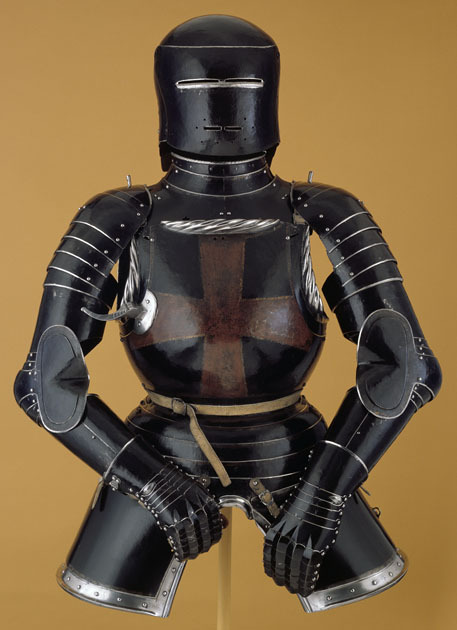
Or one who regularly cleans it…but yeah, “Black Knights” were called so because their armor was in terrible condition, and they were usually much more experienced, so they usually won tournaments.
I’m curious mainly where you got this concept from…
“Black Knights” need to be distinguished by context. I’m on my phone right now so I can’t link you all the sources I’d like to use, so please pardon me for that.
So, the concept of “knight in shining armour” comes from the idea of the knight-errant in medieval fiction, the sort of person who is on a quest, is all shiny and new, ready to test themselves. It also is a nod to the maintenance of equipment, or the wealth of a Knight; in the late medieval and Renaissance periods, well-off knights might have a suit of armour for warfare, a suit for tournaments, and a suit for formal occasions. These being used for different things, they were meant to be maintained well and show status and wealth.
So, where does the concept of a black Knight actually come from?
Surprisingly, most cases come from the idea of the tournament. Knights were meant to display who they were, “show their colours” (ie, heraldry), and show off their skills in combat. But if course you had some knights who didn’t want to show who they were, who they were fighting for, or which lady they favoured, etc. This sounds like a chivalric fantasy, and honestly, that’s what tournaments really became as time went by and the events became more formal.
Now, early “black Knights” , were those who did not wear dark or black armour, but in fact those who did not use their own heraldry, disguising themselves. Again, they may do this for various reasons, but the concept is they hide their identity. Occasionally, they might actually paint their shields black.
We also have the examples from the hundred years war where French and English knights painted their armour different colours: black for the French, Red for the English.
Some knights actually WOULD favour black armour or heraldry to the point they got called “black Knights”, and not as a derogative. The Polish Knight, Zawisza Czarny (pronounced “Zah-vu-shah Shar-ny”, approximately) become known for his feats of arms, and by his dark armour.
Linking back to the original quote, a Knight in shining armour could well be a black knight, as such. But more commonly, it meant he was either wealthy, or highly skilled at arms.
Or both. 😛
I’ve seen enough period art to convince me that “shining armour” was often a lot darker than the chrome-plated image which the term suggests.
I’ve also long thought that the whole business of “knights in shining armour” wasn’t a medieval concept at all, certainly not the default one, but was a Regency / early Victorian fictional conceit from Romance poets and Sir Walter Scott’s historical fiction. (About 10 years ago an actual expert said more or less the same thing, leaving actual amateur me feeling rather smug…) :->
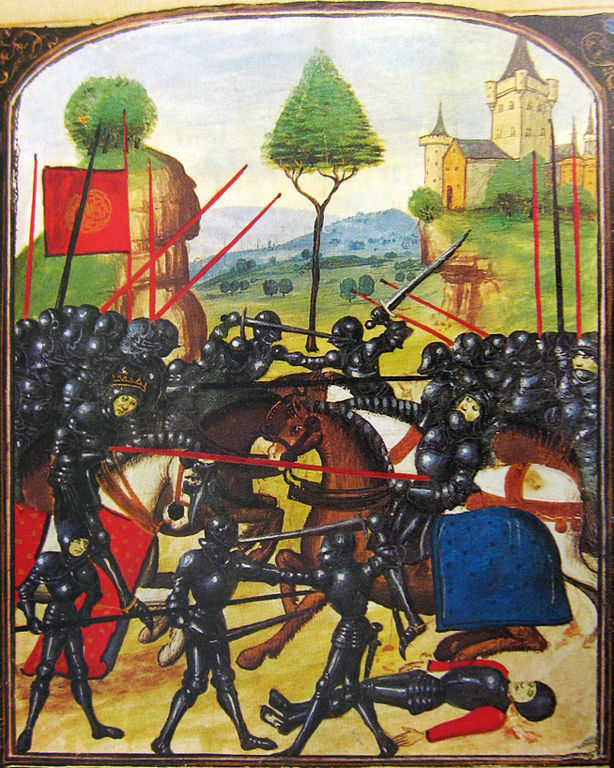
This illumination features armour that’s black or dark blue in colour, but with
the carefully-delineated highlights
of a shiny surface. There are many other like it.
Armour was coloured for both decorative and practical purposes; chemical blueing with acid produces a very dark, lustrous and effectively rust-resistant finish like the one in the medieval illustration. I once had an Arms & Armor rapier with that finish on the hilt: it looked like this…
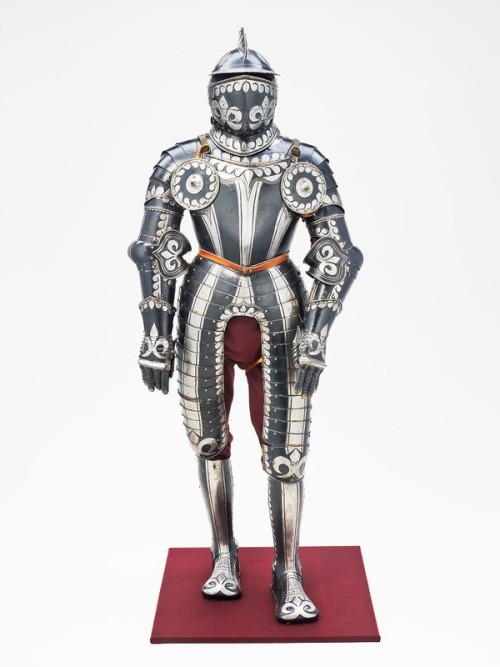
Heat-blueing, which was more blue than black, was a popular treatment for Greenwich armour of the Elizabethan period, as was browning and russetting (all of which were and are used on firearms), processes which used heat, chemicals or controlled “good rust” to create colour and also prevent uncontrolled “bad rust”.
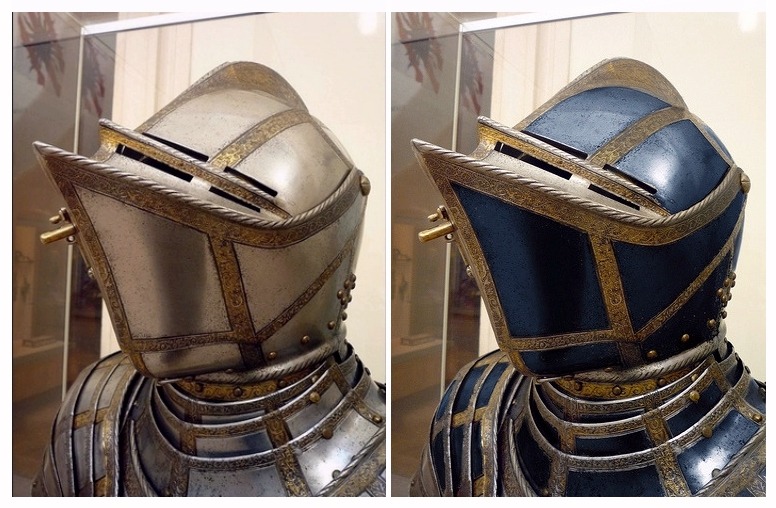
Here’s the helmet of Sir James Scudamore’s Greenwich harness, which was once blued and gilt.
The image on the left is how it looks now, after being thoroughly scrubbed with wire wool, sand or other abrasives at some stage in the 19th century to make it “shining armour”. The image on the right is a CGI restoration of its original appearance, based on still-visible traces of colour in the grooves beside the gold strapwork.
Here’s the browned and gilt “garniture” (armour with extra bits for different styles of combat, like a life-size action figure) of George Clifford, Earl of Cumberland. I don’t think grinding this beauty down to bright metal would be an improvement…
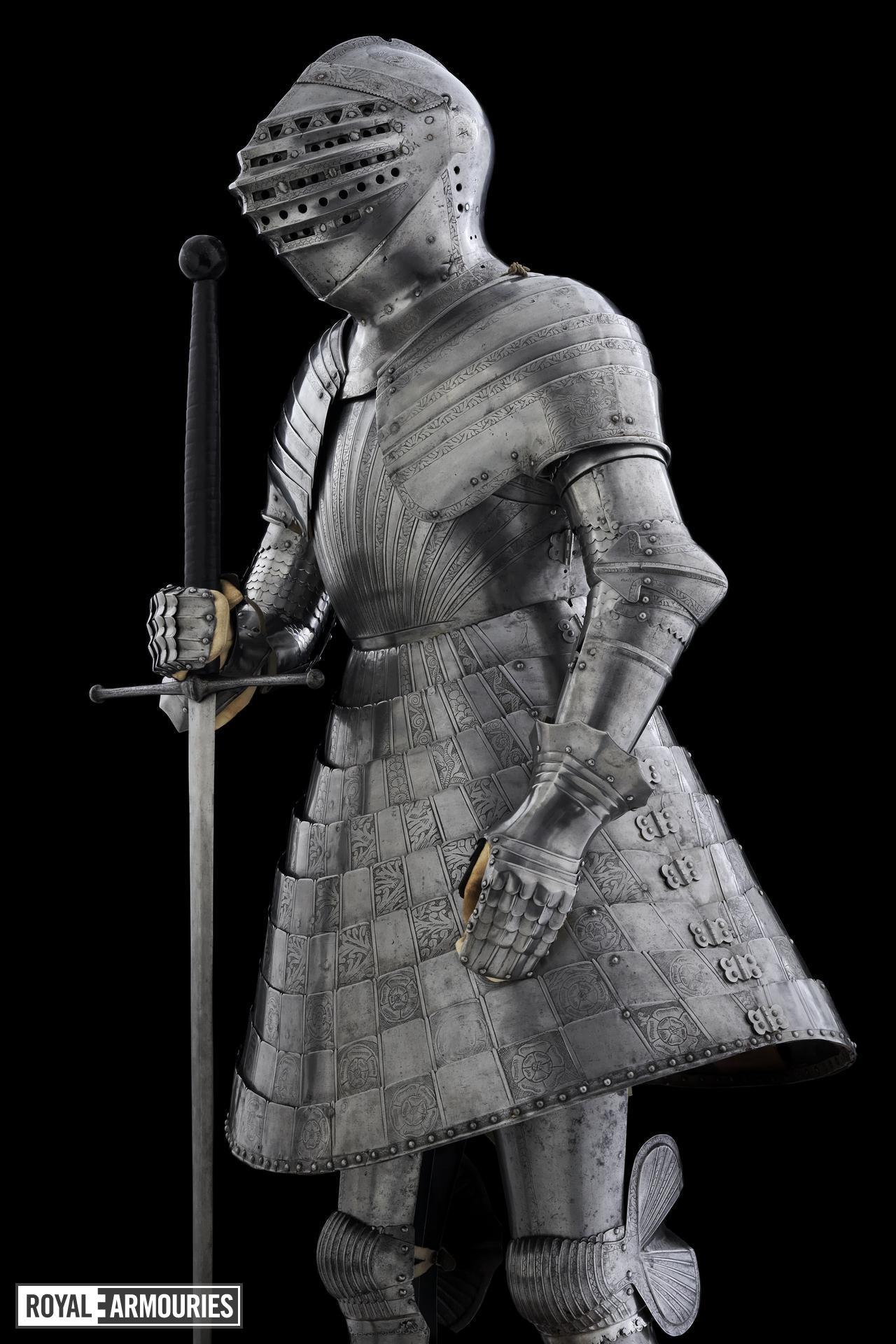
Henry VIII’s tonlet (skirted) armour for foot combat at the Field of the Cloth of Gold now looks like this:
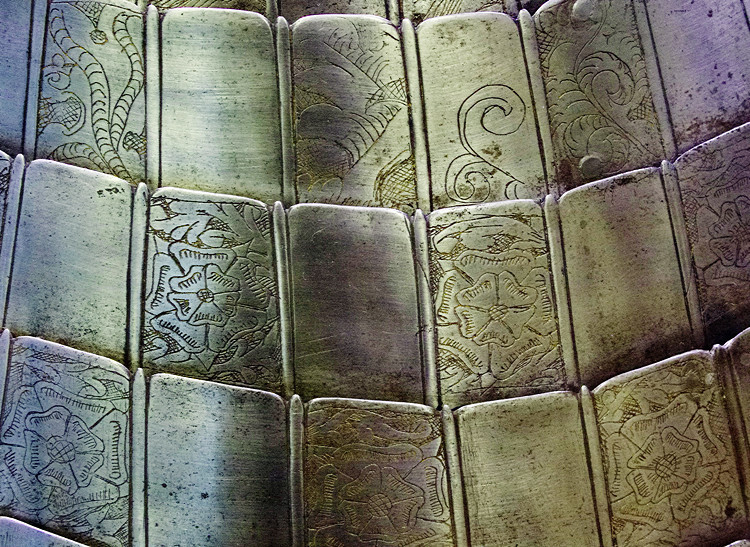
Originally it would have been shiny black or dark blue with gilt details and the engraved panels picked out in coloured paint or enamelling – red Tudor Roses, green leaves etc., but that wasn’t “shining armour”, so…
This detail shot shows the fine score-marks left after it was sanded “clean”, with dark pigmentation in the grooves as a memorial of how it once looked.
This Renaissance painting, “Portrait of Warrior with Squire”, shows black armour on the warrior and bare-metal armour on his squire, so it’s clear that armour in art wasn’t painted black simply because artists couldn’t properly represent burnished steel.
In this article, Thom Richardson, Keeper of Armour at the Tower of London and Royal Armouries in Leeds (the actual expert I mentioned at the beginning) comes straight out and calls Scott responsible for “shining armour” vandalism:
The sets of armour are not in their original black and gold because of
over-aggressive polishing in the 19th century when, said Richardson,
“they were polished with brick dust and rangoon oil to within an inch of
their life” to fit the aesthetic of what armour should look like, all
shiny and silvery. “Walter Scott is to blame,” Richardson added
ruefully.
Scott can also be blamed, according to the Oxford English
Dictionary, for creating or at least popularising that clunky, inaccurate term
“chain-mail”. It cites the first appearance in 1822 (recent when talking about mail) when a
character
in “The Fortunes of Nigel”
says:
“…the
deil a thing’s broken but my head. It’s not made of iron, I wot, nor my
claithes of chenzie-mail; so a club smashed the tane, and a claucht damaged the tither.”
Plate armour was also painted, either crudely…
…or with much more care (this style is actually called black-and-white armour); since the paint was oil-based, it also had a rust-proofing effect…
I have a notion that the more white there was on black-and-white armour, and thus the more work (by servants, of course!) needed to keep it looking good, may have been an indication of rank, status or success. Just a guess…
Armour left rough from the hammer – therefore cheaper than armour polished smooth, since every stage of the process had to be paid for – was also treated with hot oil in the same way cast-iron cookware is seasoned, again to prevent rust.
There were terms for bright-metal armour – “alwyte harness” and “white
armour” – but the existence of such terms suggests to me that they arose
from a need to describe an armour finish which needed a tiresome amount of maintenance to keep it that way. I’m betting that the last stage of a clean-and-polish was a good layer of grease, or even a beeswax sealant like the coatings used by museums today.
White armour may have been a demonstration of wealth or conspicuous consumption in the same way as black or white clothes: one needed servants constantly busy with polishing-cloths, the others needed really good colour-fast dye or lots of laundering, and all of those cost money.
One thing is certain: a knight in shining armour wasn’t the one who sweated to keep it shining. That’s what squires were for…
This German manuscript from the 15th century is a collection of astronomical and astrological texts, mostly in Latin in a cursive Gothic script, written by multiple hands.
Want to know more? Click here! And if you are interested in the facsimile, you can find it here!
As much as I’d love to have a matching pair of celestial bunnies, I actually owe most of my Arien headcanons to @othombauko, who I don’t even know if they have a tumblr anymore? ;____; They put it into my head that Arien was actually once a legit Maia of Melkor, and in fact Gothmog’s sister, but defected AWAY from his service– because hey, that shit goes both ways. She’s sort of a purified balrog, hallowed by her new employers. I liked the idea so much back in the day that I haven’t quite solidified my own unique headcanons about Arien yet… I’m not sure that the ex-balrog concept would even work with the HCs I’ve got now, but it does fit with the premise I’m working with that Melkor’s original place in the pantheon was similar to the lightbringer, so having fire-related powers as his Maia would be a logical connection. (This is DEFINITELY not a Tolkien-approved headcanon, but hey I’ve got a lot of those, and who’s counting).
Anyway, whatever I decide on, she probably won’t be a bunny. Probably. Except in my heart :’) And Tillybun’s.







 MisbehavingMaiar: Tumblr Archive