Houses of Might

misbehavingmaiar:

“Let none admire
That riches grow in Hell;
That soil may best
Deserve the precious bane.”


When he had been a young god, fresh and brazen in his power, the earth had seemed too fragile for him. He had been made before it, out of scale with it. There was nothing put up that he could not knock down; from the densest core to the vastest plains of bedrock. All were as malleable to him as clay.

When the world had been lit by volcanic fires and the two, fixed lamps, he delved Utumno, his first dwelling.

Delved, not built.

He had sunk his immaterial hands into the heaving red rock and plunged himself down. He scooped up pillars out of onyx, and scraped level his chambers with a swipe of his arm. He’d rummaged in the guts of mountains and pulled out seams of gold and copper; with a breath melting them, pooling them, unhammered and unpolished, over the floors of the monstrous caverns.

The immeasurable pillars there he twisted and clawed until they resembled coiled serpents holding aloft the jagged ceiling. Rivers of open magma lit his home, and the churning growl of the pits echoed forever through his halls. His throne was a high mound of raw jewels, and rippling blue-black lava. Nothing mortal could have survived his presence or his domain in that early age; no eyes but the Ainur’s could see the splendors he’d wrought there. All things in Utumno glittered, though darkly.

He missed it, that rough-hewn palace. It pained him to know that in his current state, even if Utumno still stood, he could no longer endure it. He did not fit its scale now. He could not wade into oceans nor plunge his head in the streaming red clouds. He stood, yes, like a fearsome tower over his enemies, but what a pittance that was! The rumbling of the earth now simply made his ears ache.

Every splendor had been muddied since the beginning– the primordial fires had cooled and green choking things crept over the earth. Even the icy walls and spines of Thangorodrim could not shield him entirely from the sun, the hateful eye of the Valar leering at him in his pain…  His only shelter was inadequate on so many levels.

Angband had been built for war and war alone. Nothing there glittered, but for steel and blackest glass. It was a dull place. A designed place.  It was true that in the early days, he’d hollowed out the spiraling pits of its dungeons, the lava-nests for the Valaraukar to rest in… but the rest of the construction he had left to his minions. Angband had been built of quarried stone and the mind of an architect. This was Sauron’s fortress; his siege breaker, his battle trench, the breeding ground for armies, and though the loyal Maia had done his best to accommodate his master, it was still cramped quarters for a Vala.

His lieutenant had salvaged some fragments of Utumno that had escaped the Valar’s wrath; obsidian from the halls, gold from the floors, glittering gems from the throne. He’d sought to please Melkor, fearing perhaps that his master thought him idle during the long years of his imprisonment in Aman. He had reshaped the dark pillars– carving them beautifully into the shapes of wyrms, snakes whose coiling bodies sought the roof and whose ruby-eyed heads formed the capitols. What once had been wrung into an unnatural helix by a mighty and careless hand, was now meticulously crafted. Every detail, each flute and column carved in the perfect likeness of serpents– no longer nature but art.

Melkor had not been able to conceal his disappointment.

Hastily added luxuries brought the Vala little comfort. Porphyry basins that could hold a steaming lake were still a poor substitute for boiling seas, and a gold-plated throneroom floor was not a gleaming netherworld. His own body had a disgusting permanence to it now; form fitting function, fixed in mass.  As he saw himself reflected in the volcanic glass mirrors of the walls and the more he hated this cage,  almost as much as he hated the sun and moon. He was too vulnerable to venture far into the world– the earth had grown strong while he had diminished.

There had been a time when the bright gold god had not known fear; when he had plundered the world, ran over it rough-shod; feeding the air and stone to his fires and casing the rest in ice. His siblings had objected, but had he not been set above them in their Father’s esteem? Had he not been named the rising star, the mightiest of the Valar? He had loved his power dearly, and the steaming Earth and his freedom most of all, though he’d been made to feel ashamed of this love.

Melkor knew shame, but he had not known fear– not because he was brave but because he had never been introduced to it, and therefore knew nothing of its dangers, like a child who has never been burnt is careless with matches.

But he came to know it in a sound: the thunder-laughter of the one who fell as a comet from heaven, making glass ripples in the desert.

When they’d unhoused him in Utumno, he’d fled to the bottom-most pit. He’d not understood that it was fear taking him there, in the unguarded chambers of his mind. At last he’d drawn himself up like a mountain, his face a lurking monster from the crushing depths of the sea, so hideous and needled it would have brought madness in a mortal mind. He had wreathed himself in flame and magma and the sound he shrieked in challenge was a hurricane’s wail and the sound of brittle ice forming amplified a thousand times. But the ruddy Vala had stepped forward onto the rock bridge and smiled, and all Melkor’s fire turned to flaccid tar.

They grappled. The Champion’s brazen hands dared the barbs and crackling heat of Melkor’s flesh. Tulkas broke the golden god’s face with his fist, crushed the furnace of his ribs, wrapped his mighty arm about the blazing head, so that strive as he may, his opponent could gain no purchase. Melkor flamed, and shrieked, and fought, and scarred the rock with clawing, but at last– and from then ever after– he was thrown to the ground by the Champion of the Valar, and his face struck the earth in bitter shame.

–Three ages after, he had not forgotten. When time is wrapped up like a ball of twine and Arda is undone, Melkor will still not have forgotten the  day when he met Fear and learned to hate him.

Yet having met fear, the dark Vala learned to recognize it in himself. Deceit was the first art he learned, after three ages gnawing on his own thoughts in the monotony of Mandos. He learned, for example, to withdraw his cowardice deep and unseen into his heart, or reproduce all the outward effects of fear while inwardly he sneered and preened.

Before the throne of Manwë he had shivered and pleaded. He flinched like a rabbit before the eyes of Tulkas and looked with contrition up at Yavanna, who’s hatred was expressed by the vicious curling and uncurling of her thick-twined hair; and for Nienna, who spoke in his favor, he conjured his most credible sincerity. And all the while inside, he laughed– not like thunder, but a stygian clatter of wings.

Now in the darkness of his keep Melkor reflected, picking at the scabs of gold that sloughed off his unhealing wounds. Each season his skin shed, and unlike a serpent, it left him duller and more tarnished than before. Each shedding left him in a tighter skin, constricting his spirit within a cage of matter.

It had always been his flexibility and cunning that had served him best; his deceit, his patience, his poisons, his knives in the dark– these had led to victories, to escape.  Towers and walls were solid and immutable; they were a liability that he was forced to rely upon… Even Formenos whose doors had been slammed and barred against him had fallen.


Angband was a mighty stronghold, fenced with mountains of fire and iron gates, but it was still fixed. It was immovable– inescapable. As much a prison as Mandos had been.

Even if he won the war against the armies that battered his gates, even if his siblings did not rise up against him, he would be entombed here, he knew. It would fall, eventually, as all things fell. And though this terrified him almost as much as the thought of diminishing to nothing, it brought with it a gallows-comfort: the idea that all towers of might must fall, that no place of power was sacred; that perhaps even, given time and strange turnings, the Halls of Eru too would crumble, and return into the endless, silent Void.

 

–Find this on AO3!–

skyeventide:

adzolotl:

adzolotl:

glumshoe:

Why are blacksmiths so stigmatized in folklore? What about the profession gave them such a bad name and caused them to be closely associated with the Devil?

¯_(ツ)_/¯

https://en.wikipedia.org/wiki/The_Smith_and_the_Devil “may be one of the oldest European folk tales […] possibly being first told in Indo-European 6,000 years ago”

https://en.wikipedia.org/wiki/Blacksmiths_of_western_Africa “feared in some societies for their skill in metalworking, considered a form of magic“

http://journals.sagepub.com/doi/pdf/10.1177/039219216801606202 Maybe because traditional smelting techniques involve, human sacrifice? Allegedly?? Or maybe “Molten metal that flows is associated with flowing blood because
of its color, heat and the danger that arises from it”

okay now i’m Invested

https://irishfolklore.wordpress.com/2017/03/13/blacksmiths-and-the-supernatural/ “Their ability to turn raw materials such as iron ore or bog iron into usable tools and weapons made them seem like they were in possession of magic.“ … “8thcentury hymn to protect people from the ‘spells of women, smiths and druids’”

http://akkadium.com/fire-forge-glimpsing-craft-ethiopian-blacksmith/ “traditional beliefs that the earth is sacred, and fire (heat) is potentially polluting”

My third link concludes:

Those who are only slightly familiar with anthropology are aware
of the many explanations that have been proposed to account for the “blacksmith complex". He is impure because he is in contact
with iron (a loathsome and repulsive element), or with fire (from
which demons are born), or because he forges murderous weapons; or because he is endogamous, or is not independent, or because
blacksmiths are the dregs of conquered peoples, do not produce
their own food, do not go to war, and break some unknown divine
interdict. They are respected because they have dared to break
a divine interdict, because they make useful instruments, because
they are rich, because they are initiators, educators, religious chiefs,
peace-makers, sacrificers, civilising heroes, and even, according to
the embryological theory of M. Eliade, because they help the Earth
to give birth to minerals and in so doing are a substitute for Time etc. Their powers issue from their tools, from spirits hidden in
the bellows of their smithies, from fire, from the “numinous” force
of iron, from the ornaments they forge for shamans; or from the
celestial origins of their techniques, from their novelty, from the
fact that these secret techniques are hereditary, or simply because
they are in their possession; or again from the “ambivalent magic
of weapons made of stone,” which, by emitting sparks when
struck, are likened to lightning, a magic that is transmitted into
the metal; or from the fact that they forge flashes of lightning
for the gods, etc… 

One can see that, even when they contain elements of truth,
all these explanations are one-sided and often in need to be
explained themselves. The only valid explanation is one that can
show the inner reason for the different manifestations of the
“blacksmith complex” and their coexistence, and attain to the
structure that determines their interconnection and renders them
interdependent. 

An interpretation that coordinates the various elements of the
problem, on the basis of the blacksmith’s violation of taboo, should
satisfy these conditions. It would form part of a wider interpretation
of magical violations of taboo in general, based on an
analysis of the nature and function of taboos.

I remember reading that, in the Middle Ages, Muslims had a restricted number of professions available to them in Christian lands, among these blacksmithing, which may have come from the association of the blacksmith with the devil or may have fed into it, or both.

I can’t find an actual source for this right now, a brief google search isn’t helping me, but it seemed worth noting.

(also @theotherwesley)

Here’s a great bit from the BBC documentary Secrets of the Castle where they talk about how blacksmiths were seen as being able to participate in black magic but were also paradoxically immune to its corrupting effects, able to “tweak the devil’s nose” and get away with it. 

Also since this is my Tolkien blog, it’s interesting to note that technology, particularly metalworking, is viewed as a powerful corruptive force in Tolkien’s work. Metal and wheels pitted against trees and water; it’s all very much based on this trope in mythology. Aulë’s forces are the only ones amongst the Valar that are capable of being corrupted to evil; Sauron and Saruman are both maiar of Aulë, Aulë dared to create the semblance of life before Eru’s children had awoken on earth when he made the dwarves, and the dwarves in turn are suspect because they can be corrupted by their love of metals and gems; the Noldor are beloved of Aulë and it is the Noldor who first use his teachings to forge weapons and bring violence to Aman. We’re told that Aulë is the closest in temperament to Melkor, but his works are not inherently evil because he still submits to the divine authority. 

we-are-knight:

petermorwood:

we-are-knight:

pyrogothnerd:

just-shower-thoughts:

A Knight in shining armor is a man whose metal has never been tested.

Or one who regularly cleans it…but yeah, “Black Knights” were called so because their armor was in terrible condition, and they were usually much more experienced, so they usually won tournaments.

@we-are-knight Am I correct? Anything to add?

I’m curious mainly where you got this concept from…

“Black Knights” need to be distinguished by context. I’m on my phone right now so I can’t link you all the sources I’d like to use, so please pardon me for that.

So, the concept of “knight in shining armour” comes from the idea of the knight-errant in medieval fiction, the sort of person who is on a quest, is all shiny and new, ready to test themselves. It also is a nod to the maintenance of equipment, or the wealth of a Knight; in the late medieval and Renaissance periods, well-off knights might have a suit of armour for warfare, a suit for tournaments, and a suit for formal occasions. These being used for different things, they were meant to be maintained well and show status and wealth.

So, where does the concept of a black Knight actually come from?

Surprisingly, most cases come from the idea of the tournament. Knights were meant to display who they were, “show their colours” (ie, heraldry), and show off their skills in combat. But if course you had some knights who didn’t want to show who they were, who they were fighting for, or which lady they favoured, etc. This sounds like a chivalric fantasy, and honestly, that’s what tournaments really became as time went by and the events became more formal.

Now, early “black Knights” , were those who did not wear dark or black armour, but in fact those who did not use their own heraldry, disguising themselves. Again, they may do this for various reasons, but the concept is they hide their identity. Occasionally, they might actually paint their shields black.

We also have the examples from the hundred years war where French and English knights painted their armour different colours: black for the French, Red for the English.

Some knights actually WOULD favour black armour or heraldry to the point they got called “black Knights”, and not as a derogative. The Polish Knight, Zawisza Czarny (pronounced “Zah-vu-shah Shar-ny”, approximately) become known for his feats of arms, and by his dark armour.

Linking back to the original quote, a Knight in shining armour could well be a black knight, as such. But more commonly, it meant he was either wealthy, or highly skilled at arms.

Or both. 😛

I’ve seen enough period art to convince me that “shining armour” was often a lot darker than the chrome-plated image which the term suggests.

I’ve also long thought that the whole business of “knights in shining armour” wasn’t a medieval concept at all, certainly not the default one, but was a Regency / early Victorian fictional conceit from Romance poets and Sir Walter Scott’s historical fiction. (About 10 years ago an actual expert said more or less the same thing, leaving actual amateur me feeling rather smug…) :->

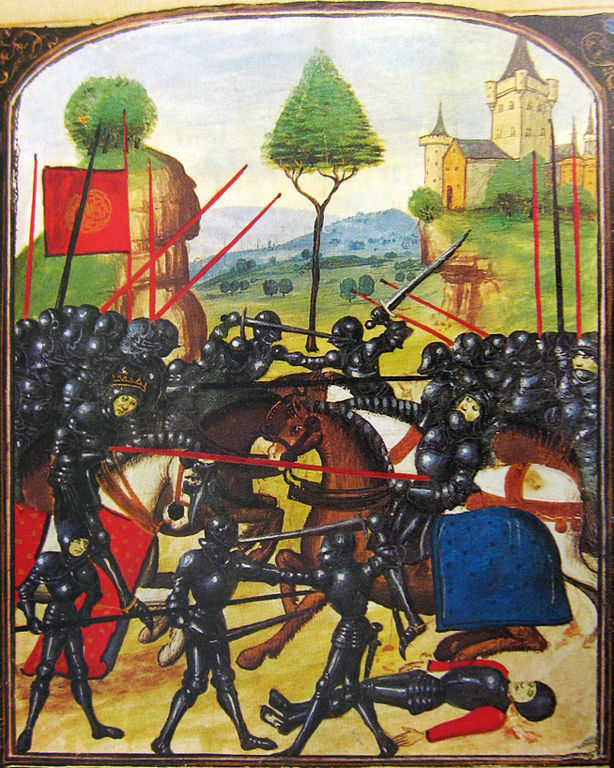
This illumination features armour that’s black or dark blue in colour, but with
the carefully-delineated highlights

of a shiny surface. There are many other like it.

image

Armour was coloured for both decorative and practical purposes; chemical blueing with acid produces a very dark, lustrous and effectively rust-resistant finish like the one in the medieval illustration. I once had an Arms & Armor rapier with that finish on the hilt: it looked like this…

Heat-blueing, which was more blue than black, was a popular treatment for Greenwich armour of the Elizabethan period, as was browning and russetting (all of which were and are used on firearms), processes which used heat, chemicals or controlled “good rust” to create colour and also prevent uncontrolled “bad rust”.

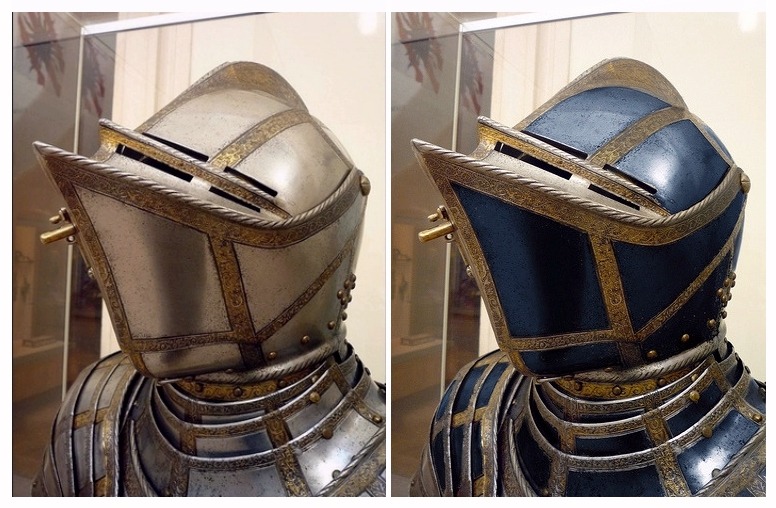
Here’s the helmet of Sir James Scudamore’s Greenwich harness, which was once blued and gilt.

image

The image on the left is how it looks now, after being thoroughly scrubbed with wire wool, sand or other abrasives at some stage in the 19th century to make  it “shining armour”. The image on the right is a CGI restoration of its original appearance, based on still-visible traces of colour in the grooves beside the gold strapwork.

Here’s the browned and gilt “garniture” (armour with extra bits for different styles of combat, like a life-size action figure) of George Clifford, Earl of Cumberland. I don’t think grinding this beauty down to bright metal would be an improvement…

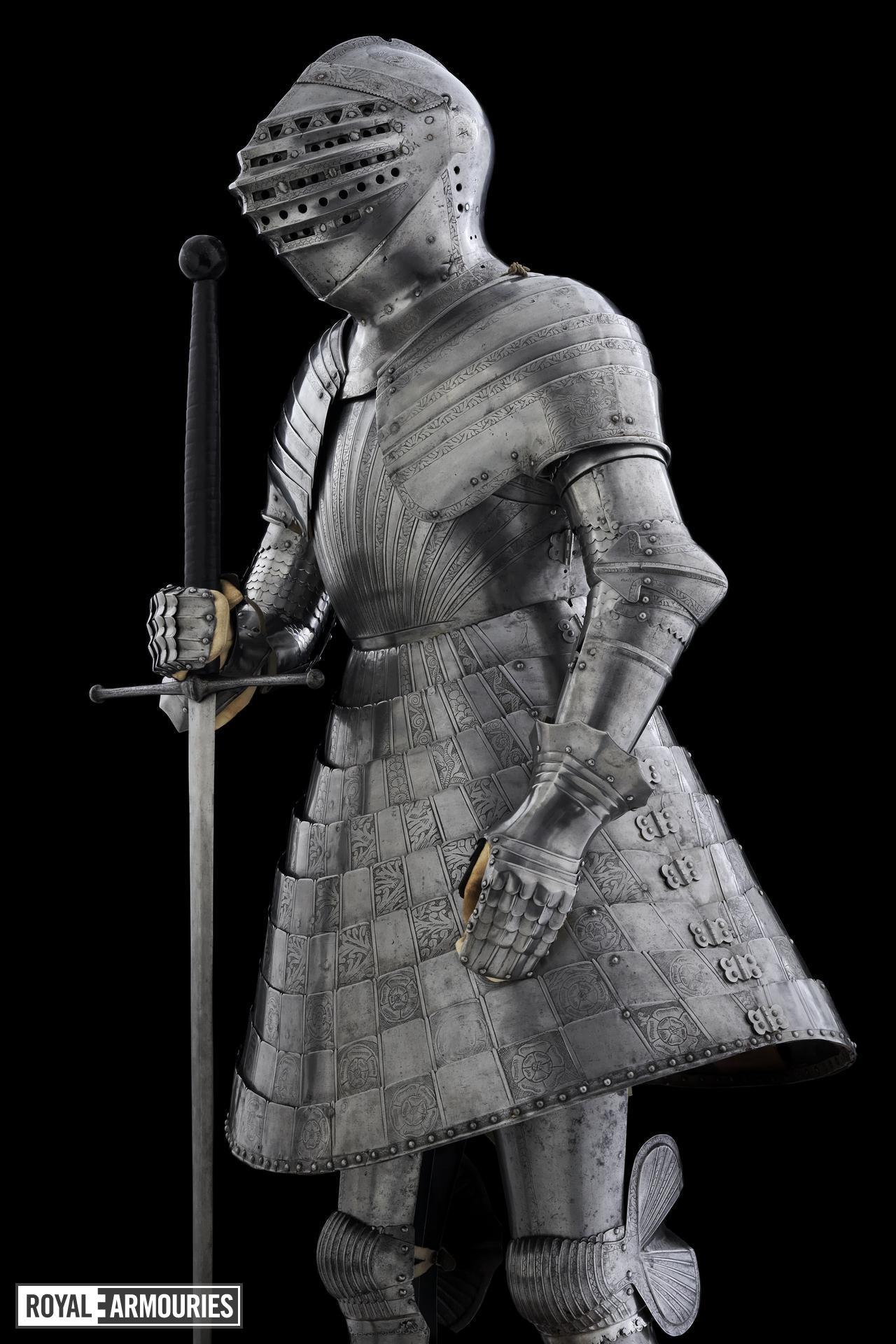
Henry VIII’s tonlet (skirted) armour for foot combat at the Field of the Cloth of Gold now looks like this:

image

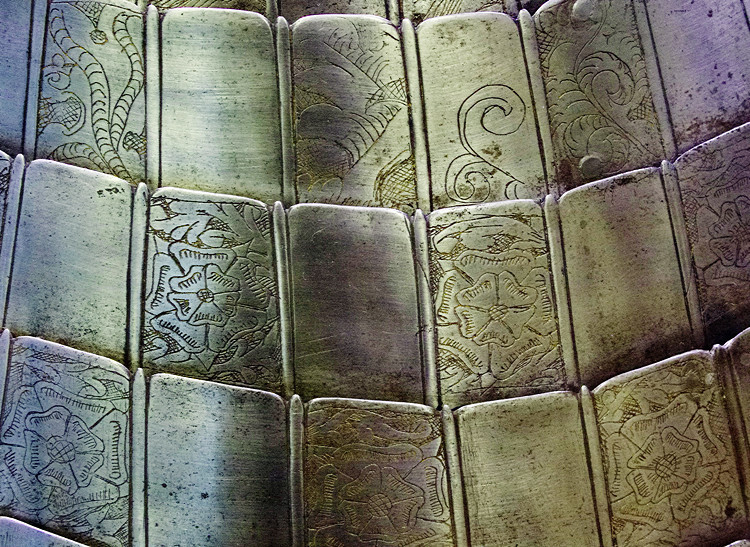
Originally it would have been shiny black or dark blue with gilt details and the engraved panels picked out in coloured paint or enamelling – red Tudor Roses, green leaves etc., but that wasn’t “shining armour”, so…

This detail shot shows the fine score-marks left after it was sanded “clean”, with dark pigmentation in the grooves as a memorial of how it once looked.

image

This Renaissance painting, “Portrait of Warrior with Squire”, shows black armour on the warrior and bare-metal armour on his squire, so it’s clear that armour in art wasn’t painted black simply because artists couldn’t properly represent burnished steel.

In this article, Thom Richardson, Keeper of Armour at the Tower of London and Royal Armouries in Leeds (the actual expert I mentioned at the beginning) comes straight out and calls Scott responsible for “shining armour” vandalism:

The sets of armour are not in their original black and gold because of
over-aggressive polishing in the 19th century when, said Richardson,
“they were polished with brick dust and rangoon oil to within an inch of
their life” to fit the aesthetic of what armour should look like, all
shiny and silvery. “Walter Scott is to blame,” Richardson added
ruefully.

Scott can also be blamed, according to the Oxford English
Dictionary, for creating or at least popularising that clunky, inaccurate term
“chain-mail”. It cites the first appearance in 1822 (recent when talking about mail) when a
character
in “The Fortunes of Nigel

says:

“…the
deil a thing’s broken but my head. It’s not made of iron, I wot, nor my
claithes of
chenzie-mail; so a club smashed the tane, and a claucht damaged the tither.”

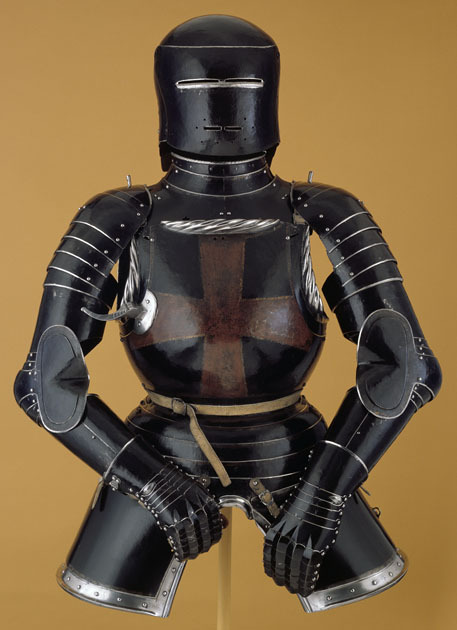
Plate armour was also painted, either crudely…

image

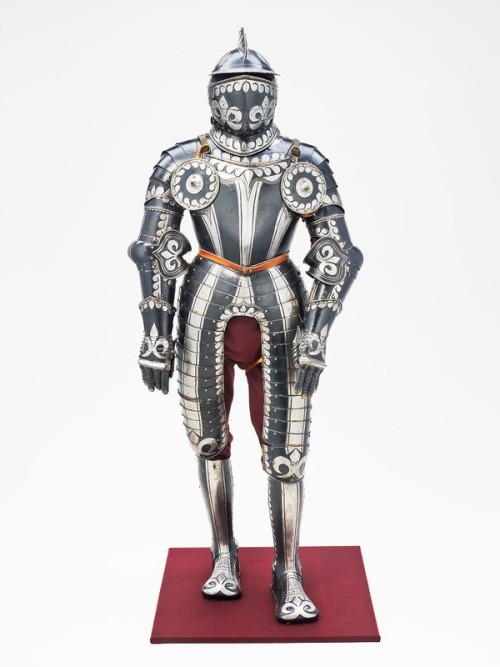
…or with much more care (this style is actually called black-and-white armour); since the paint was oil-based, it also had a rust-proofing effect…

image

I have a notion that the more white there was on black-and-white armour, and thus the more work (by servants, of course!) needed to keep it looking good, may have been an indication of rank, status or success. Just a guess…

Armour left rough from the hammer – therefore cheaper than armour polished smooth, since every stage of the process had to be paid for – was also treated with hot oil in the same way cast-iron cookware is seasoned, again to prevent rust.

There were terms for bright-metal armour – “alwyte harness” and “white
armour” – but the existence of such terms suggests to me that they arose
from a need to describe an armour finish which needed a tiresome amount of maintenance to keep it that way. I’m betting that the last stage of a clean-and-polish was a good layer of grease, or even a beeswax sealant like the coatings used by museums today.

White armour may have been a demonstration of wealth or conspicuous consumption in the same way as black or white clothes: one needed servants constantly busy with polishing-cloths, the others needed really good colour-fast dye or lots of laundering, and all of those cost money.

One thing is certain: a knight in shining armour wasn’t the one who sweated to keep it shining. That’s what squires were for…

I am a simple man: when Peter speaks, I listen.

Try Fëanor

–My caveat once again is that I owe a long-standing RP partner for permanently influencing my perception of this character and flavoring his personality in my mind.– 

Fëanor is an absolutely fascinating character in his own right, but I confess my main concern with writing him lies in understanding the place he holds in the larger narrative. I love speculating interpersonal scenes with him because he influences so many other characters, and he has some of the most hair-raisingly epic dialogue in the whole legendarium–  but to do that I feel like it’s important to map out his motivations and the place he holds in the philosophical landscape first.

( I know a lot of ink has been spilled arguing whether or not Fëanor is a Good™ or Bad™ character, and…. look. I stan dark lords. I don’t really have a horse in that race. I care about understanding the motives surrounding him, and what makes him an Interesting character. I just thought I’d put that forward in case anyone was planning on planting a flag in me as part of Team Fëanorian or Team Valar or Team Teleri…. Please don’t ;_; I am but a humble content creator living in the Rhine Valley of the Great Fandom War, I wish to farm my memes in peace.) 

ANYWAY:  Essay to follow. 

Aside from Melkor, Fëanor is THE voice of individualism and exceptionalism in a world whose dominant philosophy is deontological (am I using that right? It’s the Kant one). He’s the very definition of a Renaissance Man; a brilliant polymath and believer of the value and agency of individuals, living in a literal theocracy where the gods themselves are a present and real force in everyone’s lives. 

The Valar do not acknowledge advancements made by an individual as being the sole property of the individual, because no advancement is made in a vacuum–  everything is made possible because of collective effort, or greater harmony; everything finds its source in something higher, all the way up until you reach the Creator: All things have their uttermost source in [Eru]– therefore Eru’s will is the universal rule, the source of moral obligation. Those who will defend authority against rebellion must not themselves rebel” –because defending the natural authority that stems from Eru is a moral imperative, that must be followed even the outcome is bad. 

Melkor defies this rule and is punished for it again and again; Aulë defies this rule but repents and is forgiven (it is Aulë who defends Fëanor’s reluctance to hand over the Silmarils, because he is uniquely able to sympathize with the emotional weight of sacrificing one’s own work out of duty); and Fëanor challenges this rule at the feet of the same gods who enforce it. 

The way the narrative frames the issue of ownership of the Silmarils is very telling: Fëanor is said to love the Silmarils with a “greedy” love, forgetting “the light within them was not his own”. The presupposition is that his love is greedy because everything, ultimately, belongs to Eru, and anything made with natural resources is held above individual ownership. It is expected that you should create not for one’s self but for the will of Eru– that is what separates Aulë from Melkor in the beginning. It is an unspoken assumption that it is Fëanor’s duty to share his gifts– but he is not forced to do so.  His actions are merely frowned upon, up until the moment where he is asked to break the Silmarils for the sake of restoring the Two Trees. And of course he refuses. 

Would the Valar have forced him to break the Silmarils then, if Melkor hadn’t stolen them? I don’t know. I think it would probably have gone to trial in the Mahanaxar, and whatever the outcome, it would probably have led to an ultimatum set in law thereafter. 

I think Fëanor has a strong case for his refusal, which would likely find support from many elves and maybe some Ainur. He was not the only one in post-unchained-Melkor Aman to develop a sense of private property, but he was the only one to claim exclusive ownership of his craft. (The Teleri equate their Ships with the Silmarils as treasures that cannot be replaced or bought for any price, yet the Ships belong to their people collectively, and they freely attest learning their shipbuilding from the Oarni, Ulmo’s Maiar– this gives them the benefit of propriety. Because they acknowledge their debt to divine provenance, their refusal to give Fëanor use of the ships is not the same as Fëanor’s refusal to render the Silmarils to the Valar, in terms of the value system in-text.)

A case could certainly be made that the light of the Trees was given freely for the benefit of the Elves– there was no condition set upon its use or enjoyment. If that light was NOT given unconditionally, what then is the condition for the use of ALL things made by the Valar? If the condition is that no one may create for private use, why was this condition not made clear earlier, before the elves agreed to come to Aman? Are they or aren’t they free? Was Melkor lying, or stating a truth for his own benefit? 

Regardless of good intentions, it WAS the Valar’s decision to bring Melkor to Aman and free him, and it was they who failed to protect the Elves and the Trees. If all duty and moral law come from the Valar, and the Valar are proved fallible, it is an act of SUPREME faith to continue to trust in their authority, and it’s hard to blame the Noldor having their faith shaken. The Valar failed to provide safety in their own home, had their exclusive source of light destroyed, and then they looked to Fëanor to provide the solution by breaking the thing he most treasured. To Fëanor, of course this looks like proof of his least charitable suspicions. 

–And I do want to note: the Valar ending up looking so extremely culpable is part of why they hesitate to pursue the Noldor or take immediate action to stem the conflict; the Valar are ALSO shattered by what has happened, their faith shaken. Manwë can’t help but love the elves, and to love this incredible prodigy who burns so brightly; he’s devastated that there is no winning Fëanor back from his rage and guilt and pride. There is nothing Manwë can do that will not appear to confirm his brother’s lies and half-truths, so he holds back, and the tragedy keeps unfolding.

If Fëanor’s rebellion had not escalated after the Darkening, the Valar would probably have had a long and uncomfortable century of subpoenas ahead of them.  And that would also have been interesting! But not nearly as interesting as the bloody clusterfuck that happens instead. 

…But all of that is just floating around nebulously in Meta Space. That isn’t what motivates Fëanor’s character, it just clarifies the environment he’s in. 

What motivates him is a delicious mixture of Pride, Conviction, Dedication, Stubbornness, Curiosity, Passion, Outrageously High Standards, A Reasonably Accurate Sense Of His Own Skill And Importance, Entitlement, and Paranoia.

The pride and sense of importance are genuinely well come by; there’s a tangible metric by which to measure Elven Greatness, because spirit is a real and tangible thing for Elves, and Fëanor has enough spirit in him for like ten whole Da Vincis.

His father is a great leader, but his mother was a woman who was as peerless in skill and dedication to her craft as he became. His mother likewise took a strange and tragic road of her own choosing. You cannot forget Miriel when putting together the pieces of Fëanor. She colors his entire world. She’s the first thing lost to him in a land purportedly free of sorrow and death, the first failure of Paradise. “Surely there is healing in Aman?” No. Not for her. She keeps her mysteries, partly because there is so little written about her, but to my imagination this is also because she does not owe us an explanation. You will hold her blameless in this. She will not force herself to feel what she does not feel. She will not stay for you, not for love nor duty.  I feel there is more of Miriel in Fëanor than Finwë. I can’t prove it with citations, but it’s something I’ve always held to be true.

In this way, Fëanor comes by his Paranoia honestly as well. Paradise is full of broken promises; immortality is conditional, fealty can be broken, trust betrayed, love replaced. Comfort is fleeting. Safety is an illusion. Everything will be taken from him unless he nails it down himself. The only thing that matters is true loyalty; the loyalty of blood, of immediate kinship. He demands it of his following, and demands it of himself in return.  His loyalty does NOT extend to those outside his inner circle, particularly not his half-brothers or their followers. 

Curiosity, passion, dedication are the very blood in his veins. His enthusiasm is infectious, but there are few who are privileged enough to share a part of it.  Only those closest to him have seen his warmest and most brilliant side, impossible to stand in the glow of and not feel it kindling your own excitement and love. Even outside the scope of his intimacy, it is impossible not to be affected by his charisma, his conviction, his eloquence. His praise is so sparing it is valued greater than diamonds, his professional regard worth spending a lifetime pursing. His scholarship is legendary, but he keeps his own council, and does not reveal his processes to anyone who has not earned his rare approval. He is the greatest mind in Arda. A crown prince, the heir to a divinely chosen king. A paragon, a wonder of the world. …So why shouldn’t value himself and his lineage above those of lesser princes and their followers? He has proven every day of his life that he is greater and more worthy than they. Even the gods covet what he has made– should he think less of his abilities than they? And what are his half-brothers but the product of his father’s compromise, Finwë’s one act of weakness in his grief, an insult to his mother’s memory? A dilution of the perfect union that created him. (Have you eyes? Could you on this fair mountain leave to feed, and batten on this moor?) 

Fëanor does nothing by halves, he runs either hot or cold but never tepid. His intensity is enough to overwhelm all who cannot match it themselves– or those with enough self-assurance and good sense to weather it unfazed.  Nerdanel has always seen past the glamor of Fëanor’s conviction to the flesh and blood beneath. She is not intimidated by his moods of roaring fire or crackling ice; she is not swayed passion over reason, not impressed by grandstanding. She respects dedication and skill, but does not put them on a pedestal– she knows that one turns into the other with time. She has her own metrics for measuring success, and her own goals to fulfill– she does not value his over her own. The years that Fëanor lived in harmony with Nerdanel were by far the happiest of his life, the source of much inspiration, and more love. 

He loves her. He loves his sons. He loves his father. He loved his mother. He can, at times, bring himself to admit affection for his half-brothers, even respect. He demands much, but he is not by nature cruel. His intensity never gave way to violence before Melkor came to Aman. His pride never led to sedition and mistrust before Melkor came to Aman. God, how infatuated they are with each other. They represent what the other despises most, but the parallels between them are inescapable. Fëanor loathes every false, needy, fawning word that falls from Melkor’s mouth, but those same words echo again and again in his mind, so that in time he forgets their source, finds their message writ clear on the walls around him. Melkor will never forget that he was beaten and dragged from his fortress in chains and imprisoned for four Ages because of these pampered, petted, arrogant, entitled elves– the most arrogant and entitled of which has the GALL to look down on HIM, the Mighty Arising, while his glittering fire sits unassailable in the most beautiful vessels Melkor has ever seen…  As soon as they met they were destined for a collision-course with one another, set on mutual destruction no matter what lay between them. 

And it’s this stubbornness, the trait he passed down in equal measure to each of his sons, the absolute refusal to admit defeat or back down from impossible odds, the near inability to compromise or turn from a path once begun, that makes Fëanor and his kin impossible to ignore, deadly to underestimate. It is his stubbornness and pride and the very greatness of his conviction that fans his spirit to astonishing heights, burning hotter and brighter than any other flame in Arda, blinding those closest and burning all in its path, until like all flames it consumes its fuel to the last, and goes dark.

Try Saruman the White

OH WE’RE GOING TO HAVE SO MUCH FUN TOGETHER CURUMO, YOU SCAMP. 

I love Saruman dearly, because he is a Miscreant™. 

My headcanons are as follows: 

Curumo starts life as one of Aulë’s six highsmiths, who work in the Great Forge under Admirable-One, the forgemaster (aka Mairon). He’s never been totally comfortable with being Daddy’s Second-or-Third-or-Maybe-Fourth Favorite Maia, and when tension starts to break out between Mairon and Aulë, he sees this as an Opportunity to start sucking up to authority by being…. just…. SO obedient and dutiful; not like that bad, naughty, rebellious Mairon with his IDEAS and BAD COMPANY. By the time Mairon does finally leave Aulë, Curumo has positioned himself to take over his duties as Forgemaster.  Except, the work on Arda is basically finished by then, and he doesn’t have any especially epic duties to perform, and it’s obvious to everyone that he’s just not the same caliber of Maia, or smith, that Mairon was. 

He hates this. so. much. But it’s desperately important to him to seem completely at peace with being left in charge of more menial duties and unglamorous tasks while everyone waits for the Children to appear. 

When the Valar move to Aman, they have to build a new Great Forge, and Curumo is ecstatic because finally now maybe he’ll get to oversee something Important. The new Great Forge is mostly an institute of teaching and creating things to aid the elves, so Curumo becomes a mentor of elven smiths rather than a foreman to his fellow Maiar. –This OF COURSE doesn’t annoy him EVEN A LITTLE BIT, that he’s been demoted to teaching Noldor carpenters how to make hinges that don’t squeak. Because he’s SO HAPPY TO HELP and OBEY and SERVE with NO THOUGHT to his own esteem or reputation as an Aulendur. …Also, is it just him, or are some of these Noldor smiths really, really good? like, better than him, maybe. Even though, how could they be HAHA! They’re just. Making new unthought of totally impossible things that even the Valar want. Huh. 

But I’m being a little harsh. He does fine! Great, actually! He knows a lot about stuff, maybe not as MUCH as Mairon knew about smithing, but he’s a pretty good teacher! Maybe a little condescending, maybe a little impatient at times, but the elves do learn a lot from him! 

It’s a shame that nothing he does really seems to be important or interesting enough for Aulë or the other Valar to notice. Which is weird, because as we’ve noted, he has been THE MOST OBEDIENT, LOYAL, DUTIFUL, HELPFUL, USEFUL, KNOWLEDGABLE MAIA EVER. And he’s VERY well dressed. And SO tidy. And he has THE MOST tools, in mint condition! And he absolutely hasn’t been hoarding everything of Mairon’s that he can get his hands on, or eavesdropping on anyone who mentions him, or constantly comparing himself to him. 

After the Silmarils are stolen and the thing with Fëanor blows over, Curumo has whole AGES to be the best and most influential smith in Aman! Almost! Definitely in the top ten! Well, he’s definitely the most important smithbecause he’s in charge of so many things. He runs a VERY prestigious Academy of Learned Maiar and elves, where they discuss Theory and Praxis and Engineering. Many of the devices they dream up stay on the drawing board because in Aman there’s not a great deal of need for technological advancement. It’s almost a shame there’s not more use for heavy construction equipment in paradise…. 

Eventually the Third Age rolls around and with it, the initiative to go into Middle Earth to deal with the problem of Sauron, and oh. my. god. Finally. Finally, they realize– it’s him. It’s always been him. Curumo– the Wise, the White, the Cunning, the MAGNIFICENT; obviously the most suited and well equipped for Leadership! Now he can turn his unparalleled knowledge of other people’s work into social currency! 

Finally, it’s his opportunity to show everyone how much better he is than Mairon– who hasn’t been here for more than ten thousand years, but Aulë still sighs and cries about; who gave into Base Temptations and Moral Weakness and left his appointed duties before they’d even begun– Duties SOMEONE had to take over, Duties that SHOULD have brought fame and recognition to those who selflessly championed them, if only everyone wasn’t infatuated with the mere MEMORY of his potential… I’ll show you. I’ll show everyone how much more clever and learned and Admirable I am than you ever were. Then you’ll be so jealous. THEN you’ll have to notice me and tell me how important and smart I am. I’ll learn everything you ever knew and MORE and then you’ll be USELESS and outdated and everyone will thank me for defeating you and bringing about a new golden age of knowledge and industry. Yes… YES!

It’s the recognition he knows he’s always deserved, and he’s just so happy to help. 

Loose Connections – Oldest and Fatherless: The Terrible Secret of Tom Bombadil

elodieunderglass:

systlin:

kittyknowsthings:

argumate:

exitpursuedbyamormont:

colorfuloddity:

ironiconion:

What do we know about Tom Bombadil? He is fat and jolly and smiles all the time. He is friendly and gregarious and always ready to help travellers in distress.

Except that none of that can possibly be true.

Wow.

#YOU WERE RIGHT TO FEAR THE BOMB

yikes

@systlin Have you seen this?

NO and also ME AND MOM HAVE BEEN SAYING THERE IS SOMETHING UP WITH TOM BOMBADIL and THIS IS WHY

I like the idea, because I love Tom Bombadil. Personally I think I’ll stick with Bombadil as Tolkien intended: He is England, the genius loci of a nation, placed in Middle Earth as ecological and spiritual touchstone. (He is also, weirdly, the embodiment of science, but it makes sense in context.)

Tolkien wrote on the deliberate status of Bombadil, one of his oldest OCs, as an obscurity – a necessary mystery. In his guise as a pre-LOTR OC, Bombadil is explicitly a manifestation of the vanishing chalk downland of England (which is one of the big eco-spiritual themes of Lord of the Rings). And if we refer back to Elodie’s Puck Rant, we see the connections between Tom Bombadil and Puck of Puck of Pook’s Hill – the Oldest Old Thing in England – a breaker of narrative and agent of chaos.

“Do you think Tom Bombadil, the spirit of the (vanishing) Oxford and Berkshire countryside, could be made into the hero of a story?” Tolkien wrote to Stanley Unwin in 1937, about his favorite OC, before his more famous works. 

 He is fundamentally neutral, and unconcerned with the strivings of men, wars and modern gods. He is The Land, married to The River – this is a recurring theme in literature from the British Isles, this concept of the anthropomorphic personification of The Beloved Land ™, a descendant of the Roman idea of the genius loci, or spirit-of-place. He does not give a shit about the squabbles of elves and wizards, because he is English hedgerow, woodland and downland. He breaks the narrative – Tolkien knew he broke the narrative and distorted the story – but that’s part of the very mechanism of this character – he’s a namer and a narrator, the land expressing itself, first and fatherless.

Probably the best evidence for this are Tolkien’s own words which explain Bombadil’s construction and inclusion.

“Tom Bombadil is not an important person—to the narrative. […] he represents something that I feel important…”

[…]

“I might put it this way. The story is cast in terms of a good side, and a bad side, beauty against ruthless ugliness, tyranny against kingship, moderated freedom with consent against compulsion that has long lost any object save mere power, and so on; but both sides in some degree, conservative or destructive, want a measure of control. But if you have, as it were, taken ‘a vow of poverty’, renounced control, and take your delight in things for themselves without reference to yourself, watching, observing, and to some extent knowing, then the questions of the rights and wrongs of power and control might become utterly meaningless to you, and the means of power quite valueless…”

[…]

“And even in a mythical Age there must be some enigmas, as there always are. Tom Bombadil is one (intentionally).”

Then we can look at descriptions of Puck – shapeshifter, trickster, neutral figure, the wild welsh Pwca bound together with the benevolent English Goodfellow by Shakespeare:

(FAIRY)

Either I mistake your shape and making quite,
Or else you are that shrewd and knavish sprite
Called Robin Goodfellow […]

(PUCK)

Thou speakest aright;
I am that merry wanderer of the night. 

Puck, being highly folkloric, continues from Shakespeare in this Robin/Puck fusion, and appears in the WEIRDEST fuckin places:

Robin Goodfellow appears in an 1856 speech by Karl Marx: “In the signs that bewilder the middle class, the aristocracy and the poor profits of regression, we recognize our brave friend Robin Goodfellow, the old mole that can work the earth so fast, that worthy pioneer – the Revolution.”

In the 1906 fantasy Puck of Pook’s Hill by Rudyard Kipling we come to know Puck as the genius loci of England (in particular chalk downland):

“I came into England with Oak, Ash and Thorn, and when Oak, Ash and Thorn are gone I shall go too.”

“England is a bad country for Gods. Now, I began as I mean to go on […] I belong here, you see, and I have been mixed up with people all my days.”

it’s also implied in an acoompanying poem that the immortal Puck is required (like the ravens in the Tower of London) for the country to “live”:

England shall bide till Judgement Tide,
By Oak and Ash and Thorn!

When Puck shapeshifts to present himself as a human man in Puck of Pook’s Hill, he calls himself Tom Shoesmith, is silver-bearded/blue-eyed/brown-skinned, wears bright clothing and banters in songs and rhymes – but we immediately know who he is, despite this change in form:

‘Oh, I’ve bin to Plymouth, I’ve bin to Dover—
I’ve bin ramblin’, boys, the wide world over,’

the man answered cheerily. ‘I reckon I know as much of Old England as most.’

This chimes again in Edward Thomas’s 1917 poem, Lob, that describes the same entity – Tom, Robin, Hob [Goblin], Lob – as a mischievous/benevolent immortal who takes the form of an older man; a wanderer within the land he embodies, (spirit) guide to travelers, blue-eyed and brown-skinned, in bright clothing (usually with a blue coat), naming and therefore mastering the world around him – we realize that this Lob also speaks in rhyme, when the reader realizes that the person explaining this is actually Lob himself: 

[…]The man was wild
And wandered. His home was where he was free.
Everybody has met one such man as he.
Does he keep clear old paths that no one uses
But once a lifetime when he loves or muses?
He is English as this gate, these flowers, this mire.
And when at eight years old Lob-lie-by-the-fire
Came in my books, this was the man I saw.
He has been in England as long as dove and daw […]

[…]This is tall Tom that bore
The logs in, and with Shakespeare in the hall
Once talked, when icicles hung by the wall.
As Herne the Hunter he has known hard times. […]

(I’m not the only person to say this, btw)

Puck-Lob-Tom-Rob in these works is also associated with barrows, downs, and Things That Live Under the Hills – although he is portrayed as the master of those things, since he is not from under-the-hill, and because he cannot die. Though this is a pretty subtle thing, to me it continues this British Isles Archetype ™ and the whole thing where The King Is The Land and so on, and I feel this is a deeper understanding of Bombadil-the-character. He is also associated with entities like bees – big, unknowable things – more necessary mysteries. (I don’t know, this is all getting a bit BBC Radio.)

So Tom Bombadil is clearly harkening back to this archetype of England-as-a-character-in-its-own-folklore. And that’s why, when Frodo asks, basically, “what the fuck is he, tho?” Goldberry simply says, “He is.” 

Puck is a breaker and creator of narrative (and in fact a narrator, who tells the stories and gives you dreams – and then tells you that all stories are dreams.) Riddler, wanderer, speaking in rhyme and poetic references, he addresses the audience directly and distorts the stories he’s in.

This is also Tom Bombadil – so… what the heck? Why do this? Why shove Tom Bombadil into a narrative (LotR) where OP (and everyone else) notice he doesn’t fit? In fact, he sticks out so badly that he isn’t included in film adaptations – he would break the immersion too much. Even Tolkien knew this. So why?

Let’s go back to Tolkien quickly:

I don’t think Tom needs philosophizing about, and is not improved by it. But many have found him an odd or indeed discordant ingredient. In historical fact I put him in because I had already ‘invented’ him independently (he first appeared in the Oxford Magazine) and wanted an ‘adventure’ on the way. But I kept him in, and as he was, because he represents certain things otherwise left out. I do not mean him to be an allegory – or I should not have given him so particular, individual, and ridiculous a name – but ‘allegory’ is the only mode of exhibiting certain functions: he is then an ‘allegory’, or an exemplar, a particular embodying of pure (real) natural science: the spirit that desires knowledge of other things, their history and nature, because they are ‘other’ and wholly independent of the enquiring mind, a spirit coeval with the rational mind, and entirely unconcerned with ‘doing’ anything with the knowledge: Zoology and Botany, not Cattle-breeding or Agriculture . Even the Elves hardly show this : they are primarily artists.

Also T.B. exhibits another point in his attitude to the Ring, and its failure to affect him. You must concentrate on some pan, probably relatively small, of the World (Universe), whether to tell a tale, however long, or to learn anything however fundamental – and therefore much will from that ‘point of view’ be left out, distorted on the circumference, or seem a discordant oddity. The power of the Ring over all concerned, even the Wizards or Emissaries, is not a delusion – but it is not the whole picture, even of the then state and content of that pan of the Universe.

This is first Tom Bombadil as scientist, the means by which the Universe observes itself. More than that: he is the spirit of science.

And this is also Tom Bombadil as reminder that the Land endures, and that the story of the Ring is only a fraction of the Universe. In fact, it’s a small and frankly rather irrelevant part; even though all the other frail mortal characters are wildly obsessed with it, it means nothing to the Big Geology. 

This is Tolkien, startlingly, as an ecologist. After the wars, when the heroes are dead, there is always The Land. After the pettiness and exchange of money and waste of lives, there is still The Climate. All of these dramas are conducted against a bigger backdrop, which cannot really be broken by political trinkets. The bigger picture, always, is England. It’s an interesting thing for a storyteller to pull off – introduce a mechanism into your story that breaks your story, showing how the story itself is not the whole picture. Even though it annoys people. Just to make a point. Very meta. Very Puckish. 

(In a sense Game of Thrones kind of does this, by quietly pointing out that the political squabbles for a single throne are all very cute and distracting, but that Winter is Coming – the zombies can probably be defeated, but the climate itself is the big real story here.)

(This is also something that we could think about in 2018. As interesting as all these money concerns and hobbies and celebrities are, and as much as we obsess over the latest Threat to Our Whole Existence, we are picking over a tiny piece of the picture, which is meaningless against the big backdrop of The Environment.) 

Bombadil is the Big Sublime that makes our concerns trivial and meaningless. We don’t like to see him belittling the One Ring, because we want to believe that our concerns are Actually Very Important. We like to believe that our latest cycle of drama is as significant as it feels to us.

So going back to Tom’s role in the narrative. What does England care for one ring? What does the living earth care about jewelry, however spooky? What promises could a demon offer the land itself? What power – natural or supernatural – could make Puck shut the fuck up? There isn’t anything – not even God. The land is the land. 

Instead (as Tolkien points out, and anyone who feels a Vague Mystical Connection to the Earth will agree) the land is mostly concerned with its trees and kingfishers and poetry. The earth will host and care for you in its benevolence, but it can’t – and won’t – save you from your own machines, and their consequences. Its only interest in little dark magics, fleeting power-obsessions, capitalism, etc is in whether or not these things will affect its kingfishers and its rivers. Today, we would challenge Bombadil not with the spooky dark power of a ring, but some other apocalypse – climate change, or nuclear winter – and we know that he would still laugh merrily, unconcerned, because He Is. Those are our problems.

That, actually, is the comfort and terror of Bombadil. The necessary mystery. 

All of Middle Earth is obviously erased and gone; and also, it was all fantasy. You can’t really turn a corner and meet Elrond, even if you travel in time. Hobbits weren’t really real – Tolkien made them up, borrowing quite a lot of them from Hob-Goblin. But the chalk downland remains.  You could maybe meet Tom Bombadil, or Lob, or Puck. Our governments could fall, our nations collapse, our societies splinter, and he would still be somewhere, watching his bees. 

He cannot – will not – leave, until Oak, Ash and Thorn are extinct. He keeps old paths clear. He, perhaps, could be out there. 

He doesn’t need philosophizing about. He Is. and what He Is is something big – something that makes you laugh at it, almost, rather than facing your own guilt and awe. Something that you read as “jolly,” because the alternative feels increasingly awkward and strange.

And worse, perhaps, he never thinks of you at all.

HERE it is, here’s the only Tom Bombadil meta that I’m going to reblog ever again.

“…[T]he means by which the Universe observes itself” is putting into words the exact thing I’ve struggled to put into words whenever I see this topic.

Before now I kept making vague gestures and saying things to myself like “that one character from Gunnerkrigg Court, who sort of represented humanity’s observation of the world even before humans evolved? It’s like that but also, trees, and the earth doesn’t care if you make it unlivable for yourselves. AM I MAKING SENsE???*”  (*No, no Wesley, you were not).  But now I don’t have to articulate any of those things because Elodie is here and has put it down much better than I ever could have, and that is good, right, and proper. Elodie knows things about England and about Puck that I don’t. And I think this is probably the version, the understanding of things, that the Professor would approve of most and would be happy to know he’d imparted to tree-minded folk who have spent time in the same landscapes he spent time in while he was busy imagining stories. 

I’m mostly equipped for topics relating to Dark Lords and their surface-level squabbles, but I DO like thinking about how the idea of a vast, impartial universe terrifies the absolute shit out of them. (The Uncaring But Beautiful Universe is also the role I ascribe to Varda, and why Melkor fears and hates her the way he does, because he is uncomfortable when things are not about he?? Loving the stars is very much an exercise in learning to love and take comfort in one’s own ephemerality in the face of Time and Nature, even if you’re immortal; and oh boy he just hates that. Melkor himself is a bit of a personification of humanity’s fear of death, discomfort with the unknowable, and the selfish desire to put one’s own ambitions at the heart of everything. He’s sort of a tantrum-y child with demiurgical powers, and I love him very much.)

Gosh I love Place-Spirits. 

Loose Connections – Oldest and Fatherless: The Terrible Secret of Tom Bombadil

misbehavingmaiar:

doegred-main:

misbehavingmaiar:

doegred-main:

misbehavingmaiar:

doegred-main:

misbehavingmaiar:

doegred-main
reblogged your post and added:

No, not really. Do you want to walk it off? Oops…

#I walk into the depth of Angband #crown: down# pardon: asked for #feet: hewn from under me #I am forcibly removed from my dungeons and thrown into the void

…You really are the rudest young man. 

Thank goodness your father isn’t here to see how your manners have developed.

Too bad for you your own “father” always is… 
Watching and waiting gleefully for you to fail, as he set you up to. 

Oh, my father set me up to fail? That’s rich. 

I have more Silmarils in my crown still than you have brothers left, boy. 

Indeed yours did, with much glee. I guess the taste for punching in the direction one perceives down runs in your family. 

Too bad for you your crown and our Silmarilli shall abandon you as soon as your luck runs out. My family stuck together to the end.
Then again: for you brothers are a sour spot, I guess. 
Let’s not start with the wrong foot. 
You should know the dangers of it. 
Those of your brothers you do not wish to humiliate or bed end up humiliating and beating you… Ops.. That is all of them, even those you wish to humiliate and bed. 

Pity.

Again, this is all so very rich coming from the kin-fucking king in a line of great kin-fuckers

You may notice, blind to subtlety though you are, that I’ve made my own family, and we’ve held together splendidly since the Utumno days…

Whether or not my “luck” runs out, you’ve lost all capacity to take advantage of the opportunity. Your family is dead and will never see Valinor again, your mission to destroy me failed, and your oath will join Fëanor’s ashes in the wind. 

You played all your cards at the Dagor Nírnaeth and you didn’t even make it past the foyer. You are toothless, kinless, handless; I have nothing to fear from you now. 

..But yes, clever, that comment about my foot. I gained a limp while you lost an uncle, ~ooh~, what a smarting blow. 

image

I lost an uncle, true enough, but gained a new hope in a cousin. 
You lost a foot, and part of your face, and your pride.. Or what is left of it. I guess it is pretty much like an overused rug, by now. You know, after all that bending and grovelling. 

As for what I might have lost: my dignity is not among the losses, which puts me several steps ahead of you, which, I understand, you might not understand, given your… complex relationship with it. 
I shall keep my oath and I shall honour my father’s legacy.
Unlike your own “family”, which is made of people who will and would turn your back on you and mindless thralls. 

As for “opportunities” I fear you are thinking like a vulture. I am not. 
I shall see you defeated and know I fought against you, held you thrall for more than four hundred turns of Vàsa, and that is what keeps my head high. 

I am under the impression that Throndor’s talons and that pathetic crown made with the work of one so much mightier than you to make you taste the wood of his door, might have impaired your ability to do the same. 

I do not blame you, though. 
I think shame and charred flesh suits you. 

Nice try, Lefty, but that cousin is also dead; my beloved Gothmog saw to that, just as he saw to your father. 

You see, this is the difference between us, Fëanorian: you count your victories in “dignity”, while I count them in material gains. You have your pride, and I have all of Beleriand, my Silmarils, my freedom, and the decimated line of Finwë and the Two Trees on the roster of my defeated foes. 

I find that entirely acceptable. 

A pity that you cannot wield shame against me, for without it, you have nothing else to strike with. Your arsenal and your threats are empty. Remember, I’ve seen you in chains too, my darling. I may have worn mine for four Ages, but you cannot say I didn’t make those who put me in them pay for every moment. And unlike your grandmother and the rest of your kin, I came out of Mandos. 

And yes, I tasted the wood of Fëanor’s door. And other things of his as well. He too liked the sight of me on my knees.

Do you want to hear about it? I bet he never told you those stories, speaking of shame. 

And So, Humbled they Came

misbehavingmaiar:

beruthielthequeen:

@misbehavingmaiar

Anadûnê was a star of five points. She had seen it drawn out upon a map; and she had seen it, too, through the eyes of a great seabird wheeling high above, wings spread to the thermals. It was a star of five points, and so a star of five points – not eight, never eight – was embroidered upon its banners, engraved upon its fine, high doors.

In the center of the isle, or near enough, there was a mountain, the Pillar of Heaven, Minul-Târik. It, too, was a star of five points when seen from above, five long ridges of stone spreading out from the central base. It was said there was an altar at the top, a degenerate thing dedicated to the gods of the Nimîr, but she had never seen it and expected she never would.

Her ship had landed at Rómenna. The passage had been long, and distinctly unenjoyable; the sea smelled to her heavy and decaying, nothing like the clean, dry winds of her homeland. The salt reek of the waves had sickened her, or their ceaseless, grey and white movement had; and she had curled miserably below decks and longed for the umber and gold of the great Dune Sea upon whose verge her city had rested, longed for the cool blue shadows of evening and the hot, sharp vibrancy of day.

They had looked at her strangely in Rómenna, jabbering to each other in the Adûnâyê which was and was not like the Adûnâyê she knew; the rhythms had been strange, the words. The vowels had seemed longer, the consonants clipped off as though bitten between sharp teeth. She had not understood them, but she had understood enough. They looked at her, at her clothing and her hair and her skin, and knew her for foreign. She had never felt so alone as she had upon that reeking dock, nor so stripped down naked and vulnerable.

Upon her arrival at last in Armenelos, however, she had quite quickly learned how much more alone and vulnerable a woman might be. Her betrothed husband Tarannon Bâr n’Sakal, a man of noble birth and of many victories in the conquests of Umbar, had looked at her as a man might have inspected a mare for his stables. Not once had he looked at her with any softer expression, through all the long and all but incomprehensible ceremony which was their marriage, through all the long and all but unbearable night which followed it, nor in all the long and interchangeable days since then.

There were gardens at her husband’s house in Armenelos, though they were not like the gardens she knew. She walked in them, all the same. There were birds in the gardens, tiny red ones called kiriniki which were much beloved by the men and women here. Raucous white gulls wheeled always overhead, and larger birds, ospreys and sea eagles with far-reaching eyes which she loved to borrow and pretend she was as free as they. She missed the britti of her homeland, the muted brown bird sometimes called a desert lark. She missed the little pink pimchee flowers. She missed the long-legged desert cats, and the black crows breasted in white. She missed air which was not wet; and she missed good sweet mint tea.

She missed eyes which did not look at her and see only strangeness. She missed the sound of voices speaking like her own.

She wore black, in this new land, and jewelry of silver set with amber and nacre from her homeland. She wore her hair in tight braids, pulled back and away from the bones of her face, and she wore a head-covering of thin silk held in place by silver combs. She would not ape their foolish garb with its stays and bindings and its brightness; and she would not be a pretty, all but silent kiriniki. She was britti, she was a long-legged desert cat. She had been Tamar Margoliantë; in this new land she renamed herself Béruthiel.

There was only one here who was of her lands and might understand; but he was so far above her as to be unreachable. He might just as well have been across the sea in the east, for all she could speak to him. Or all she could even try. The Zigûr, the wizard he was called. She had known him – known of him, by other names. Giver of Gifts was one. Eye of the Sun, another. Her mother had told her the stories; but the great Lord in his fiery manse in Mordor had fallen before Béruthiel-who-had-been Tamar had been born.

She walked in the gardens at the palace of Ar-Pharazôn, her husband having been called to a council. It was a great honor, she was cognizant of it; and knew further she had been brought only as an ornament to his power. So too had he brought his horse, a proud-necked Umbarim stallion the color of beaten gold. So too had he brought his slaves. Or his other slaves, the ones who wore their collars and chains more openly.

But she had not been invited to the council, of course, but been left to her own devices once her purpose had been served; and, left to them, she had found the gardens. With half her mind soaring above on the wings of a sea-eagle, she could walk their twisting pathways, graveled in pale stone, and forget. For a little while.

Only once since the beginning of the world had he crossed the sea.

They had taken him on foot across the desert, chained between two horses like a slave, down the Harad Road and across the Harnen, passing through kingdoms and villages where he had been worshiped as an avatar of god, the Eye of the Sun. Never once did he stumble or tire. When the king’s men left him unattended in the panic before a sudden sandstorm, he had weathered it alone, eyes shining in the false red night and shrieking winds, as if he belonged there. 

But the sea had broken him; though he saw little of it, chained in the hull of a galley, where he sweated and lay limp in his bonds, shivering and panting with fever as they pulled farther from the shore. The waves around the fleet were fierce and belligerent, as if they knew, and hated, the cargo born to Anadûne, the Gifted Land. 

The sickness left him only when they reached port; and though the dust of a hundred miles lay grey on his caracal skin, he walked proudly as they paraded him through the streets of Armenelos, by far the greatest prize won in Ar-Pharazon’s conquest of the East. He’d not flinched at the stones hurled, the jeering left him unfazed. And when called upon him to perform tricks for the pleasure of the crowds, he changed shape obligingly, and as a great lion had lain at Pharazon’s feet; the tame sorcerer, the warlord humbled. The King had bidden him then to sing for the pleasure of his Queen, Tar-Miriel, who looked on him ever with distrust, and loathing, and did not meet his gaze. He had done so, though she closed her eyes in discomfort, his voice as deep and rolling as the heart of a mountain, as finely tuned as it been in the Beginning. From thence he had been called often to sing for the court’s amusement, and amaze them with secret knowledge of the world and his craft. He’d been made cup-bearer, canny of all poisons and plots long before they reached the throne and having their trust at last, he’d told them still of other things. 

“…Out of the Darkness was the world made, and Darkness alone is worshipful, being the womb of creation where the spark of life was nurtured. Only one has dwelt in and gained mastery of the Dark, and in it that Lord may yet make other worlds to be gifts to those that serve him, and so increase their power without end.’ 

Who is the Lord of the Darkness?’ the King had asked– and still bound in chains of gold, Sauron had told him: “It is he whose name is not now spoken; for the Valar have deceived you concerning him. They have put forward the name of Eru as the true god, the One all-knowing; but that is a phantom devised in the folly of their hearts, with which they seek to enchain Men in servitude. For the Valar claim that they alone are the oracle of this Eru, whose words bind them with false dichotomies and condones their continued tyranny over earth. But he that is the world’s true master shall yet prevail, and he will deliver you from this phantom: his name is Melkor. Lord of All, Giver of Freedom. And he shall make you stronger than they.

From slave to entertainer, from minstrel to cup-bearer, from cup-bearer to royal advisor he’d climbed, all in a handful of decades. The rites of the faith he’d invented from whole cloth he taught to the king, and besotted, Ar-Pharazon had bid him teach it to the masses of Anadûne. So it was he’d become a figure nigh equal in power to the crown: Zîgur, they called him, the right hand of Ar-Pharazon, high priest of the Temple of Freedom.  

And this was good; he’d gained much more and in a shorter time than he’d dared hope at the onset of his ruse. Willing captivity had brought him close to the heart of the West, the perfect launching point for his chief mission.

He’d done it single-handedly, at half his power, with only his wits and the vulnerability of Men to aid him. Now he found himself once more at the center of a delicate web of deceit, royal favor, distrust, and manipulations, of subtle surrenders and plays for power, as he wound the threads ever tighter about the necks of his former captors. 

Oh, politics was a clever game, a potent game, and he was terribly good at it now. He thrilled at the dangers and the complexity of its rules, and he played against opponents whose very existence opened a boiling, dark chasm in his heart– casting each and every one of the Edain into it would bring him the keenest, most hideous pleasure. 

But he had not accounted for the long silences between games, both impossibly fast, at the breakneck pace of humanity, and a crawl of mundane hours. He was without allies, surrounded by a vastness of water that was a surer prison for him than any iron cell– and every day he spoke the name of his Beloved as though he were a present god, who might at a whim reach down and answer the prayers of his supplicants. But Melkor was not looking down on him from above, and he would not reach out a hand from the Void to touch his servant, except in the dreams he both cherished and feared. His likeness loomed shining at the heart of his Temple, but the gold of his skin was only metal.

 It was well that plots and machinations were all about him, for the silence that fell while he was alone was unbearable. The echo of the sea could be heard even inland, reminding him that if he did not succeed in going forward, he would wither here alone. 


That silence dogged him in the sultry hours after noon, as the duties of his station came to a pause. He’d been half the day at the King’s side speaking of matters of loyalty and surveillance, pulling up the treacherous weeds of Faithful dissent from the ranks, gathering the trustworthy close to the throne, and carefully gardening around the Queen’s untouchable kin and her appointed public servants, so that they had no real power within the law. The waiting lords would now have their hour with King, receiving benefits or councils according to their due– matters beneath the Zîgur. Now there stood a drift of time before the evening services, when fires would be lit, and fingers pricked, and the drops of ceremonial blood offered up to the Giver of Freedom in smoke. He had nothing to occupy him until then. 

As he swept down the hall from the council chamber, a pavilion of the royal gardens beckoned to him enticingly with its quiet sounds and reprieve from the grasping ambitions of Men. To the east, the balcony faced the great temple tower and its shining dome, and westwardly it overlooked the river valley flowing down from the Pillar of Heaven. His feet took him along the white path through the walls of flowers; lilies and orchids, musk and tea roses, poppies and waxflower, myrtle, mint, euphorbia, and sea lavender as purple than the heavy robes he wore draped over one shoulder. There were flowers here he’d not seen since his stay in Umbar, on the golden banks of a brown river, brimming with life. 

Quietly, almost unawares, he found a song pouring from his lips, slow and sweet as dripping honey. It was a song about the joy of rain in the desert, the replenishing life it brought, the serenity of the open sky; a nomad’s song, from the sailors of the Dune Sea beyond hills of the coast of Umbar. 

He’d come to the final stanza when he realized he was not alone in the garden– there was a woman here, whose presence had been drifting high above, where he’d mistaken it for an eagle. She was tall and darker than many in the capital city; straight-backed, though there was something almost timid in her demeanor, shy and quiet as a wild cat.  

Sauron blinked his slit-eyes slowly, and gave a slight bow. “Forgive me, my lady. I did not mean to disturb your solitude– I thought myself alone.” 

It’s been a million years since I trotted out this headcanon

So let’s talk about how Melkor physics work in Wesley!verse:

Melkor is genderfluid– dark, glittering, gender fluid spilling all over the place, oh my god.

Whenever he changes shape, and whenever he makes something for himself out of himself– including his clothes, Grond, and the Iron Crown (which I think I had a different headcanon for originally but fuck it, this is way better), anything that needs to be able to change/size to match the rest of him, he achieves by manipulating his essence in a way that looks like magnetized ferrofluid.

He’s a very goopy boy, my Melkor. When he’s not actively trying to emulate having a fleshbody (and even sometimes when he is), he frequently dissolves, grows spikes when emotional, and gets drippy when depressed. The drips and spikes can extend, harden, or grow crystalline like ice when he wills it, and then fall into shapeless liquid again when he stops thinking about them.

In the beginning, this essence looks like molten gold or lava, but the longer he stays physically bound in Beleriand, the more oily and tar-like his transformations become. His body starts to look brittle and spiny, with bits of him crystalizing and hardening and chipping off as he gets less flexible. But liquid gold is still what he’s known for, and his go-to aesthetic for as long as he can still achieve it. (There’s a reason Gold is attributed to Melkor, why Glaurung is gold, why dragons are lured by gold and love it so much, why Sauron makes his Ring out of gold, and continues to associate gold with his Master. In my mind, the statues of the Giver of Freedom are gold, the floors of Utmno were gold, the throne of Angband began as gold.) 

Melkor’s blood, and really anything that detaches from him, reacts sporadically for a bit before sizzling into the ground. Every part of him is chaotic and generative– in my HC this is the origin of many unaccounted for creatures in Middle Earth like trolls that don’t really breed and aren’t a “corruption” of anything, they just sort of sprang out of Melkor’s teeth that got knocked out in fights with Tulkas or whatever. The results aren’t consistently biological or sentient or necessarily anything other than, like, brief cornstarch experiments, but leftover Melkor-bits are always interesting.

….I like to think that “can’t create anything new that didn’t originate with Eru” just means “can’t create new stuff out of nothing, but can still definitely make weird monsters out of my own body parts and children.”  

Anyway, the main takeaway of this post is: Ferrofluid. I enjoy science experiments far, far too much and will use any excuse to utilize weird fluid dynamics in character designs.

♫♩Hells made of iron and hot Orodruin,

Bright golden temples and dark ferrous fluid,

Mind-reading dragons and powerful rings,

These are a few of my favorite things… ♬ ♪

I want to archive things but i have so many posts idk where to start. I don’t even know what I want to save tbh, i don’t wanna save every single thread and post. help me sauron, lord of organisation.

He’d be so tickled to know he’d become the Patron Maia of Filing Systems… 

*clears throat*

CAVEAT: THIS IS ABSOLUTELY THE MOST MANUAL, LABORIOUSLY HAND-PICKED WAY OF ARCHIVING. THERE MAY BE A BETTER WAY, THERE MAY BE SOME ONLINE ARCHIVING SERVICES YOU CAN USE, BUT I’M NOT FAMILIAR WITH THAT. THIS IS JUST HOW I DO THINGS, BECAUSE I LIKE TO KEEP MY OWN RECORDS. 

With that said: 

  • HOW DO I START:

–If you have any tags for long threads or replies, head there first and pick out the most memorable or lengthy threads. Only you can do this. Only you know what your favorite parts of your blog are, and what you want to keep. I cannot help you in this, you must go alone. 

–If you don’t have tags, start by going into your Archive and getting the lay of the land. Even if there isn’t a button on your theme for “archive”, every tumblr blog has one; you can get to it by adding /archive after your url. 

–At the top, where it says “Filter by post type”, select for “Text Post”, or “Ask Post”. Start by just looking at the last month’s worth of text posts and pick out the ones that look longer or most relevant. Open each post that looks promising in a new tab, and come back to it later. 

–You may be tempted to open EVERY post. This urge will pass. If/When your browser tabs no longer have recognizable first letters on them, you will start to become more discerning about what posts you save. Trust me. 

  • FINDING STUFF: 

–Make friends with the Search function. Tumblr lets you search for keywords as well as tags! Typing in people’s usernames is sometimes the only way to find the stuff you’re looking for, if you haven’t been using tags. 

– Everything is going to be in reverse chronological order on your blog, and the notes only link to the last known reblog. Finding all the replies and asks that went into a particular conversation or RP is going to a pain in the ass. This is why tagging your threads is important!

–When you come across a long thread with a bunch of replies, the hard part is going to be finding the *beginning* of the thread, so hunt that down before you start copy/pasting. 

–You will sometimes have to traverse your treasured mutuals’ blogs in order to find replies. You will begin to have Judgements about other people’s tagging habits and choices of blog theme. Try to remain friends. Take a deep breath. You too have sinned. Cast not the first stone. 

  • SPEAKING OF COPY/PASTE:

–Tumblr formatting is a known bitch

–You can’t just Select All and C/P into a document and have it come out like it is on the website. You have to select the usernames and the posts separately in a lot of cases, and c/p each reply in order while adding your own page breaks. 

–Develop a shorthand for this, or keep the usernames on hand so you can quickly c/p them onto new replies, or just add breaks between each reply and then title the whole document “Me_TreasuredMutual01_TheSmutHappens.rtf” or whatever and assume that Future-You will be able to figure out who’s talking by inference. 

–If you’ve got reaction gifs/pictures interspersed with your text, you usually have to add those separately, it depends what word processor you’re using.

–You’re probably going to have to deal with a lot of weird web formatting stuff showing up in your word documents. There are ways to deal with this if you want to clean up your text files, but if you don’t have a lot of time to spend on this, just… let it be, let it be, let it be, let it be; whisper words of wisdom, let it beeeeeee… 

–YOU CAN ALSO *SCREENCAP*. REMEMBER THIS. IT WILL SAVE YOU. 

  • WHERE DO I PUT THIS SHIT:

–I like to keep separate documents for important threads while slapping all my miscellaneous or one-off replies into one long Misc Document.  If you’re less obsessive than I am, you have my permission to just dump everything into one document “MY BLOG CIRCA 2017 LOL.rtf” and move on with your life. This too is acceptable. I won’t tell Sauron. 

–I keep a folder for all my blog stuff. You can too! You can make folders by year, by category (”roleplay”, “asks”, “out of character”, ”headcanons”, “discourse™”, etc), or by muse! Or you can, once again, dump everything into “favorites” and forget about it until your grandchildren unearth it while looking for your last will and testament. 

WHAT ABOUT TUMBLR CHAT RP?:

–I’m so sorry.

–Just keep scrolling. Don’t get a hand cramp. 

–Good fucking luck. 

  • UUUGGGHHHH:

–I know

–You can be as granular or as slapdash as you want to. It doesn’t have to take up your whole life, of even your whole day. Set aside the afternoon and see how far you get.  Try starting from the beginning! Seeing old stuff first tends to put the newer stuff in context and help you prioritize what you save.

–It may take way, way less time than you thought. Or, you may find yourself taking a walk down memory lane! You might have a grand old time reliving some classic RPs and fun times. It’s like going through your old year books; it can be kinda fun and kinda cringy and sometimes you’ll find something surprising that you’d totally forgotten about and it’ll be exciting.

–The first time is the worst, but each successive time you only have to catch up to where you left off.

–Just keep in mind what you’d seriously, seriously miss if tumblr stopped working tomorrow. Again, this will help you prioritize what you save. You don’t have to save everything! Some shitposts are just shitposts. Some old headcanons can slip quietly into the dark and be forgotten because you’ve grown and improved as a writer. 

I HOPE THIS HELPED! GOOD LUCK AND GODSPEED, MY INTREPID ARCHIVISTS! 

image

“A question for the both of you really, because I enjoy our pleasant casual chats. Do you have any form of favorite form of torture? I must admit that the brazen bull can be quite amusing”

image

The bull? No, too impersonal for me… As a form of ritual execution, perhaps, but not for torture. 

As to my favorite method, I suppose it depends on what my goal is. Is it a threat to others? A corrective punishment for willful thralls? A means of gaining information? Perhaps personal satisfaction? 

I am not a torturer by trade; it is a relatively new craft I’ve had to learn since joining Melkor, one I’ve come to appreciate– though if I am honest with myself, I may have had the aptitude for it long before I came to Angband; I simply never had cause or desire to exercise that potential while serving Aulë. It was only a small push, to think of living things as objects upon which I could exert my craft. Indeed, it did not take much creativity to turn the tools of my old trade into tools of the new. One can use a hammer, chisel, tongs, and hot iron for more than just metalwork.  

In many ways, I view it as an extension of my occupation as a smith, or rather, it’s reversal. It is a very intimate and somatic form of deconstruction.

 …I don’t wish to romanticize the practice too much; it’s a simple thing to hurt people, to use pain to force one’s will on another. But there are more and less artful ways of going about it; one must consider it a tool to achieve a particular end, and keep the desired result in mind while working towards it. It is essential to consider the particular weaknesses and values of one’s victim, to think of each as a unique project. Otherwise it is simple butchery, and nothing more.

The Quendi, now… I can say with certainty that I take a personal interest the Quendi. They pose a most engrossing challenge– they can endure much more, for far longer, than any other creature, and yet, their spirits can shake free of their body if the torment to their psyche is too great. One must be delicate. It takes time to create a masterpiece, the ones whose taming is so thorough they can be released back to into the world and yet remain yours, always returning to their cage. I appear to have gotten a taste for it over the centuries; I am embarrassed to admit, there are certain elves I would pay dearly to get on my table, that I’ve passed hours imagining how to disassemble most intimately. A few of my… earlier projects got away from me, and the desire to get them back still feels like a hot coal in my breast. 

I am getting carried away. As I said before, torture is not something I intend to hold aloft as a true art form– It is a practical tool with a practical purpose, and the fantasy of it is seldom its truth. But still. The power it gives you over creatures of flesh and blood is rather intoxicating, isn’t it? If that prospect held no allure for me, I would not be where I am today.

I am not proud of everything I have become since I left Aulë, but I suppose there’s no use in denying what I am. I’ve earned the names I’ve been given.   

“How were the dragons created? What inspired their design and how did they go from Stumbling Giant Land Beast to Death From Above?”

image

They’re my children, of course! 

The claim that I cannot create anything of my own is outrageous, and absolutely typical of the lies they tell about me… I have loins, don’t I? I have my own “flame imperishable” within my breast, and that may be propagated the way most life is propagated! Tsch. 

My kin and their pet elves will tell you I can only twist life in a mockery of Eru’s Children– that’s their clever way of phrasing things so they don’t have to admit or record the things they’re too squeamish to accept. They don’t like to think that maybe their ancestors, or the ancestors of Men, or indeed some of their favorite Ainur, might have copulated with the “great foe of the world”. 

Oh, what stories I could tell them, if they’d listen; I’ve some tales that would upset more than one marriage bed in Valinor.   

To answer your question: my dragons were not designed, they were born. I didn’t shape them out of clay. There was no progression from one to another, like gradually perfected recipe– hah! Since the beginning of Arda, was there ever a time I worked in such a tame, linear fashion? 

Each of my dragons came from a different mate, if you’re wondering why they are so different from each other. Glaurung was my first to hatch, and he did not have wings because, I suppose, wings were not among the traits supplied him by Nature. Given his parentage, I’m not surprised; he was clearly made for water… It’s a shame that we are so at odds with all the powers of the Sea. I would have liked to see my golden chick swim as he was meant to, a terror upon the coasts, churning the waves with his tail… 

From experience I can tell you that my own supply of inheritable characteristics is vast and unpredictablefor I am vast and unpredictable, am I not? I can be so many things… or, I could be, in the days when I could still change shape like mercury with barely a thought. So of course my children are variable and diverse. Some you’d barely recognize as being the same species as one another; some do not match even themselves from one side to the other! That is their beauty, their strength. They adapt, they are opportunistic, they can survive in any hostile, desolate, forgotten scrap of earth they dig their claws into. They do not fade from sorrow or wither for lack of beauty; they gain strength from their hurts, they take pride in their scars, their asymmetry. 

That is something my kin have never appreciated, and their pretty, boring elves will never tolerate. This is why I’ve had to kill so many of them– who doesn’t want a better, safer world for themselves and their children? 

A Hidden Shrine

elf-and-iron:

misbehavingmaiar:

elf-and-iron:

misbehavingmaiar:

elf-and-iron:

misbehavingmaiar:

elf-and-iron:

“Father, all the Arts have their patron but this one.”

Oropher raised an eyebrow at his son, and a shadow creased his smile. “Do you not give your thanks to Aulë when the wire bends true, and mere metal becomes a song in the hand?”

“Of course,” said Thranduil, but he was a perceptive boy, and he saw the shape of something he was not being told.

~

The boy, bending wire into spiraling baubles, became a youth; the youth began to learn the arts of fire, and mere baubles became gleaming jewels, more suitable for wear than for dangling to adorn a window’s arch. He wore them in deliberate contrast to stark and elegant Oropher, and when he ran and danced with the other youth of Nivrim, often the chime of metal on metal accompanied him.

Still, the thought did not leave his mind that all other Arts had a patron; that all other patrons had a shrine, be it Aulë’s grotto tucked away beneath the roots of the greatest oak, or the open, living structure of intertwined trees dedicated to Elbereth herself. Aulë was the master of all crafts, yes – but in his shrine were the loom and the brush, the chisel and the potter’s wheel. The forge was conspicuous by its absence.

Still he could not find the answer; still the shape of something hidden teased at his mind. Asking bore no fruit, for the elder Elves merely frowned and asked why he wanted to know; pushing for an answer received only his mother’s gentle remonstrance, and an overheard argument wherein she wanted to tell him… whatever it was… and Oropher did not. “He is still too young,” Thranduil heard, and he clenched his teeth and crept away silently through the branches. He did not hear “I do not want to burden him yet,” nor did he hear “Our little wild thing will fly to the forbidden, so best we do not forbid.”

None the less, he was drawn to the vacuum, and in a surge of great feeling he ran. Down the boughs, into the carved and ornate cave that served his family as home, flying like the deer before the hounds. He took up his tools, and took a great breath, and ran again.

Past his own room, half sheltered in stone and half shaded by great trees, and out into the forest, to a place he and few others knew, he darted. It was a quiet limestone hollow, its entrance a low arch crowded by unshaped roots and hidden beneath an exuberant spray of flowering canes. A hollow in the trunk above let in light, filtered by leaves.

Inside was a low bench, crafted of twisted wood and carefully planed and polished. He swept aside the few bits of wire that adorned it.

What did a shrine need? Open space – the oak wood had that aplenty, and this little chamber had some of its own. Quiet seclusion – that was here also. And something to direct the mind, to focus the thoughts. To guide the work.

Thranduil knew not what he was focusing on, save that he felt keenly the lack of something to which to dedicate himself. Yet, he had a thought, and in careful secrecy he assembled it.

A ceramic tray, blackened from the fire below and glossed irregular white with flux above; a hammer, a delicate thing with a handle of silvery wood; a pair of copper tongs, impeccably clean, but their tips rainbowed with heat. Last, a single unburnt rod of charcoal, still showing the texture of the bare wood it had once been.

At last the youth arranged the tools upon the tray, blew out a breath he hadn’t realized he held, and sat back.

He contemplated his work for a short time, smiled, and took out a hair-fine wire, and a tiny glittering stone to spin upon it, to craft an earring. This was no place for hot work, not yet- but it could be, and perhaps it would.

In all innocence, he sat and worked his project, in contemplation of his new shrine to the Maia of the Forge.

It began like an itch, something tickling up the spine. 
There was little to do in the darkness of the keep but wait, patient as a stone, for scouts and messengers to bring tidings from afield. The sensation burned brighter in the absence of distraction. 

The throneroom was cold; the castle empty of servants to tend and maintain it. The marshland air lay heavy and damp, and the wet crept up every wall and grew on every tapestry. Wolves gnawed at bones in the courtyard while orcs patrolled he halls. 

With a sudden intake of breath, Thû was filled with a sudden longing for heat, for the ringing of metal. Cold ashes swirled in the dead fireplace, and he ached to set it ablaze. What was it that had snuck into his brain like a gadfly? And why did his exile to this wet, chilly island feel so especially unbearable today?

The smithy here was pitiful; a peasant’s excuse for an anvil rusted unused in the  abandoned court. Who stoked the fires in the Great Forge at Angband, now that he was gone? Was his workplace, too, gathering dust? Abandoned since his dubious “promotion”? 
Unbidden, his heart recalled the rush of ignition, the oxygen-devouring inferno, the shimmer of convection and the white heat of molten ore. He remembered his forge– not at the heart of Thangorodrim, nor even Utumno, but farther back in the reach of his past; a place he’d tried to forget, the memories interlocked with the sight of familiar red hands, rough as sandstone, guiding him, offering support and direction.

Thû closed his eyes, growling with a shake of his head that sent stray guard wolves cowering. Behind his eyes, he sought the source of this irritation, isolated it to a single point. And as he focused upon it, it grew; like a knock at the door, like a stranger calling his name. 

 He was not accustomed to being the recipient of prayer. He was not like Ossë, to whom the Falathrim built shrines, who sailors praised and offered supplication. Nor was he Melian, whose name was thanked day and night by those she sheltered, lending her strength. He was The Cruel, The Abhorrent; loved by none save those as removed from the Valar’s light as himself, and that had been the nature of his existence since before the first elf opened their eyes to see the stars. 
That was perhaps why the feeling took him by surprise, why the faint brush of acknowledgement against the walls of his spirit eluded naming. 

But whatever it was, it had a child’s voice. And it came from just beyond the border of Melian’s Girdle, on the edge between forest and fen.  

It was a long, long way from Tol Sirion as men might travel. But for a spirit unclad, it was a short journey, and in a grove shaped by water and stone and root, he found the source of his peculiar, gentle torment. 

He moved without shape, without sound, and watched the oak-dark fall of hair over delicate shoulders stooped in concentration, observed the silverwood hammer, the tongs, the tools of his trade set into a hastily made shrine, built with both impudence and sincerity. And the little nut-brown prince, all fawn-limbs and intense eyes, whose nimble fingers bent jewelry out of spider silk wire, attentive yet carefree. 

Curiosity moved him more powerfully than caution or cunning. 

Boy,” he asked, moving the air with thought rather than sound, “what are you doing? Why do you build to me, whose name you do not even know?

It started with a breath of heat, barely felt – the sensation unexpected, and thus worrisome. Then, a voice – real and deep, and unlinked to any presence that should lend it such weight.

On the wire, the gem stopped its dance and glittered in a brief backward arc. Swift brown fingers caught it before it could tumble free, just as quickly set the silver web to rights. Thranduil glanced about, half off his bench before he was satisfied that nobody else had entered the little grotto.

Nobody, that is, that he could see. The back of his neck prickled. Why did he build to – then –

He was torn between laughter and flinging himself to the ground in fear; between fleeing at top speed and dancing his sudden delight. It was real, whatever else it was. It had worked.

Then, a perilous thought: it worked, yes; but he was no priest, nor son of a priestess. The forms of address were
foreign to him, and the risk of offending this mystery seemed suddenly
very high. He palmed the half-completed earring, careful to conceal without damaging it, equally careful not to think that Something capable of speaking without a mouth may also be able to see without eyes.

Truth would be the only possible recourse. “I saw no shrines for the metalworker.” Had his voice sounded so reedy, when he was begging his parents for information? Or was it comparison that made him sound a piping bird next to the terrible unsourced sound?

“And I thought – I didn’t expect – “ he floundered to a stop, glancing about for anything to address.

What matter of being was this – and why hadn’t he learned its- no, his – name?

For the metalworker? 

The child’s words flitted about in his brain, unable to find purchase. At last, something in memory stirred; titles he’d left behind him, all those eons ago, titles he’d never had a chance to use, or be called by anyone. Aulë was of course The Maker; but he had been the First Smith.

They will have need of fire, of heat, metal, tools, and craft,
 he’d been told, and the ancient word for “craft” encompassed all invention, all innovation and progress made from the first rock ever chipped into an arrowhead to the building of towers that scraped the heavens. His duty had once been overseer of the first forge– the patron, he supposed, of all forges. But even the Khazad did not refer to him by name; perhaps because they had never known it, or because they did know, and were too wise to use it. The figure in the back of Mahal’s shrines was nameless, his history omitted. 

So had this boy, this sapling of a Silvan elf who had never lain eyes upon the Valar, summoned him by chance alone? 

Was it so easy to reach through time and distance, working backwards to find the source of something one had no name for, but knew must exist by virtue of its observable effects on nature? How very clever… how much like an Aulendur. he felt an unlikely thrill of pride move his spirit, like a smile.  

Thû laughed. “You did not know to whom you spoke or if I would even appear, is that it? What a precocious young priest… You invented rites for me and reached into the darkness and plucked me down to bear witness, all on your own. You do not even know what I am.” 

Bodiless, he saw the full circumference of the room simultaneously, heard the whispers of the boy’s unguarded thoughts. He was sparking with emotions, fear and excitement and dismay going in all directions. The earring he’d strung together sat in his palm like a glittering insect he was being careful not to crush; To Thû it seemed limned with silver, and shown through flesh and shadow quite clearly. It called to him like a little bell; he knew in his heart he was meant to acknowledge it in some way, before taking his leave. 

He stretched out his spirit to touch it–  how little prince’s heart hammered! Like a wild rabbit in a snare. As he brushed the silver glow, a bolt of clarity shot from his presence in the grotto all the way back to his body, left in the damp throne of Tol-in-Gaurhoth. It startled him, but pleasantly; it seemed to blow fresh heat into his coals. 

A breathless sigh stirred the dry leaves on the floor. 

“No one has ever given me tribute before,” he mused, his thoughts echoing distantly. “I did not expect anyone ever would…. How warm it feels.” 

He paused, focusing for a moment on the young elf’s face, reading his eyes, his features. “You are both very brave and very foolish for inviting me here. But I thank you all the same– is there anything you wish from me, as your ‘patron’?” 

How he shook.

That terrible Being was… not a wild cat, but the presence of a wild cat. He could feel it circling, and his ears rang for the roar, the nape of his neck prickled for the bite. Thranduil took a deep breath through flared nostrils, and counted the seconds as he let it go.

And then the earring he’d palmed, half-strung, chimed with that radiant mind, in a way he could neither describe nor expect. He lost his breath and kept his hand from leaping up only because he clasped it with the other. In the thin wire, he knew the sensation of dark and cold, of an ancient and cunning malice.

No name.

No tribute. 

Very foolish, indeed.

Rustling leaves told him time was passing, while he contemplated the new knowledge. The mystery of how he’d whispered up the Presence from the depths would have to wait; for now, merely escaping intact had become the priority.

Once again he regretted his casual attention to the priests. How did it go, how did the rites close? It was formal Quenya, a set-phrase normally delivered in a priest’s warbling song. He did not trust his voice to keep from breaking, and spoke it instead. Better a simple work done well, than a fine one done badly-

“I thank you for your presence, for your eye upon my works. I need for nothing, and ask for nothing, save your grace.”  

Even that had a request in it.

In stark imitation of a Noldorin priest, Thranduil crossed his arms and bowed, the tiny jewel dangling from between the fingers of his open hand. He dared not voice the thought: take it, please. It and not I.

The specifics of the rite meant little to him, he found; only its nature mattered, that the object in the elfling’s hands had been dedicated to him and no one else.

He had no body with which to accept the little dew-drop of silver, yet on a whim he extended his spirit to touch it anyway. It moved as he brushed it, and when enclosed, it disappeared– far away, in the cold fortress on the river, a minuscule weight manifested in his palm.

The voiceless spirit made a curious, pleased sound, and laughed, delighted.
Such a discovery wanted testing– and Thû wrapped the grasp of his thought around the prince’s extended wrist like a shackle.

Nothing. He passed through flesh like water, and all other material that had not been pledged to him.

You truly wish for nothing? That seems a foolish waste of a gift.” His words rolled smoothly around the genuflected prince. Their exchange had left him feeling particularly generous. “I might offer to spare you in battle, should we meet in the field. Or grant you knowledge of my craft; perhaps silver-working, or the secret of fine steel–

He might have gone on listing temptations, but something loomed into his periphery like a fast-building tempest; the presence of another, far less artless being than the trembling boy. A grown Sindar lord rushed out from the invisible wall of Melian’s Girdle, beyond which Sauron could see nothing, and his spirit was ablaze with paternal vigilance. 

…I will owe you a favor, then,” he finished curtly, sensing this was a threat he could not ignore, even bodiless.  Annoyed at the interruption, he withdrew from the forest quick and silent as a falling shadow, returning on the thread he’d spun from far away in Tol Sirion.

Thranduil would have sworn that he gripped the wire too tightly to risk dropping it, and yet, it slipped from his numbing fingertips. Despite himself he gasped and spun, searching wide-eyed across the gnarled tapestry of roots and moss that made up the floor of the hollow trunk. No little gleam of light sparked up at him, and surely it could not have fallen so far from the light.

Then a tingling, aching cold enveloped his wrist, and he knew. 

That voice – oh that Voice, now a tiger’s seducing purr. It offered him such delightful things! To truly know the ways of silver and fine steel, to become an artist (dare he think it, to rival even the fated Celebrimbor -)

Outside, in the still wood, came a shout, and the high note of an elven horn.

“No-” the word was directed to the interruption and not to the Voice, but he feared it was taken in answer anyway.

…I will owe you a favor, then.” And the blood rushed back to his chilled fingertips, stinging like a reprimand. 

The horn called again, closer, its notes in the familiar cadence of quarry found. The hooves of great-stags thumped heavy on the earth, and Thranduil scrambled forth from his hiding place. No flame burned inside to give him away, nor would there be a trace of what he’d been doing – the earring was gone, utterly gone.

“Thranduil!” His father’s voice rang out – and there they were, Oropher himself flanked by a pair of hunters, with one of Melian’s sacred riding her own great-stag just behind.

The King in the Greenwood flung himself from his saddle and ran to his son, hands patting over head, shoulders, back, hips. “You’re safe? You’re… safe. You went too far, wild one – ” He blew out his breath all at once, and over Thranduil’s protest gathered the young elf up and bundled him into the saddle. The hunters, alert, kept watch with narrowed eyes under their shining helms.

He thought he’d escaped until the priestess stepped down, lithe as a young sapling despite her moon-white hair and ancient eyes. She walked a circle, from her own mount past Oropher and his wayward son, with its farthest point just at the edge of his hidden space. Back at her mount, she gathered supplies – fresh flowers, a bird’s feather, incense. “I will be some time,” she said, brusquely as few dared in such company. “Please, precede me.”

Oropher studied his son, and Thranduil started back from the merciless gaze. Yet he did not flinch, when the King reached up to embrace him and lay his head on Thranduil’s breast. “My son, oh my brave, brilliant, foolish son. It’s far past time you learned. Come home with me – there will be a fine meal tonight, and tomorrow, we will send you with the sacred ones, to learn what we should have taught you already.”

“I will be honored to learn with them, Father.” Thranduil stroked his father’s gleaming hair, taken aback.

“You will indeed. But for now – home, and safety. Your mother is worried.”

They left one of the guards with Melian’s chosen, and as Oropher swung up into the saddle and patted the great-stag into motion, Thranduil slid a hand into his pocket. The earring-stone remained missing, but its mate was there, and would doubtless sparkle on just as brightly alone.

Design a site like this with WordPress.com
Get started