failsnail:

kvothe-kingkiller:

scarlettjane22:

just wow…

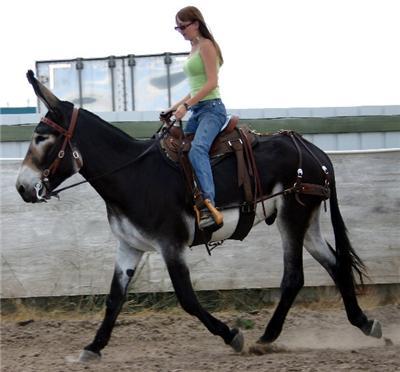
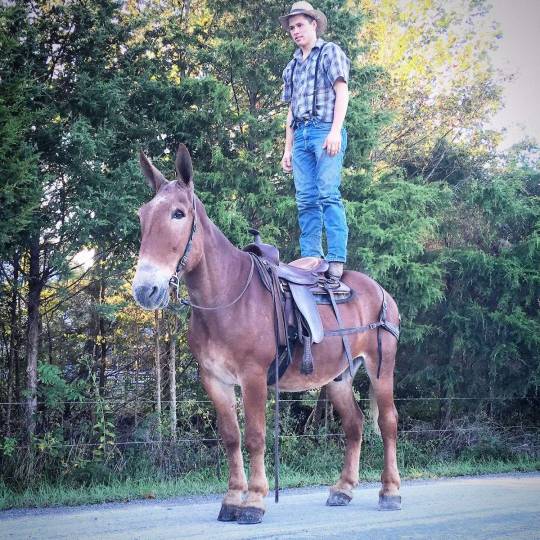
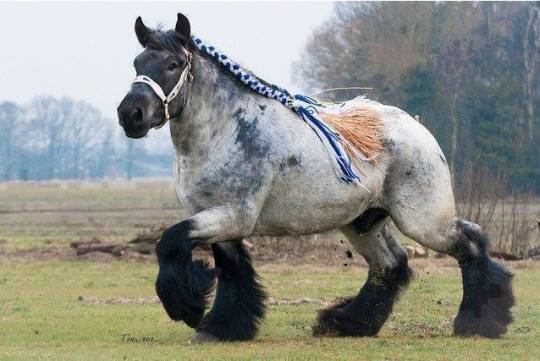
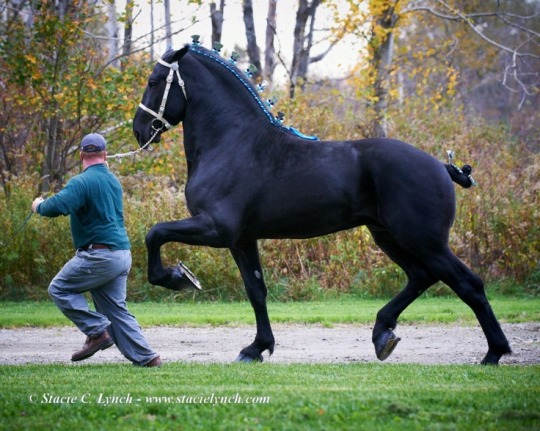
fun fact! while that move is mainly for show now, it originated from when we used horses in wars and battles so they trained the horses to do this and absolutely obliterate anyone behind them

(yes that means someone would be on the horse while it does this)

It’s one of the highest level dressage movements, isn’t trained in many horses now days(not needed and requires an incredibly fit horse to do) but the Spanish Riding School has high level horses trained like this(second photo is from there)

hrafnhrid:

Casting Runes

Fehu: domestic cattle, wealth | possessions won
or earned, earned income, luck / abundance, financial strength in the
present or near future / sign of hope and plenty, success and
happiness / social success / energy, foresight, fertility,
creation/destruction | reversed or merkstave: loss of
personal property, esteem, or something that you put in effort to
keep / indicates some sort of failure / greed, burnout, atrophy,
discord / cowardice, stupidity, dullness, poverty, slavery,
bondage

Uruz: auroch, a wild ox | physical strength and
speed, untamed potential / time of great energy and health / freedom,
energy, action, courage, strength, tenacity, understanding, wisdom / sudden or unexpected changes (usually for the better) / sexual desire,
masculine potency / the shaping of power and pattern, formulation of
the self | reversed or merkstave: weakness, obsession,
misdirected force, domination by others / sickness, inconsistency,
ignorance / lust, brutality, rashness, callousness,
violence

Thurisaz: thorn or a Giant | reactive force,
directed force of destruction and defense, conflict. Instinctual
will, vital eroticism, regenerative catalyst / tendency toward
change / catharsis, purging, cleansing fire / male sexuality,
fertilization | reversed or merkstave: danger, defenselessness, compulsion, betrayal,
dullness / evil, malice, hatred, torment, spite, lies / a bad man or
woman

Ansuz: the As, ancestral god, i.e. Odin | a revealing message or insight, communication / signals, inspiration,
enthusiasm, speech, true vision, power of words and naming / blessings, the taking of advice / good health, harmony, truth, wisdom | reversed or merkstave: misunderstanding, delusion, manipulation
by others, boredom / vanity and grandiloquence

Raidho: wagon or chariot | travel, both in
physical terms and those of lifestyle direction | a journey, vacation,
relocation, evolution, change of place or setting / seeing a larger
perspective / seeing the right move for you to make and deciding upon
it / personal rhythm, world rhythm, dance of life | reversed or merkstave: crisis, rigidity, stasis, injustice, irrationality / disruption, dislocation, demotion, delusion, possibly a
death

Kenaz: beacon or torch | vision, revelation,
knowledge, creativity, inspiration, technical ability / vital fire of
life, harnessed power, fire of transformation and regeneration / power
to create your own reality, the power of light / open to new strength,
energy, and power now / passion, sexual love | reversed or merkstave: disease, breakup, instability, lack of creativity / nakedness, exposure, loss of illusion and false hope

Gebo: gift | gifts, both in the sense of
sacrifice and of generosity, indicating balance / all matters in
relation to exchanges, including contracts, personal relationships
and partnerships |  merkstave: greed, loneliness, dependence, over-sacrifice / obligation, toll, privation, bribery

Wunjo: joy | joy,
comfort, pleasure / fellowship, harmony, prosperity / ecstasy, glory,
spiritual reward, but also the possibility of going “over the top” / if restrained, the meaning is general success and recognition of
worth | reversed or merkstave: stultification, sorrow, strife,
alienation / delirium, intoxication, possession by higher forces,
impractical enthusiasm / raging frenzy, berzerker

Hagalaz: hail | wrath of nature, destructive,
uncontrolled forces, especially the weather, or within the
unconscious / tempering, testing, trial / controlled crisis, leading to
completion, inner harmony | merkstave: natural disaster, catastrophe / stagnation, loss of power / pain, loss, suffering, hardship, sickness,
crisis

Nauthiz: need | delays, restriction / resistance
leading to strength, innovation, need-fire (self-reliance) / distress,
confusion, conflict, and the power of will to overcome them / endurance, survival, determination /  time to exercise patience / recognition of one’s fate / major self-initiated change / face your
fears | reversed or merkstave: constraint of freedom,
distress, toil, drudgery, laxity / necessity, extremity, want,
deprivation, starvation, need, poverty, emotional hunger

Isa: ice | a challenge or frustration / psychological blocks to thought or activity, including grievances / standstill, or a time to turn inward and wait for what is to come, or
to seek clarity / reinforces runes around it | merkstave: ego-mania,
dullness, blindness, dissipation / treachery, illusion, deceit,
betrayal, guile, stealth, ambush, plots

Jera:
a year, a good harvest / the results
of earlier efforts are realized /  time of peace and happiness,
fruitful season / can break through stagnancy / hopes and
expectations of peace and prosperity / the promise of success earned / life cycle, cyclical pattern of the universe / everything changes, in
its own time | merkstave: sudden setback, reversals / a major change, repetition,
bad timing, poverty, conflict

Eihwaz: yew tree | strength, reliability,
dependability, trustworthiness / enlightenment, endurance / defense,
protection / the driving force to acquire, providing motivation and a
sense of purpose / indicates that you have set your sights on a
reasonable target and can achieve your goals / an honest man who can
be relied upon | reversed or merkstave: confusion, destruction,
dissatisfaction, weakness

Perthro: lot cup, vagina | uncertain meaning, a
secret matter, a mystery, hidden things and occult abilities.
Initiation, knowledge of one’s destiny, knowledge of future matters,
determining the future or your path / pertaining to things feminine,
feminine mysteries including female fertility etc. / good lot,
fellowship and joy / evolutionary change | reversed or merkstave: addiction, stagnation, loneliness, malaise

Algiz: elk, protection | protection, a
shield / the protective urge to shelter oneself or others / defense,
warding off of evil, shield, guardian / connection with the gods,
awakening, higher life. It can be used to channel energies
appropriately / follow your instincts / keep hold of success or
maintain a position won or earned | reversed: or merkstave: hidden danger, consumption by divine forces, loss of divine link / taboo, warning, turning away, that which repels

Sowilo: the sun | success, goals achieved, honor / the life-force, health / a time when power will be available to you
for positive changes in your life, victory, health, and success / contact between the higher self and the unconscious / holeness,
power, elemental force, sword of flame, cleansing fire | merkstave: false goals, bad counsel, false success, gullibility, loss of goals / destruction, retribution, justice, casting down of vanity / wrath of
god

Tiwaz:
Tyr, the sky god | honour, justice,
leadership and authority / analysis, rationality / knowing where one’s
true strengths lie / willingness to self-sacrifice / victory and
success in any competition or in legal matters | reversed or merkstave: one’s energy and creative flow are blocked/ mental
paralysis, over-analysis, over-sacrifice, injustice, imbalance / strife, war, conflict, failure in competition / dwindling passion,
difficulties in communication, and possibly separation

Berkano: Berchta, the birch-goddess | birth,
general fertility, both mental and physical and personal growth,
liberation / regenerative power and light of spring, renewal, promise
of new beginnings, new growth / arousal of desire / a love affair or
new birth / the prospering of an enterprise or venture | reversed or merkstave: family problems and or domestic troubles / anxiety about someone close to you / carelessness, abandon, loss of
control / blurring of consciousness, deceit, sterility,
stagnation

Ehwaz: horse, two horses | transportation / may
represent a horse, car, plane, boat or other vehicle / movement and
change for the better / gradual development and steady progress are
indicated / harmony, teamwork, trust, loyalty / an ideal marriage or
partnership / confirmation beyond doubt the meanings of the runes
around it | reversed or merkstave: not really a negative
rune / a change is perhaps craved / feeling restless or confined in a
situation / reckless haste, disharmony, mistrust, betrayal

Mannaz: man, mankind | the Self; the individual
or the human race / your attitude toward others and their attitudes
towards you / friends and enemies, social order. Intelligence,
forethought, create, skill, ability / divine structure, intelligence,
awareness / expect to receive some sort of aid or cooperation now | reversed or merkstave: depression, mortality, blindness,
self-delusion / cunning, slyness, manipulation, craftiness,
calculation / expect no help now

Laguz: water, or a leek | flow, water, sea, a
fertility source, the healing power of renewal / life energy and
organic growth / imagination and psychic matters / dreams, fantasies,
mysteries, the unknown, the hidden, the deep, the underworld / success
in travel or acquisition, but with the possibility of loss | reversed or merkstave: an indication of a period of confusion in your
life / you may be making wrong decisions and poor judgements / lack of
creativity and feelings of being in a rut / fear, circular motion,
avoidance, withering / madness, obsession, despair, perversity,
sickness, suicide

Ingwaz: Ing, the earth god | male fertility,
gestation, internal growth / common virtues, common sense, simple
strengths, family love, caring, human warmth, the home / rest stage, a
time of relief, of no anxiety / a time when all loose strings are tied
and you are free to move in a new direction / listen to yourself | merkstave: impotence, movement without change / poduction, toil,
labour, work

Dagaz: day or dawn. | breakthrough, awakening,
awareness / daylight clarity as opposed to nighttime uncertainty /
time to plan or embark upon an enterprise / the power of change
directed by your own will, transformation / hope and happiness, the ideal / security and certainty / growth and release / balance point, the place
where opposites meet | merkstave: a completion, ending, limit, coming full
circle / blindness, hopelessness

Othala: ancestral property | inherited property
or possessions, a house, a home / what is truly important to one / group order, group prosperity / lLand of birth, spiritual heritage,
experience and fundamental values / aid in spiritual and physical
journeys / source of safety, increase and abundance | reversed
or merkstave
: lack of customary order, totalitarianism, slavery,
poverty, homelessness / bad karma, prejudice, clannishness,
provincialism / what a man is bound to

skyeventide:

adzolotl:

adzolotl:

glumshoe:

Why are blacksmiths so stigmatized in folklore? What about the profession gave them such a bad name and caused them to be closely associated with the Devil?

¯_(ツ)_/¯

https://en.wikipedia.org/wiki/The_Smith_and_the_Devil “may be one of the oldest European folk tales […] possibly being first told in Indo-European 6,000 years ago”

https://en.wikipedia.org/wiki/Blacksmiths_of_western_Africa “feared in some societies for their skill in metalworking, considered a form of magic“

http://journals.sagepub.com/doi/pdf/10.1177/039219216801606202 Maybe because traditional smelting techniques involve, human sacrifice? Allegedly?? Or maybe “Molten metal that flows is associated with flowing blood because
of its color, heat and the danger that arises from it”

okay now i’m Invested

https://irishfolklore.wordpress.com/2017/03/13/blacksmiths-and-the-supernatural/ “Their ability to turn raw materials such as iron ore or bog iron into usable tools and weapons made them seem like they were in possession of magic.“ … “8thcentury hymn to protect people from the ‘spells of women, smiths and druids’”

http://akkadium.com/fire-forge-glimpsing-craft-ethiopian-blacksmith/ “traditional beliefs that the earth is sacred, and fire (heat) is potentially polluting”

My third link concludes:

Those who are only slightly familiar with anthropology are aware
of the many explanations that have been proposed to account for the “blacksmith complex". He is impure because he is in contact
with iron (a loathsome and repulsive element), or with fire (from
which demons are born), or because he forges murderous weapons; or because he is endogamous, or is not independent, or because
blacksmiths are the dregs of conquered peoples, do not produce
their own food, do not go to war, and break some unknown divine
interdict. They are respected because they have dared to break
a divine interdict, because they make useful instruments, because
they are rich, because they are initiators, educators, religious chiefs,
peace-makers, sacrificers, civilising heroes, and even, according to
the embryological theory of M. Eliade, because they help the Earth
to give birth to minerals and in so doing are a substitute for Time etc. Their powers issue from their tools, from spirits hidden in
the bellows of their smithies, from fire, from the “numinous” force
of iron, from the ornaments they forge for shamans; or from the
celestial origins of their techniques, from their novelty, from the
fact that these secret techniques are hereditary, or simply because
they are in their possession; or again from the “ambivalent magic
of weapons made of stone,” which, by emitting sparks when
struck, are likened to lightning, a magic that is transmitted into
the metal; or from the fact that they forge flashes of lightning
for the gods, etc… 

One can see that, even when they contain elements of truth,
all these explanations are one-sided and often in need to be
explained themselves. The only valid explanation is one that can
show the inner reason for the different manifestations of the
“blacksmith complex” and their coexistence, and attain to the
structure that determines their interconnection and renders them
interdependent. 

An interpretation that coordinates the various elements of the
problem, on the basis of the blacksmith’s violation of taboo, should
satisfy these conditions. It would form part of a wider interpretation
of magical violations of taboo in general, based on an
analysis of the nature and function of taboos.

I remember reading that, in the Middle Ages, Muslims had a restricted number of professions available to them in Christian lands, among these blacksmithing, which may have come from the association of the blacksmith with the devil or may have fed into it, or both.

I can’t find an actual source for this right now, a brief google search isn’t helping me, but it seemed worth noting.

(also @theotherwesley)

Here’s a great bit from the BBC documentary Secrets of the Castle where they talk about how blacksmiths were seen as being able to participate in black magic but were also paradoxically immune to its corrupting effects, able to “tweak the devil’s nose” and get away with it. 

Also since this is my Tolkien blog, it’s interesting to note that technology, particularly metalworking, is viewed as a powerful corruptive force in Tolkien’s work. Metal and wheels pitted against trees and water; it’s all very much based on this trope in mythology. Aulë’s forces are the only ones amongst the Valar that are capable of being corrupted to evil; Sauron and Saruman are both maiar of Aulë, Aulë dared to create the semblance of life before Eru’s children had awoken on earth when he made the dwarves, and the dwarves in turn are suspect because they can be corrupted by their love of metals and gems; the Noldor are beloved of Aulë and it is the Noldor who first use his teachings to forge weapons and bring violence to Aman. We’re told that Aulë is the closest in temperament to Melkor, but his works are not inherently evil because he still submits to the divine authority. 

we-are-knight:

petermorwood:

we-are-knight:

pyrogothnerd:

just-shower-thoughts:

A Knight in shining armor is a man whose metal has never been tested.

Or one who regularly cleans it…but yeah, “Black Knights” were called so because their armor was in terrible condition, and they were usually much more experienced, so they usually won tournaments.

@we-are-knight Am I correct? Anything to add?

I’m curious mainly where you got this concept from…

“Black Knights” need to be distinguished by context. I’m on my phone right now so I can’t link you all the sources I’d like to use, so please pardon me for that.

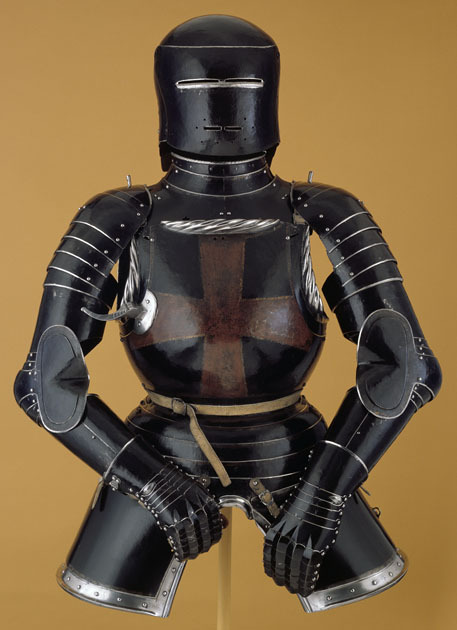
So, the concept of “knight in shining armour” comes from the idea of the knight-errant in medieval fiction, the sort of person who is on a quest, is all shiny and new, ready to test themselves. It also is a nod to the maintenance of equipment, or the wealth of a Knight; in the late medieval and Renaissance periods, well-off knights might have a suit of armour for warfare, a suit for tournaments, and a suit for formal occasions. These being used for different things, they were meant to be maintained well and show status and wealth.

So, where does the concept of a black Knight actually come from?

Surprisingly, most cases come from the idea of the tournament. Knights were meant to display who they were, “show their colours” (ie, heraldry), and show off their skills in combat. But if course you had some knights who didn’t want to show who they were, who they were fighting for, or which lady they favoured, etc. This sounds like a chivalric fantasy, and honestly, that’s what tournaments really became as time went by and the events became more formal.

Now, early “black Knights” , were those who did not wear dark or black armour, but in fact those who did not use their own heraldry, disguising themselves. Again, they may do this for various reasons, but the concept is they hide their identity. Occasionally, they might actually paint their shields black.

We also have the examples from the hundred years war where French and English knights painted their armour different colours: black for the French, Red for the English.

Some knights actually WOULD favour black armour or heraldry to the point they got called “black Knights”, and not as a derogative. The Polish Knight, Zawisza Czarny (pronounced “Zah-vu-shah Shar-ny”, approximately) become known for his feats of arms, and by his dark armour.

Linking back to the original quote, a Knight in shining armour could well be a black knight, as such. But more commonly, it meant he was either wealthy, or highly skilled at arms.

Or both. 😛

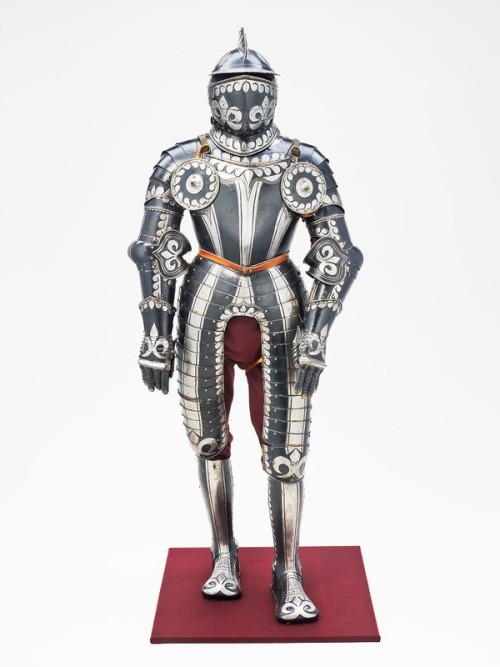
I’ve seen enough period art to convince me that “shining armour” was often a lot darker than the chrome-plated image which the term suggests.

I’ve also long thought that the whole business of “knights in shining armour” wasn’t a medieval concept at all, certainly not the default one, but was a Regency / early Victorian fictional conceit from Romance poets and Sir Walter Scott’s historical fiction. (About 10 years ago an actual expert said more or less the same thing, leaving actual amateur me feeling rather smug…) :->

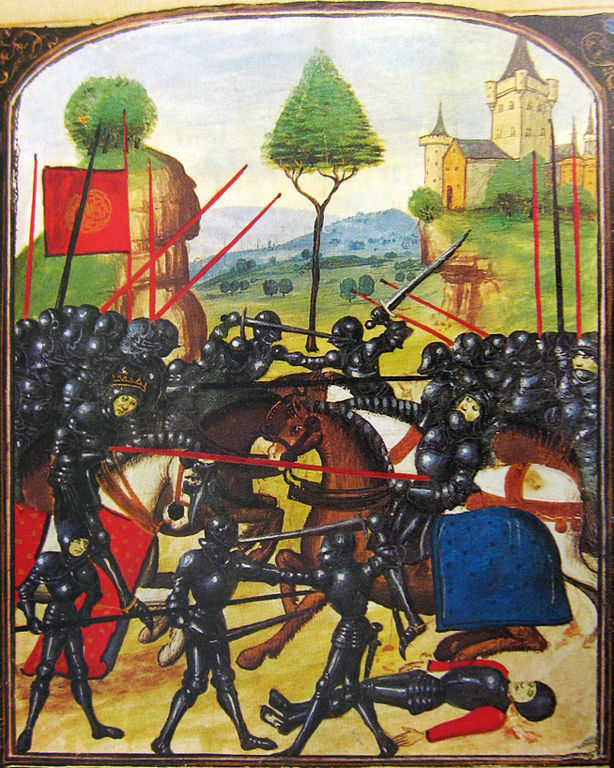
This illumination features armour that’s black or dark blue in colour, but with
the carefully-delineated highlights

of a shiny surface. There are many other like it.

image

Armour was coloured for both decorative and practical purposes; chemical blueing with acid produces a very dark, lustrous and effectively rust-resistant finish like the one in the medieval illustration. I once had an Arms & Armor rapier with that finish on the hilt: it looked like this…

Heat-blueing, which was more blue than black, was a popular treatment for Greenwich armour of the Elizabethan period, as was browning and russetting (all of which were and are used on firearms), processes which used heat, chemicals or controlled “good rust” to create colour and also prevent uncontrolled “bad rust”.

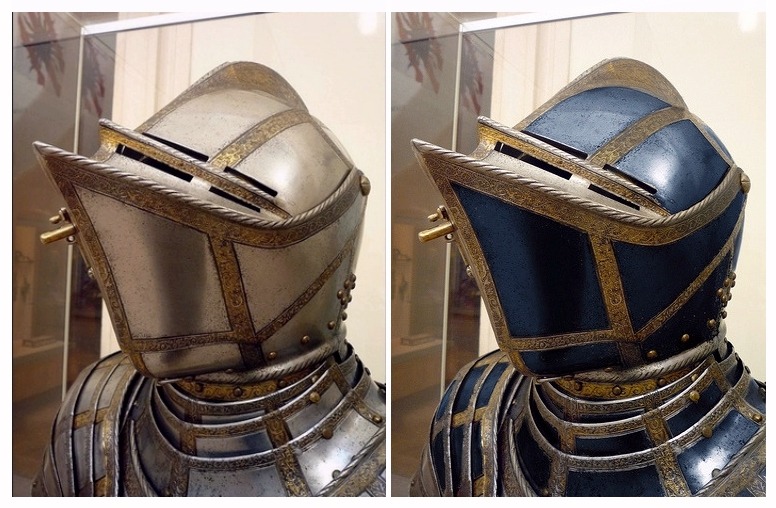
Here’s the helmet of Sir James Scudamore’s Greenwich harness, which was once blued and gilt.

image

The image on the left is how it looks now, after being thoroughly scrubbed with wire wool, sand or other abrasives at some stage in the 19th century to make  it “shining armour”. The image on the right is a CGI restoration of its original appearance, based on still-visible traces of colour in the grooves beside the gold strapwork.

Here’s the browned and gilt “garniture” (armour with extra bits for different styles of combat, like a life-size action figure) of George Clifford, Earl of Cumberland. I don’t think grinding this beauty down to bright metal would be an improvement…

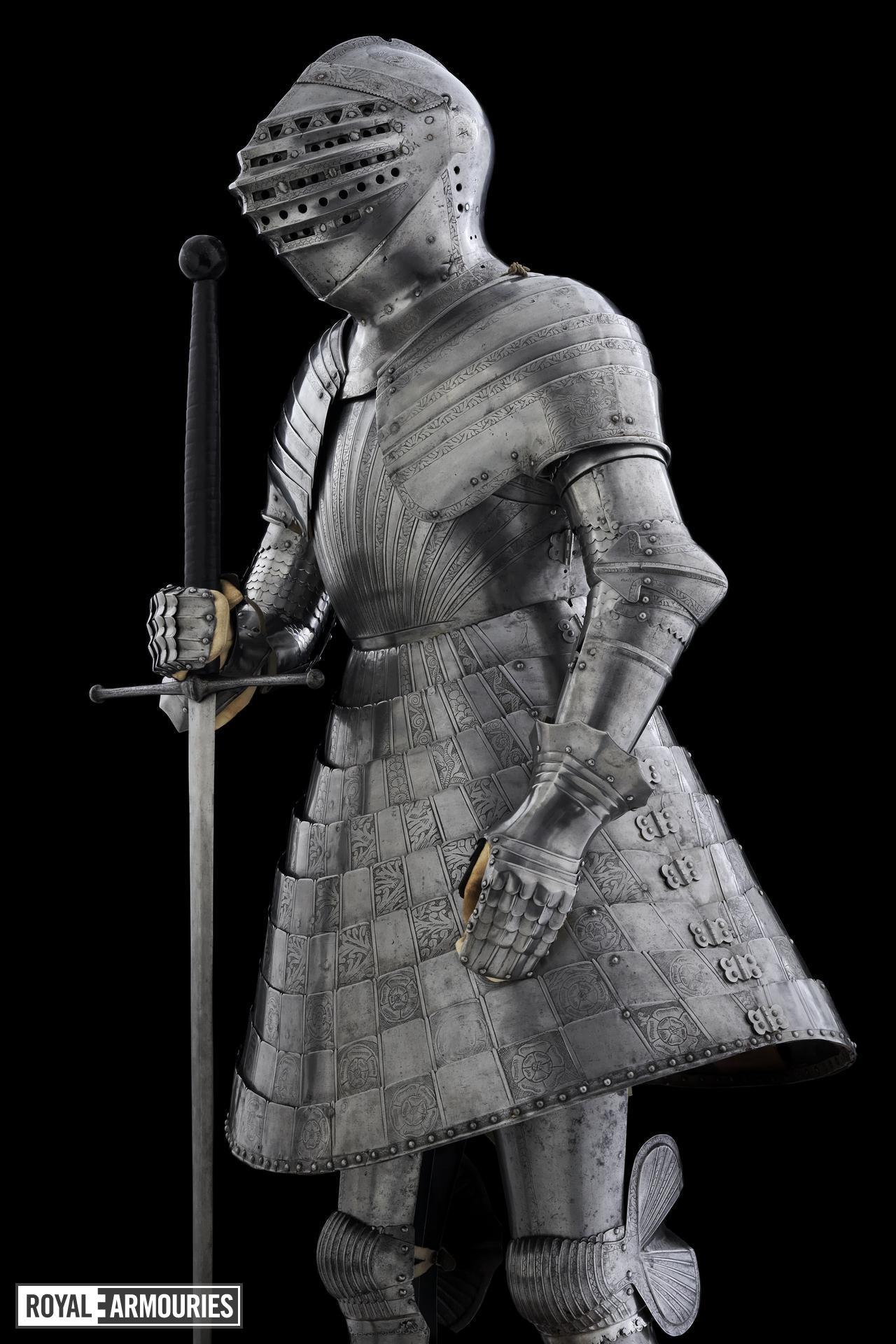
Henry VIII’s tonlet (skirted) armour for foot combat at the Field of the Cloth of Gold now looks like this:

image

Originally it would have been shiny black or dark blue with gilt details and the engraved panels picked out in coloured paint or enamelling – red Tudor Roses, green leaves etc., but that wasn’t “shining armour”, so…

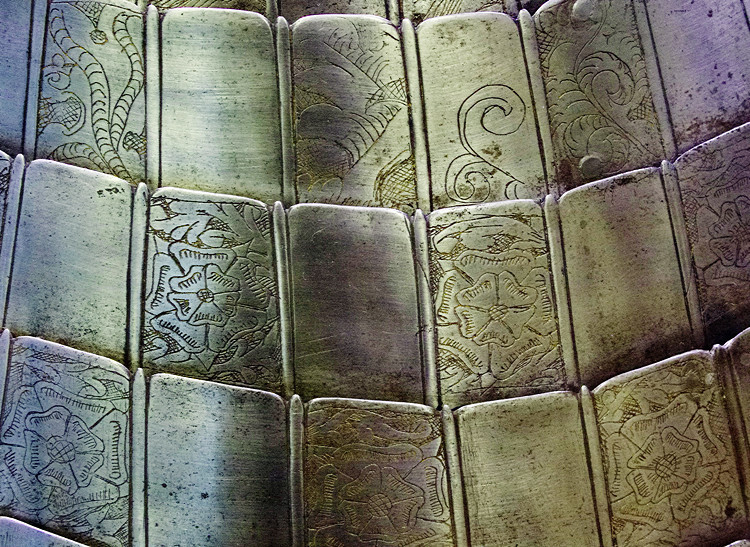
This detail shot shows the fine score-marks left after it was sanded “clean”, with dark pigmentation in the grooves as a memorial of how it once looked.

image

This Renaissance painting, “Portrait of Warrior with Squire”, shows black armour on the warrior and bare-metal armour on his squire, so it’s clear that armour in art wasn’t painted black simply because artists couldn’t properly represent burnished steel.

In this article, Thom Richardson, Keeper of Armour at the Tower of London and Royal Armouries in Leeds (the actual expert I mentioned at the beginning) comes straight out and calls Scott responsible for “shining armour” vandalism:

The sets of armour are not in their original black and gold because of
over-aggressive polishing in the 19th century when, said Richardson,
“they were polished with brick dust and rangoon oil to within an inch of
their life” to fit the aesthetic of what armour should look like, all
shiny and silvery. “Walter Scott is to blame,” Richardson added
ruefully.

Scott can also be blamed, according to the Oxford English
Dictionary, for creating or at least popularising that clunky, inaccurate term
“chain-mail”. It cites the first appearance in 1822 (recent when talking about mail) when a
character
in “The Fortunes of Nigel

says:

“…the
deil a thing’s broken but my head. It’s not made of iron, I wot, nor my
claithes of
chenzie-mail; so a club smashed the tane, and a claucht damaged the tither.”

Plate armour was also painted, either crudely…

image

…or with much more care (this style is actually called black-and-white armour); since the paint was oil-based, it also had a rust-proofing effect…

image

I have a notion that the more white there was on black-and-white armour, and thus the more work (by servants, of course!) needed to keep it looking good, may have been an indication of rank, status or success. Just a guess…

Armour left rough from the hammer – therefore cheaper than armour polished smooth, since every stage of the process had to be paid for – was also treated with hot oil in the same way cast-iron cookware is seasoned, again to prevent rust.

There were terms for bright-metal armour – “alwyte harness” and “white
armour” – but the existence of such terms suggests to me that they arose
from a need to describe an armour finish which needed a tiresome amount of maintenance to keep it that way. I’m betting that the last stage of a clean-and-polish was a good layer of grease, or even a beeswax sealant like the coatings used by museums today.

White armour may have been a demonstration of wealth or conspicuous consumption in the same way as black or white clothes: one needed servants constantly busy with polishing-cloths, the others needed really good colour-fast dye or lots of laundering, and all of those cost money.

One thing is certain: a knight in shining armour wasn’t the one who sweated to keep it shining. That’s what squires were for…

I am a simple man: when Peter speaks, I listen.

elodieunderglass:

staxilicious:

systlin:

theleeallure:

hypno-sandwich:

danipup:

striderofthenorth-dom:

danipup:

striderofthenorth-dom:

striderofthenorth-dom:

mrmattegrey:

danipup:

striderofthenorth-dom:

synonymforhappiness:

striderofthenorth-dom:

sighinastorm:

chiribomb:

striderofthenorth-dom:

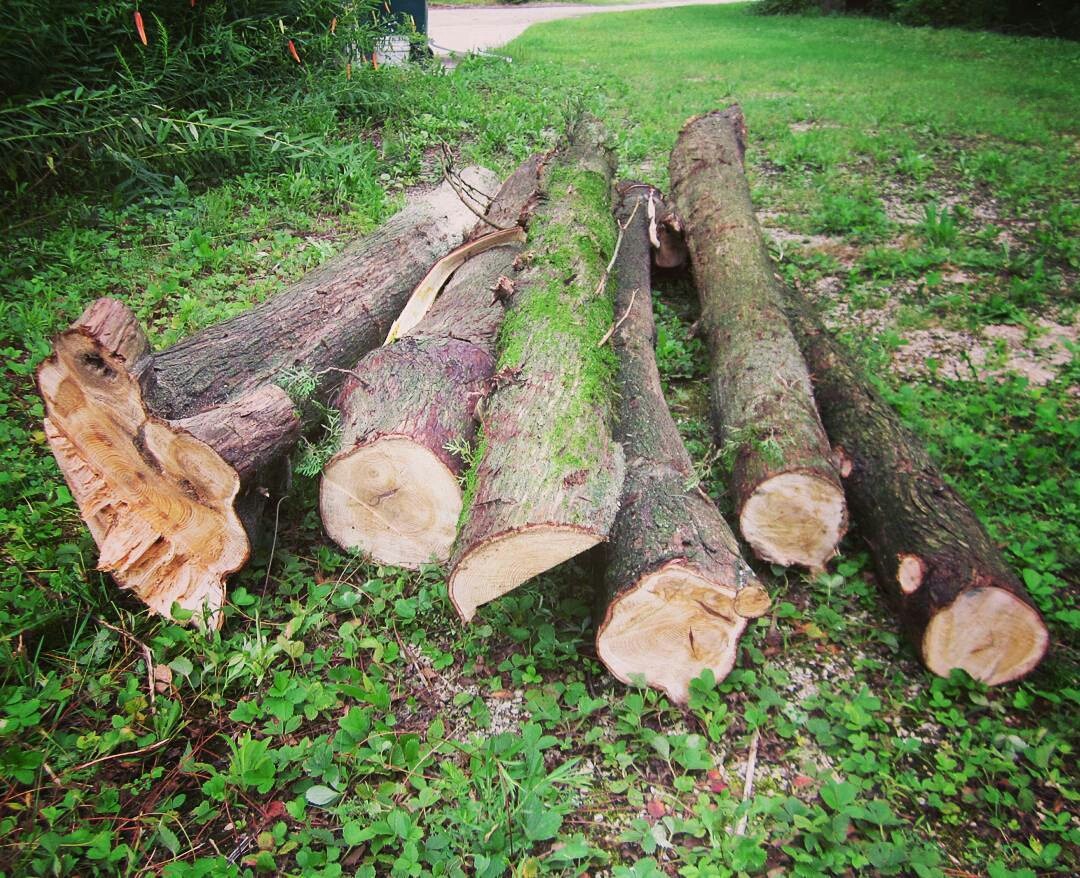
I’ve been working on a wooden longbow most of the afternoon.  Here are ten easy steps for making your own 🙂

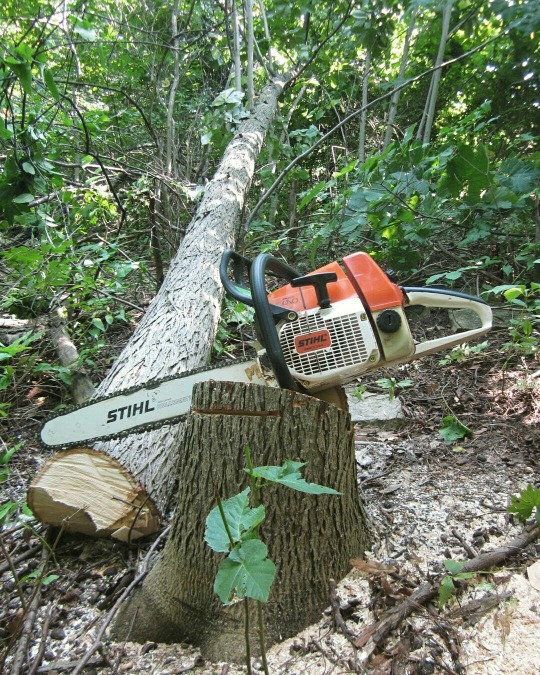
1. Cut down a tree

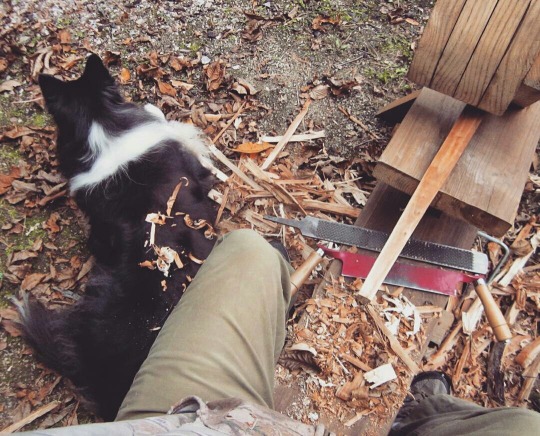
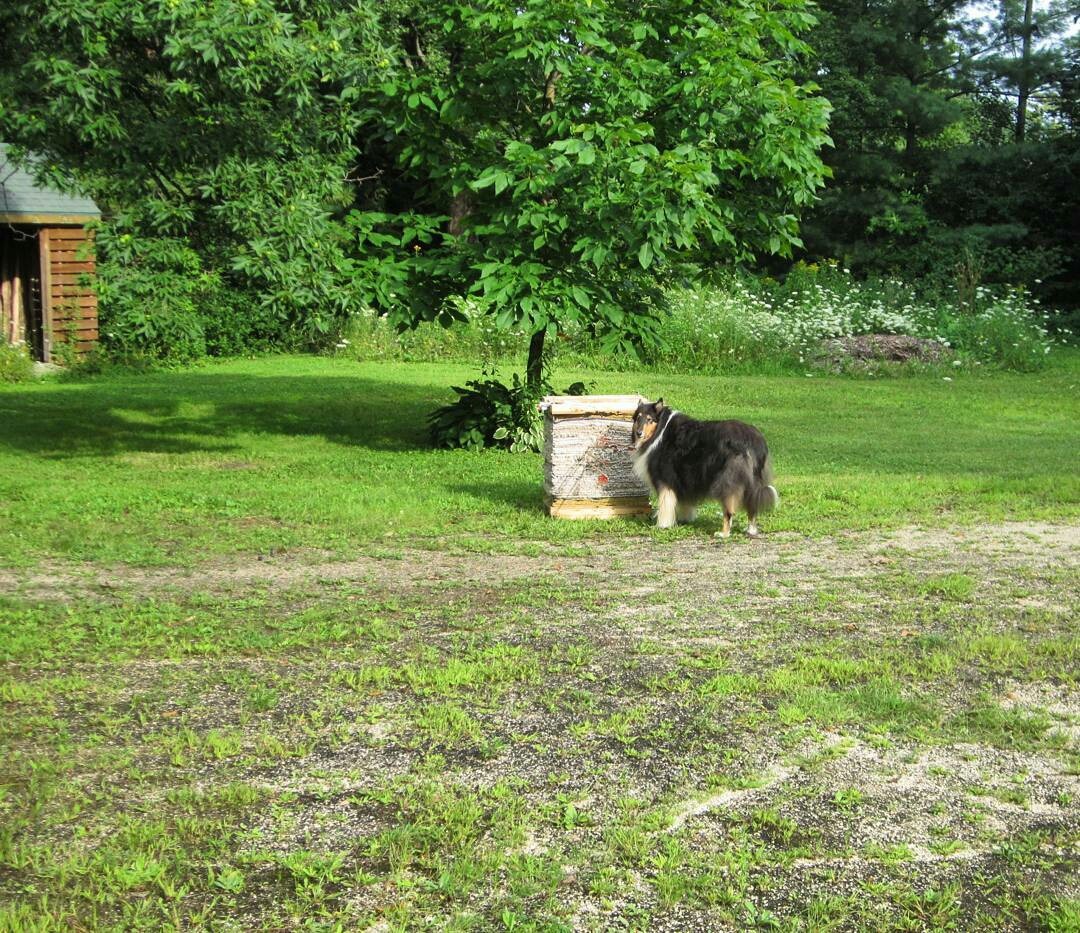
2.Split that tree into lengthwise sections called staves. The dog will help

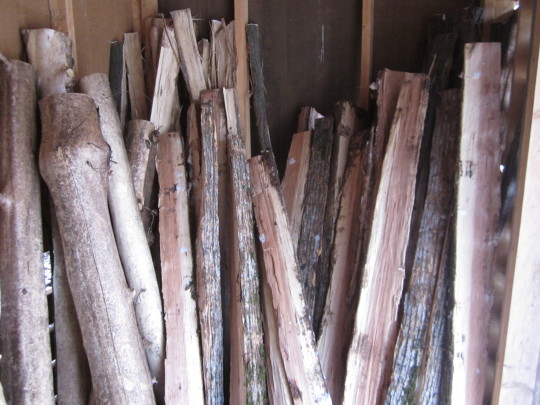
3. Build a woodshed

4. Let those staves dry for a few years in the shed

5. Remove all the shit that isn’t a bow. The dog will help again by lying on your foot

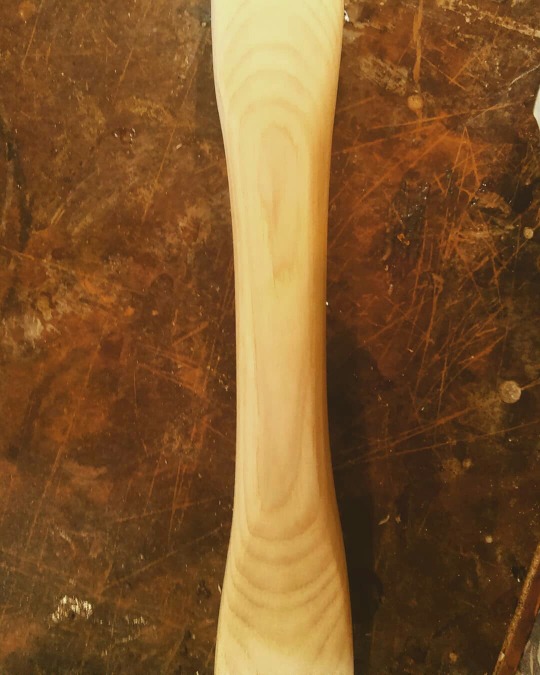
6. Make sure the handle stays centered in the growth rings

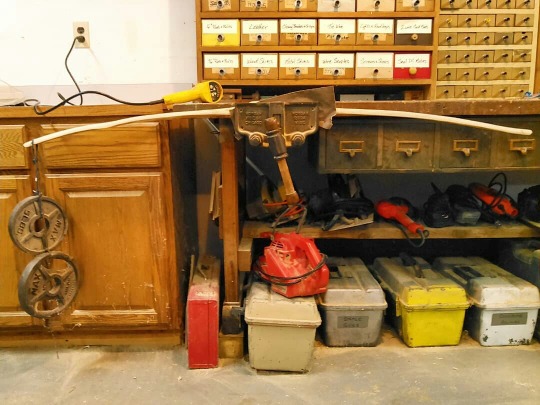
7. Steam bend and weight the wood so that both limbs start with the same bend

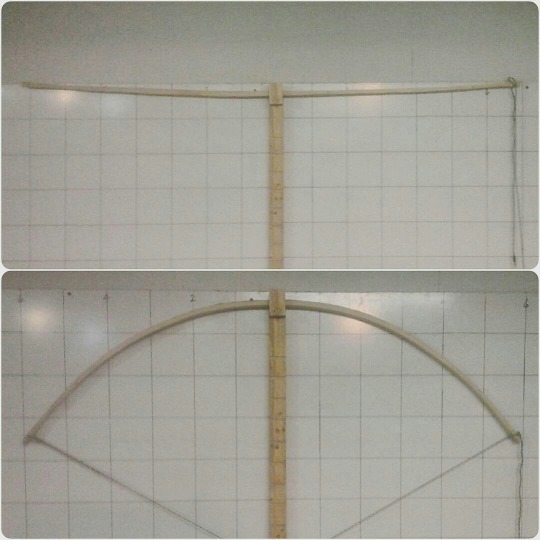
8. Slowly remove wood from the belly of the bow on both sides until they bend evenly

9. Add tip overlays, handle wraps, and all the fancy crap

10. Go out in the yard and practice till hunting season starts

I may need to drive to town for some human contact.

😮

Any particular wood?  What was it here?  I always meant to try making a bow out of my parents’ overgrown yew shrubbery, but that didn’t work out.

Pictured in the compilation above are shagbark hickory, hop-hornbeam, and common buckthorn. While English yew is rightfully considered one of the best bow woods, almost any straight grained hardwood can make a very nice bow. You can even use maple boards from the hardware store to start.

“Shagbark Hickory,” “Hop-Hornbeam,” and “Common Buckthorn,” all sound like the names middle earth kids give their high school garage bands.

😂😂😂… and now my brain just created Ent Metal as a genre. It’s pretty damn Larghissimo, but very strong.

what a fuckin’ nerd.

Okay now I want to figure out what ent metal would sound like.

I’m thinking thunder and whale song. Somehow.

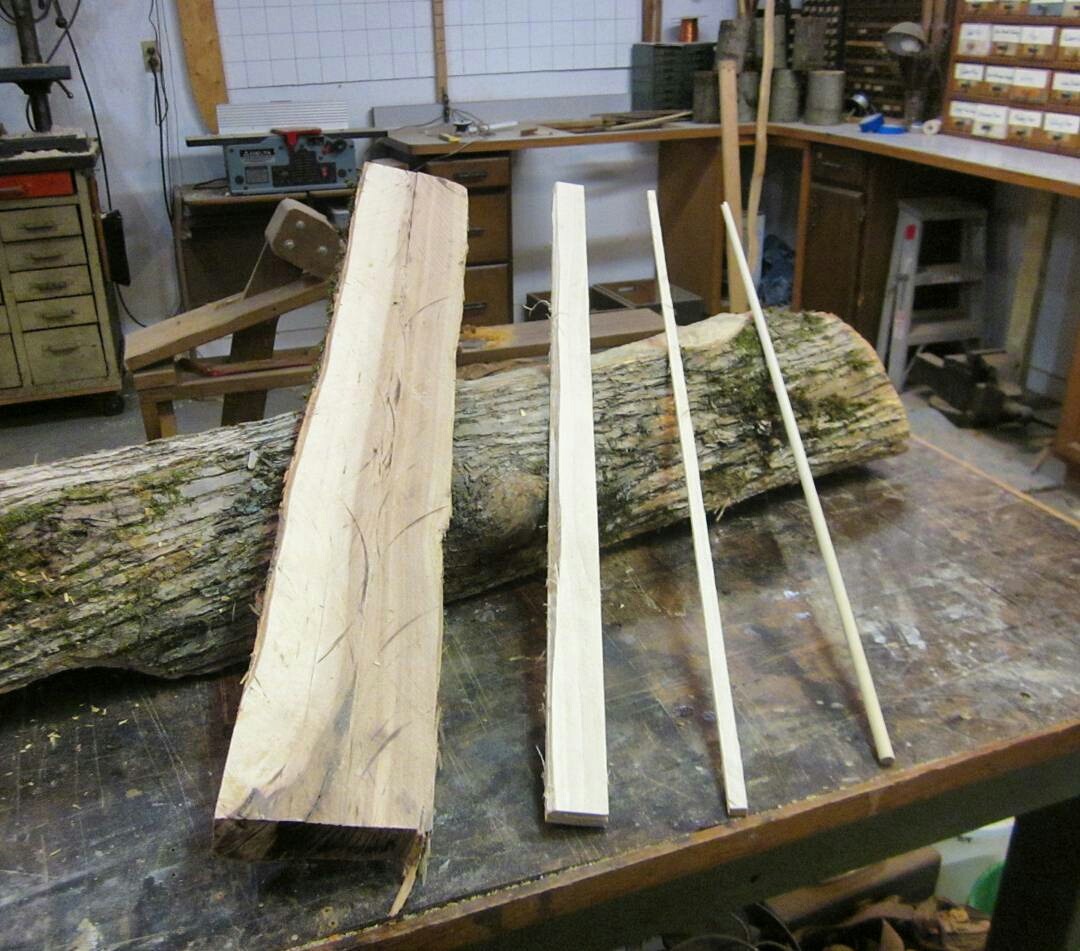
The amount of notes this has gotten is absurd. That doesn’t happen to my posts, but since you crazy kids seem interested here’s (one of a gajillion ways) to make the accompanying primitive arrows.

We want lighter wood than we used to make the bows. This is white cedar- nice and light and sproingy.

Mill that up into rectangular pieces as long as your arrows need to be.

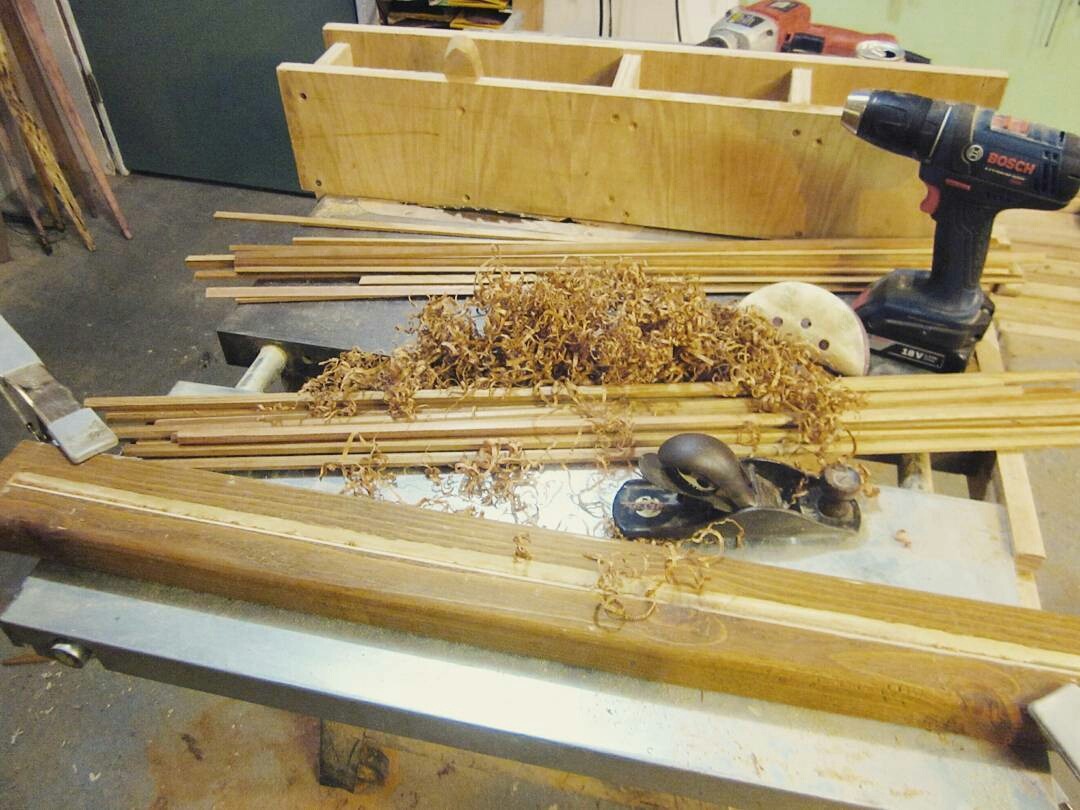
Then you use this homemade tool called a shooting board to rest them in while you hand plane them from rectangular to round.

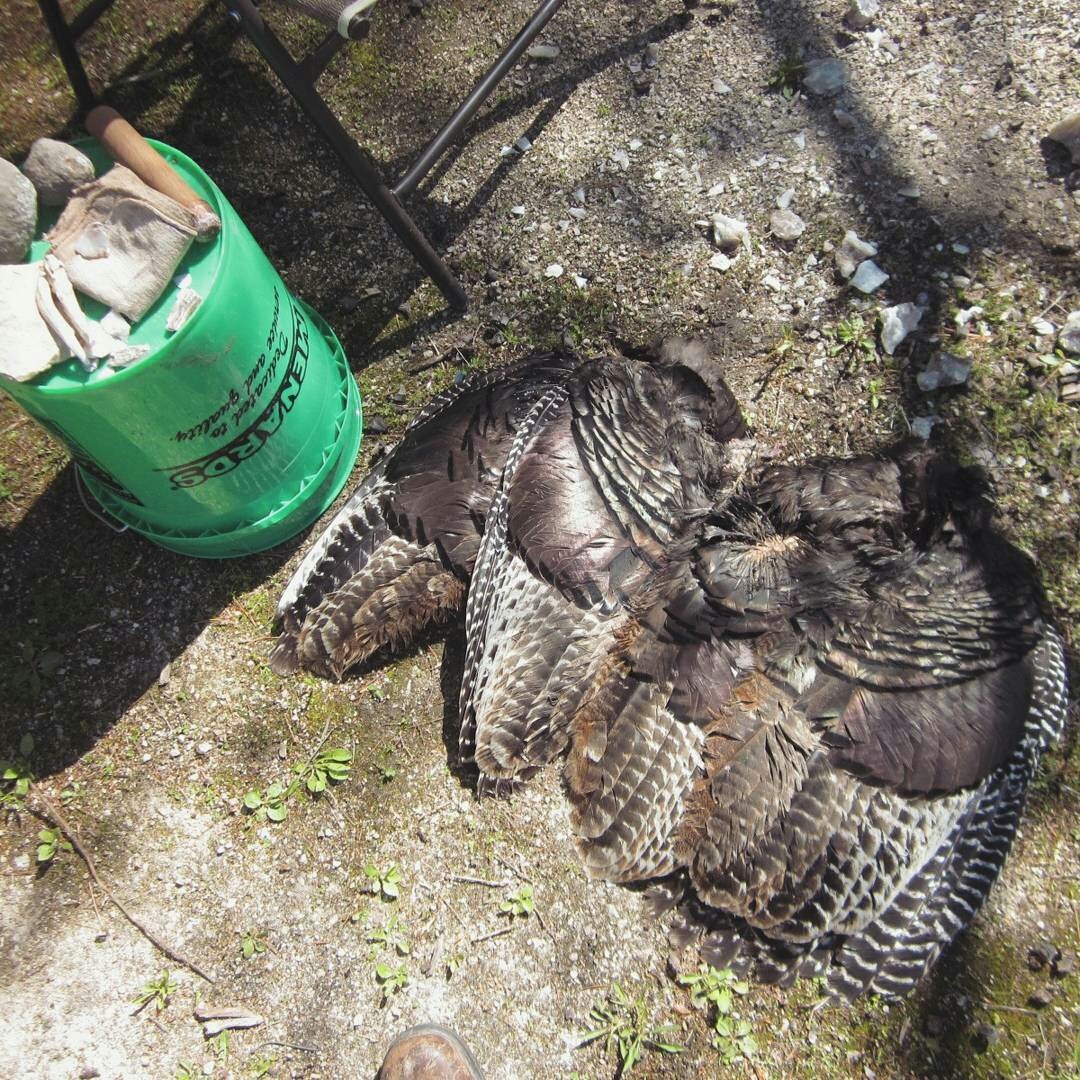
You saved your wings from the spring turkey hunt, right? Good, we’re gonna need those primary feathers.

Make yourself a pattern out brass or copper sheet, clamp the feather to it, and burn it with a torch. This will shape the feathers into fletchings.

Now we need to make pine pitch glue by melting together pine pitch (you can pick it off pine trees where they’ve been injured) and hardwood charcoal. Think of it as ancient people’s super glue.

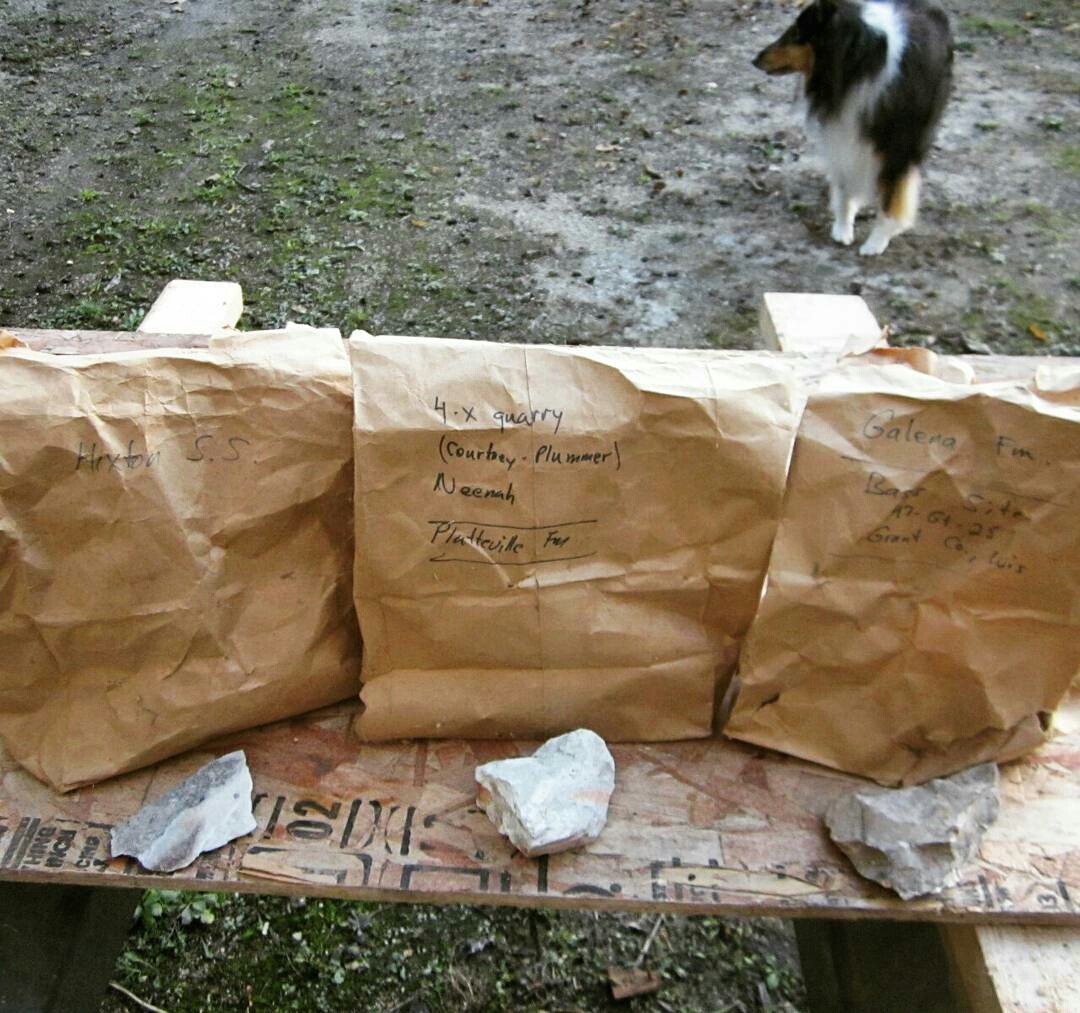
Get your paleontologist buddy to give you some rock from actual Paleolithic quarry sites ‘cuz that’s pretty rad.

Learn flint knapping… he said casually after years of hair-pulling-out struggles with it.

Attach your stone points to your arrow shafts using the ancient super glue stuff and leg sinew from the deer you got last year. Do the same for the fletchings.

And you’re finally ready to start practicing! Don’t worry, the dog will help again by standing directly in front of the target because she’s beautiful and loving, but not very good at critical thinking sometimes.

mansies, this post keeps getting more awesome. 🙂

also, proposal: should Caradhras have a different name in summertime? i’m feelin’ a more Bag End or Hobbiton vibe when the place isn’t covered in show.

You can’t go changing place names seasonally, @danipup What would the maps look like? Every place has 4 names?😂😂

I’m living in 3018 map ideas, @striderofthenorth-dom . get with the program, Bow Boy. 💡

From up the thread- I’m glad all these Old Romantics are into Ent Music.

@systlin this seems like it would be right up your.. archery lane?

Holy shit

You can also do a bath and bend version where you use straight pieces of wood instead of carving them, soak the wood in salted water, set to dry using clamps to shape it; repeat the bath soak then clamp set (moving the clamps for each new set) until your bow is in the preferred shape.

(This is how my uncle taught me to make long bows in his workshop at Howitzer when I was a child. They made a lot of fiberglass bows, which I was too young to be around the manufacturing of, and mostly made compound bows (the ones with pulleys that give more tension to the pull). My uncle designed the Warthog bow for himself and other short people who like to now hunt. OP has a couple of clever life hacks to my uncle’s method (using lifting weights is a genius idea), and an excellent bow making method. I am only sharing a different technique for those who may find soaking easier than steaming (or those who find themselves needing to make a bow in the wild since you could bind the wood around a tree instead of clamping it to shape).

this is such a nice post

I very much enjoy everything happening here

I Curse My Enemy To Fart. Alot! 17th Century Icelandic Folk Magic Preserved In Book Form

norsesuggestions:

excerpt from the swedish history musuems text about a 17th century icelandic book of magic

“Om du till exempel vill framkalla kräkning hos en ovän, ristar du
trolltecken på ost eller fisk och ger till den du vill driva med “då
skall han icke hava nytta av det som han äter den dagen”.

Om inte detta är straff nog kan du sedan använda dig av fjärt-runor.
Skriv då trollstavar med ditt eget blod på ett vitt kalvskinn och säg:
”jag ristar dig åtta assrunor, nio naudrunor, tretton thursrunor vilka
må plåga din buk med svår väderspänning och … våldsamt fjärtande … måtte
aldrig ditt fjärtande upphöra varken dag eller natt…” “

English Translation (by me)

Say that you want to curse your enemy to vomit, then you are adviced to carve magical symbols on cheese or fish. Then you shall give these food items to the one you want to mock. the result, according to the book is “that they will be unable to gain nourishment nor pleasure from any meals for a day”.

but, if this is not enough punishment for your enemy you can step up your game, and use farting – runes. write magical runes with your own blod on the white pelt of a calf and say: “I am carving you with eight a – runes, nine n – runes, thirteen th – runes. may they torture your stomach with a severe feeling of bloating and aggersive farting. may your farting last forever, yes day and night you shall fart, forevermore!”

Source

a book of magical spells from either the 17th or 16th century, written in icelandic. bought
1682

in copenhagen by the swedish historian 
J. G. Sparfvenfeldt, who aquired for the swedish crowns collection. unknown who wrote the book, and for what porpuse, but because of the different handwritting in the book, it is believed it was written by at least two authors.

the book is kept at historiska museet in stockholm, sweden.

http://historiska.se/sokresultat/?q=svartkonstbok&i=ksamsok

http://historiska.se/upptack-historien/object/117747-bok-svartkonstbok-av-papper/

http://historiska.se/upptack-historien/artikel/en-islandsk-svartkonstbok/

eschergirls:

halfarsedhermit:

Spent the last two days working on this little archery guide in art and writing. Considering the rise in popularity of archers in pop culture this hopefully  comes in handy for a bunch of fandoms.

Since odd or hilariously awkward archer poses show up a lot on this blog, I thought this might be a useful tutorial/reference post to pass on! :3

An Iron Brew: 2,500-Year-Old Drink Recreated by Archaeologists and Brewers

elodieunderglass:

petermorwood:

ancientorigins:

In some of the latest news in archaeology, a bronze cauldron was discovered inside a burial plot from 400 or 450 BC in Germany. The walls of the vessel contained precious remnants of an old drink recipe. Now, researchers have managed to recreate the ancient brew.

Read more…

Here’s the important bit – the ingredients and how it tastes.

Paleobotanical analysis of the vessel’s contents allowed the researchers
to discover the ingredients of the brew’s recipe. They found that it
was made up of yeast, barley, honey, meadowsweet, and mint.

….research was continued in Milwaukee’s Lakefront Brewery,

where the cellarmaster Chad Sheridan (an
expert in homebrewed meads) helped re-create the process of preparing
the ancient drink …

His result was a smooth and pleasant drink which has been described
as tasting like a dry port, but with a herbal minty tinge (and) an [alcohol by volume] of over 8 percent.

…adding honey at this stage would
probably make it more drinkable for [today’s] mead imbibers, we decided
to leave it as is.

Sounds very pleasant.

I’d second the “no extra honey” – a lot of modern commercial meads are too sweet (Bunratty here in Ireland, for instance). It’s like putting sugar on a bowl of pre-sugared cereal
such as Frosties or Ricicles (or Calvin’s favourite Chocolate Frosted
Sugar Bombs – to which he often adds extra sugar because “they’re kinda
bland” without it). I sometimes wonder if customers are reluctant to accept a honey-based drink that tastes dry.

Defunct company Penlyn Mead of Cornwall used to make the best mead I’ve ever encountered.
It didn’t involve anything besides water, honey, yeast, time and skill.

The drink was bottled out at 13% abv, (red wine level)

and though the honey scent and flavour remained, there was no cloying sweetness since

a higher proportion of the sugar had become alcohol.

Writer Note: (for interesting names) Mead with added grape juice is “pyment” (pih-ment? pie-ment? pee-ment?); with added berry juice is “melomel”; with added herbs and/or spices is “metheglin”.

I’ve seen the word “metheglin” written before and I love it; it seems to promise so much mystery.

faun-songs:

cesiasaurus:

when-it-rains-it-snows:

esendoran:

inquisitorhierarch:

betterbemeta:

volfish:

evnw:

railroadsoftware:

handsomejackass:

horse people are weird

what does this mean

horses can see demons

@betterbemeta are you able to translate this? Is it true horses can see netherbeings?? Will we ever know the extent of their powers???

I think I have reblogged this before but I’ll answer it again bc its a fascinating answer I feel and i was more funny than informational last time.

The truth is that horses see what they think are nether beings, I guess. They have a perfect storm of sensory perception that, useful for prey beings, marks false positives on mortal danger all the time. Which is advantageous to a flight-based prey species: running from danger when you’re super fast is much ‘cheaper’ than fighting, so you waste almost nothing from running from a threat that’s not there. Versus, you blow everything if you don’t see a threat that is there.

Horses also have their eyes positioned on the sides of their heads, which gives them an incredible range of peripheral vision almost around their entire body with only a few blind spots you can sneak up on them in. But this comes at the cost of binocular vision; they can only judge distance for things straight ahead of them. Super useful for preventing predators sneaking up from the sides or behind, but useless for recognizing familiar shapes with the precision we can.

Basically we now have a walking couch with anxiety its going to get attacked at any second, that can see almost everything, but mostly only out of the corner of its eye. It has a few blind spots and anything that suddenly appears out of them is terrifying to it. Combine that with that it actually has far superior low-light vision than us, and that its ears can swivel in any directions like radar dishes, and you’ve basically given a nervous wreck a highly accurate but imprecise danger-dar.

To be concise: all horses, even the most chill horses, on some level believe they are living in a survival horror.

This means that you could approach it in a flapping poncho and if it can’t recognize your shape as human, they mistake you for SATAN… or you could pass this one broken down tractor you’ve passed 100 times on a trail ride, but today is the day it will ATTACK… or your horse could feel a horsefly bite from its blind spot and MAMA, I’VE BEEN HIT!!!… or you could both approach a fallen log in the woods but in the low light your horse is going to see the tree rings as THE EYE OF MORDOR.

However, they actually have kind of a cool compensation for this– they are social animals, and instinctively look towards leadership. In the wild or out at pasture, this is their most willful, pushy, decisive leader horse who decides where to go and where it’s safe. But humans often take this role both as riders and on the ground. They are always watching and feeling for human reactions to things. This is why moving in a calm, decisive way and always giving clear commands is key to working with this kind of animal. Confusing commands, screaming, panic, visible distress, and chaos will signal to a horse that you, brave leader are freaked out… so it should freak out too!

On one hand, you’ll get horses that will decide that they are the leader and you are not, so getting them to listen to you can be tough– requiring patience and skill more than force. On the other hand, a good enough rider and a well-trained horse (or a horse with specialized training) can venture into dangerous situations, loud and scary environments, etc. calmly and confidently.

The joke in OP though is that many horses that are bred to be very fast, like thoroughbreds, are also bred and encouraged to be high-energy and highstrung. Making them more anxious and prone to seeing those ‘demons.’ All horses in a sense are going to be your anxious friend, but racehorses and polo ponies and other sport horses can sometimes be your anxious friend that thinks they live in Silent Hill.

Reblogging some horse knowledge for certain people who write fantasy books but know nothing about horses *cough cough*

reblogging for the line “Basically we now have a walking couch with anxiety”.

Also: horses have very limited depth perception. You know that thing where you out your finger on the bridge of your nose and it disappears because it’s behind your field of vision? Now imagine your nose is as long as a horse’s. The blind spot in front of a horse’s nose is huge, four to six feet or so. When a horse jumps, it can’t see the fence, it has to be trained / remember to look for it and remember where it is and how high. They cannot tell if that is a spot of oil or a black hole in the road. It’s probably a black hole. Better avoid it.

Horses can’t see your hand, they smell the treat (and use very sensitive skin/whiskers to feel.) Some horses are garbage at doing this gently, just absolutely awful, but remember – they can’t see what they’re doing.

Horses also have partial color vision – they see horse relevant colors. Blue, yellow and therefore green. No red derived colors. If you want to see an anxious couch have a bad trip, ride it in an arena with alternating sections of purple and yellow seating. Grey grey YELLOW YELLOW HOLY SHIIIIIIIT. Every single horse would walk past the purple seats and go OH MY FUCK at the yellow ones. This is why the bright red (grey) bucket isn’t a problem, but oH my FfffffffffSHIttTTTT do they notice a stray yellow plastic grocery bag.

Last statement here is, instinct tells a horse that anything clinging to your back is going to eat you. That we spend so much effort convincing them otherwise is amazing and in general a testament to the human race’s commitment to Bad Ideas.

Thank u horse science side of tumblr

If you want to see an anxious couch have a bad trip is by far my most fav sentence

elodieunderglass:

yellingintothevoid:

elodieunderglass:

waterhobbit:

glumshoe:

wandaluvstacos:

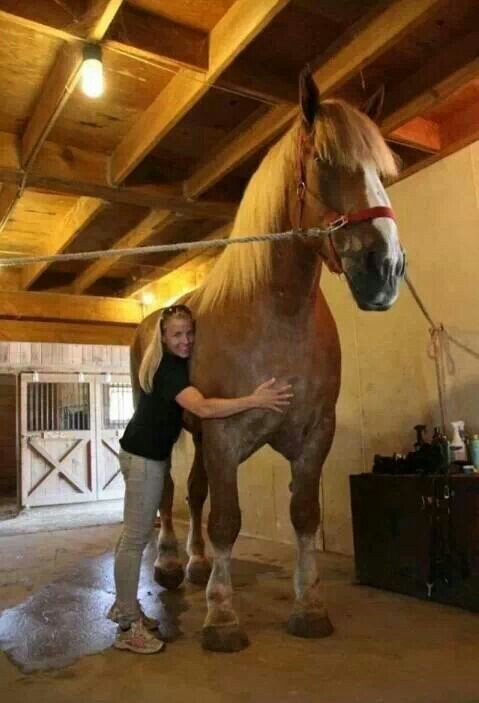
I never made a post about draft horses. :T They are the gentle giants of the horse world, sometimes growing as large as 20 hands and over 2000 lbs. The tallest horse in the world is an American-type Belgian horse named Big Jake (I think???).

image

A very big (but good) boy!

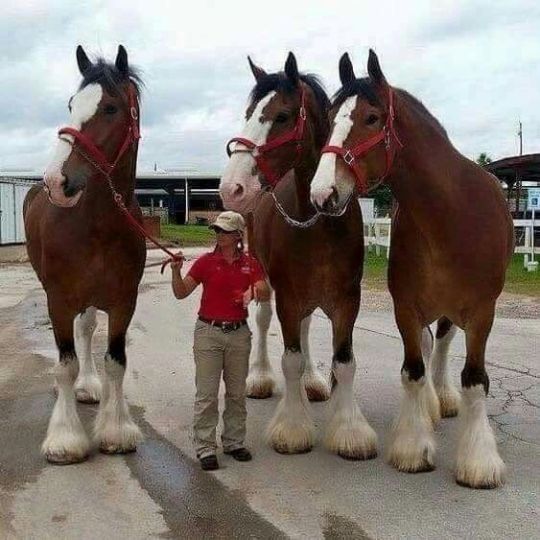
Despite their size, draft horses are known for their quiet, even temperaments, which make them good work horses. They were originally bred to pull wagons and plows, and they still do that. The most famous draft horses are probably the Budweiser Clydesdales, i.e. the horses in those Superbowl commercials that make us cry every goddamn year.

image

Draft horses can be ridden, and they are often crossed with lighter breeds, such as Thoroughbreds and Quarter Horses, to create tall, sturdy-boned, quiet sport horses.

image

Such horses were a common sight during foxhunts, as “hotter” breeds, like Arabians and Thoroughbreds, tend to lose their minds a bit in the chaos of the hunt. Draft horses can also be crossed with Mammoth Jack donkeys to create draft mules, which are also used to pull plows for the Amish.

Mammoth Jack donkey:

image

Draft Mule:

image

There are a lot of draft breeds, some more common than others. Many of the common ones are easy to tell apart from the others, but they’re all large-boned and tall, except for the draft ponies, such as Halflingers and Norwegian Fjord horses.
The Belgian

There are two Belgian horses, one that’s popular in Europe and another that’s very common in the US.

This is the European-type “Brabant” Belgian, which tends to be very thick boned and roan in color.

image

This is the American-type Belgian, which is lighter-boned and always sorrel/palomino in color:

image

Here is a Brabant Belgian mare pulling some shit:

A lot of draft horses really do enjoy pulling stuff, as much as a horse CAN enjoy doing anything that’s not eating grass and farting. Horse pulls are a common sight in Middle America, often done using Belgian horses. Here’s one of a team pulling 9200 lbs. They pull for a very short period of time, often only a few seconds.

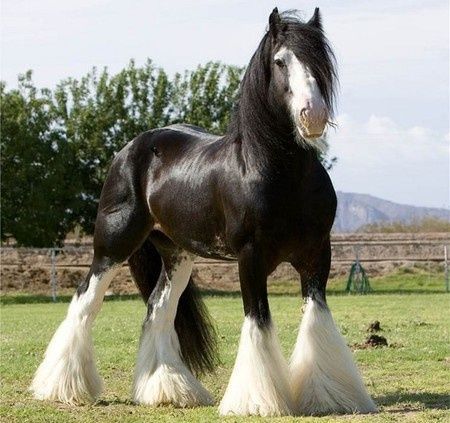
Next up is the Percheron, which has a similar body type to the Belgians but are always black or dapple. They can be slightly more spirited than Belgian horses, with some demonstrating high stepping action.

image

They are not to be confused with Friesians, who have much more “feathered” legs and feet (long hair around the lower legs) and are lighter-boned. Friesians also don’t come in dapple colors, like the horse at the top of this post.

Clydesdales

Clydesdales are recognizable because they are a) always bay colored and b) almost always have four white socks and a blaze on their faces. They also have much more feathering on their legs than Percherons or Belgians. Clydesdales are more common in parades and the like because they tend to be slightly lighter than Percheron and Belgians, and because of this, they’re more agile and “showy”. You probably would not want to plow with a Clydesdale. You could, but their feathering means their feet get dirty much easier than a Belgians might.

image

Shire Horse

Shires come in a variety of colors, usually black or bay, and they are probably the most “feathered” horses of the popular breeds. They’ve got lots of fur on their feet.

image

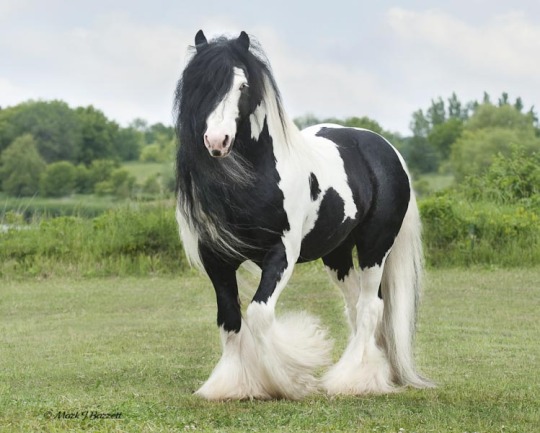
Gypsy Vanner Horses

Gypsy Vanner horses got their start pulling Roma wagons, but now they’re mostly used in fantasy photoshoots, and you can see why. They are beautiful horses, definitely not the type you’d want toiling in the muck. They are almost always paint colored, which distinguishes them from Shire horses.

image

These are the main, most popular and commonly seen full-sized draft breeds, at least in the US. However, there are also draft ponies, the most popular of which is the Halflinger, which resembles a shrunken Belgian horse. They are ALWAYS sorrel/palomino colored, but their frame can vary. Some Halflingers are lighter-boned and more suitable for riding. Others are thicker-boned and better for pulling.

image

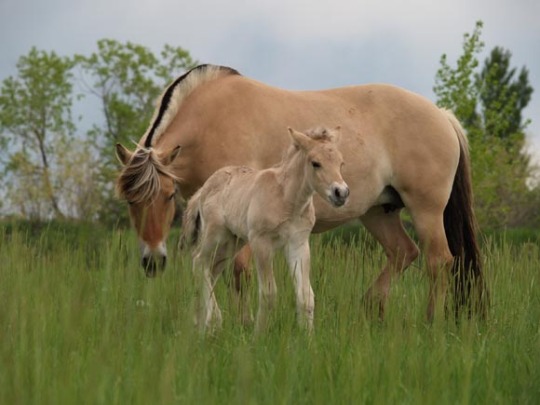
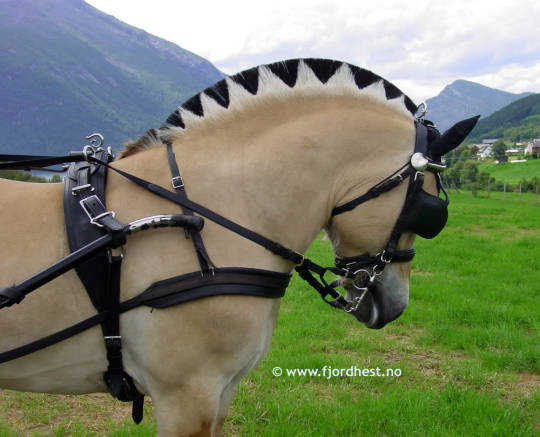
The other unmistakable draft pony is the Norwegian Fjord, easily recognized by the black stripe in the center of its mane, like a reverse ice cream sandwich.

image

This can lead to some creative hair cuts

image

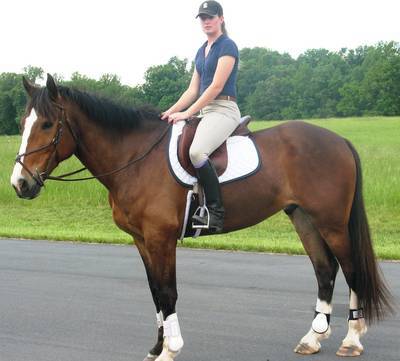
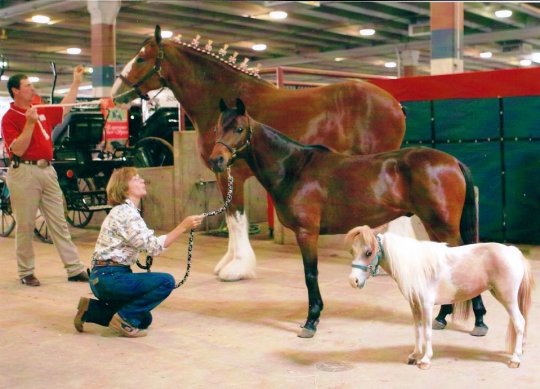
So there you go. That’s a somewhat comprehensive review of draft horse breeds. Here is a size comparison for funsies, with the average riding horse in the middle.

image

the bigger they are the bigger they are

@elodieunderglass

There was a time in my life where I had to choose whether I would marry Dr Glass and move to England OR take on the functional ownership of a chubby Clydesdale named Belle, who had aspirations of dressage, and riding her was exactly like sitting on an overstuffed couch. I’m happy with how my life turned out but then I see photos like these and I mope around for ten minutes regretting my total lack of Clydesdales and my inability to ever get any. And my husband points out that that is an INCREDIBLY UNREASONABLE life expectation, and I’m just like “well SOMEBODY has to own all these clydesdales”

That’s not the ‘average riding horse’ in the bottom picture.  Looks like a large pony, actually, assuming the people in the picture are not, in fact, 7 feet tall.  The average riding horse is probably 15 to 16 hands high; the average draft is 16 to 19 hands high (4 inches to a hand).  I’m 5′4″ and my horse is 15.3, and I can look over his back when standing flat-footed beside him.

Also I’ve ridden both a Belgian warmblood and a Percheron.  I even jumped the Belgian.  That was a hell of a workout; she was so big it felt like I had to do half the jumping for her, like she didn’t just pop neatly over the jumps, you best have that leg on her and be urging her up and over.  Also mildly uncomfortable, hitting the ground that hard.

Jumping a Belgian! I’m actually not that good with horses (just a casual/ fake horse girl) but even I can recognise the impressiveness of that feet.

God, “jumping a Belgian” sounds almost absurd, like “flying a crocodile” – though TBF dressage on a chubby Clydesdale was a bit like trying to parallel park a blue whale.

You’re absolutely right about the “average” riding horse being bigger than that! although it might be the MEDIAN riding horse – given the preponderance of children’s lesson horses….! ( /joke) I think OP may have been misled by looking at the distance between them, it’s kind of an optical illusion if you don’t look at the lady.

and for those who don’t know how to tell hands by eyeballing, riding horses are usually about the size of the Mammoth donkey, maybe a little smaller (proportions are weird.)

fiftysevenacademics:

elf-kid2:

fiftysevenacademics:

publius-esquire:

whatagrump:

I think we’ve all had enough of the many amrev RPFs that describe guys as smelling like smoke and gunpowder and whatever other boring manly scent. So in an extension of that post about wigs and hair powder, I thought I’d write something brief about pomatum. At the Colonial Williamsburg wigmaker, @azulaludgate, @runawayforthesummer and I sniffed two different types of pomatum: one made from pig’s fat, the other from sheep’s. As has been pointed out, pomatum is heavily scented with things like jasmine, roses, nutmeg, clove oil, lemon, etc. 

From what I can recall, the sheep’s fat pomatum contained white wine, apples, and jasmine, among other things, and smelled pretty much like a really nice candle. The pig’s fat one had a warmer, spiced scent to it. I can’t say for certain what the combined smell of unwashed hair, pomatum, and powder would be like, but it’s worth bearing in mind that most people’s hair adjusts pretty quickly if they stop washing it with shampoo.

I know the popular wisdom is that people in the 18th-century reeked and used perfume to cover up their horrible odors, but as was explained in the original wigs post, pomatum served a purpose beyond masking one’s scent, so I wouldn’t go ahead and assume that everyone’s hair smelled terrible. The pomatum is also not an overwhelming scent, it’s relatively subdued. Also! Most of the descriptions of pomatum/pomade that you’ll find online will bring you to posts about women’s hair, but make no mistake: men were using this scented pomatum as well, though I’m not sure if the scents were ever gendered (somehow I doubt it).

tl;dr Writers of amrev RPF, especially writers of romantic stories (*cough*lams*cough*) might want to consider incorporating some of the more pleasant scents of the 18th-century into their writing, and admit to themselves that a lot of these guys just smelled like your grandma’s house. 

Everything I’ve read suggested that there were no real gendered fragrances during this time in the 18th century – whether for pomatum or for perfumes in general – and that both women and men used the same floral essences. 

Until, you guessed it, the 19th century, when floral became associated with feminine and men started applying their fragrances more subtly and used sharper “rugged” “manly” scents like woodland fragrances. 

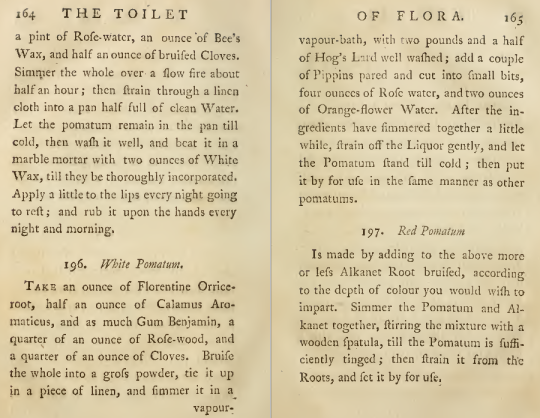
Yes, this is true. Pomatum AND hair powder (which was also very highly scented) were non-gendered– everyone used the same stuff. I don’t know what recipe they use at Williamsburg, but here is a recipe for one that contains apples:

image

As for smelling bad… Bathing was somewhat a matter of personal preference and affordability. A full bath required a lot of water to be drawn and heated, so enjoying a daily bath in your own home was a rare luxury that only a few, mostly slave owners, would indulge in. Others came up with ingenious ways to take daily baths, such as the guy who figured out how to rig up a shower by pulling a lever, and the guy who could afford to have water piped into a bathtub. Other people with access to a river or lake enjoyed swimming every day. In Europe, public baths WERE a thing. I am not sure how many of these operated in America. Regardless, people kept clean. To quote Orange is the New Black, they washed “tits, pits, and bits” every day, whether they lived in America or Europe.

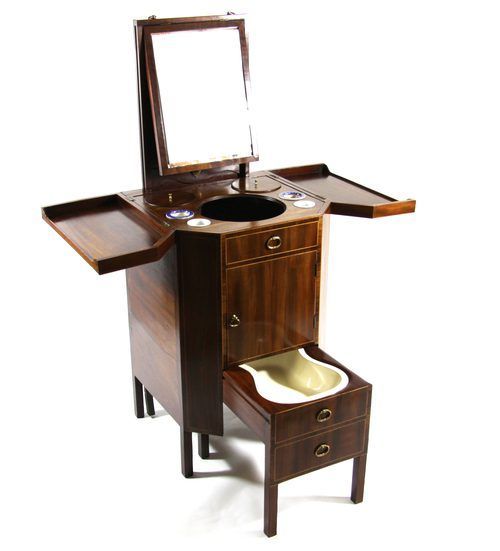
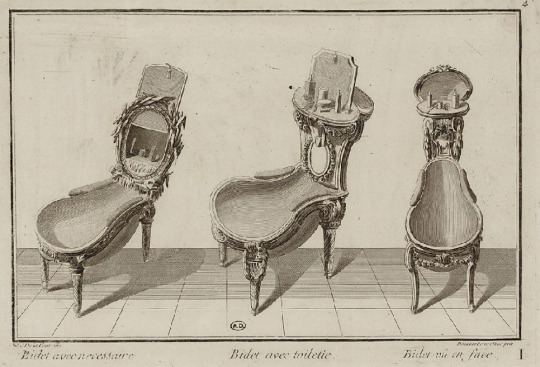
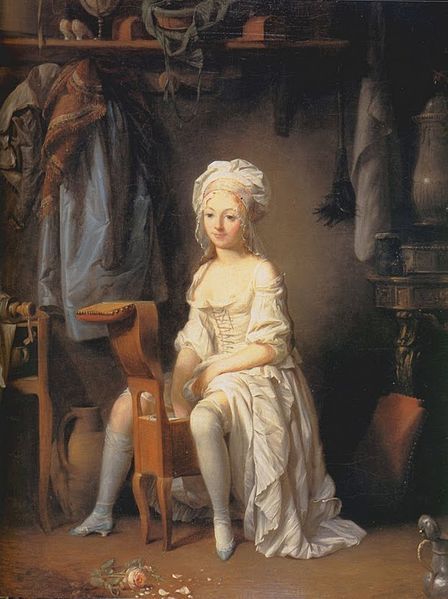
In Europe, people used these early bidets to attend to the most relevant personal hygiene:

image
image
image

Did they have deodorant? No. But in reality, people don’t smell that bad if they wash the relevant parts at the end of the day. Fresh sweat doesn’t smell. It’s bacteria that grows in old sweat that stinks, and as long as you keep your sweatiest parts clean, you won’t smell that bad. 

Mind you, contemporary Americans are ridiculous. They think that unless you literally reek of chemicals, if you have the slightest trace of natural human scent, that you stink. That’s our problem. We need to get over it.

Also, part of the hygiene standards of the time involved wearing fresh linen or cottonundergarments, which were changed daily.

In a scientific/historical experiment, a man tried it. He stopped bathing for about a month, but wore clothes comparable to those worn in the eighteenth century and earlier, changing into clean linens (linens being the garments that touched the skin, including both undershirt and underpants) every day. As long as he kept to this routine, he did not smell (this was confirmed by other people he interacted with who were adhering to modern hygiene standards at the time).

Further more, they discovered that when he bathed after adhering to the ‘change your linens’ routine for over a month, bathing caused him to reek. Really stink. It is theorized that this is because it threw off his natural ‘skin/scent rythems’.

Sorry for not providing sources.

Are you thinking of this article, about a historian who replicated personal hygiene practices of the Tudor era? 

People have a lot of misconceptions about hygiene prior to the contemporary era. It’s true that daily immersion bathing was less common from the Middle Ages through the Early Modern era, but that doesn’t mean people were filthy and stinky all the time. People washed, and had other ways of cleaning themselves (such as vigorous rubbing with a linen towel). Sponge baths are just as effective as immersion baths. In the Middle Ages, public bath houses were very popular, and not only for the very rich.

Here’s an article about bathing in colonial America. People used toothbrushes in the eighteenth century and, by the end of the century, included mildly abrasive powders to clean teeth more thoroughly (I saw interesting recipes for tooth powders in a cookbook the other week). 

There is no doubt that frequent bathing disrupts the skin’s natural microbiome. Because for so long we’ve assumed that bacteria=bad, frequent cleaning with harsh soap=good, we haven’t learned enough about the natural ecology of human skin. How many dermatological problems are the result of destroying the microbiome? How much body odor is the result of the same? There’s some research on this but nothing definitive. Doesn’t stop people from trying to market products though, and this writer for the New York Times did an experiment with one of them

Soap and shampoo-free washing got trendy after BoingBoing picked up on this post. And here’s a Reddit thread about a household that has been showering with water only– no soap or shampoo.

In short, we overestimate what it takes to stay clean, reasonably fresh-smelling (i.e. like a clean human, not stinky artificial scents), and to keep the skin healthy. In fact, our obsession with cleanliness and smell might be doing some harm to our skin.

chroniclesofrettek:

petermorwood:

his-quietus-make:

mumblytron:

severalowls:

did-you-kno:

Medieval castle stairs were often built to ascend in narrow, clockwise spirals so right-handed castle defenders could use their swords more easily. This design put those on the way up at a disadvantage (unless they were left-handed). The steps were also uneven to give defenders the advantage of anticipating each step’s size while attackers tripped over them. Source Source 2 Source 3

Not really the best illustration since it totally negates the effect by having a wide open space for those ascending. Castle tower staircases tended to look like this:

Extremely tight quarters, with a central supporting pillar that is very, very thoroughly in the way of your right arm.

Wider, less steep designs tend to come later once castles moved away from being fortresses to simply noble family homes with the advent of gunpowder.

Oh! Pre-gunpowder military tactics are my jam! I don’t know why, but this is one of my favorite little details about defensive fortifications, because the majority handedness of attackers isn’t usually something you think about when studying historical wars. But strategically-placed walls were used basically worldwide as a strategy to secure gates and passages against advancing attackers, because most of the world’s population is right-handed (and has been since the Stone Age).

Pre-Columbian towns near the Mississippi and on the East coast did this too. They usually surrounded their towns with palisades, and they would build the entrance to the palisade wall in a zigzag – always with the wall to the right as you entered, to hinder attackers and give an advantage to the defender. Here’s some gates with some examples of what I’m talking about:

image

Notice that, with the exception of the last four (which are instead designed to congregate the attackers in a space so they can be picked off by archers, either in bastions or on the walls themselves) and the screened gate (which, in addition to being baffled, also forces the attackers to defend their flank) all of these gates are designed with central architectural idea that it’s really hard to kill someone with a wall in your way.

In every culture in the world, someone thought to themselves, “Hey it’s hard to swing a weapon with a wall on your right-hand side,” and then specifically built fortifications so that the attackers would always have the wall on their right. And I think that’s really neat.

Ooh, ooh, also: Bodiam Castle in Sussex used to have a right-angled bridge so any attacking forces would be exposed to archery fire from the north-west tower on their right side (ie: sword in the right hand, shield on the useless left side):

These tactics worked so well for so long because until quite recently lefties got short shrift and had it trained (if they were lucky) or beaten out of them.

Use of sword and shield is a classic demonstration of how right-handedness predominated. There’s historical mention of left-handed swordsmen (gladiators and Vikings), and what a problem they were for their opponents, but that only applies to single combat.

A left-handed hoplite or housecarl simply couldn’t fight as part of a phalanx or shield wall, since the shields were a mutual defence (the right side of the shield covered its owner’s left side, its left side covered the right side of his neighbour to the left, and so on down the line) and wearing one on the wrong arm threw the whole tactic out of whack.

image
image

Jousting, whether with or without an Italian-style tilt barrier, was run shield-side to shield-side with the lance at a slant (except for the Scharfrennen, a highly specialised style that’s AFAIK unique.) Consequently left-handed knights were physically unable to joust.

image

There’s a creditable theory (I first read it in “A Knight and His Horse”, © Ewart Oakeshott 1962, 1998 and many other places since) that a knight’s “destrier” horse – from dexter, “right” – was trained to lead with his right forefoot so that any instinctive swerve would be to the right, away from collision while letting the rider keep his shield between him and harm. (In flying, if a pilot hears “break!” with no other details, the default evasive direction is right.)

The construction of plate armour, whether specialised tournament kit or less elaborate battle gear, is noticeably “right-handed“ – so even if a wealthy knight had his built “left-handed” it would be a waste of time and money; he would still be a square peg in a world of round holes and none of the other kids would play with him.

Even after shields and full armour were no longer an essential part of military equipment, right-hand use was still enforced until quite recently, and to important people as well as ordinary ones – it happened to George VI, father of the present Queen of England. Most swords with complex hilts, such as swept-hilt rapiers and some styles of basket-hilt broadsword, are assymetrical and constructed for right handers. Here’s my schiavona…

image
image

It can be held left-handed, but using it with the proper thumb-ring grip, and getting maximum protection from the basket, is right-handed only. (More here.) Some historical examples of left-hand hilts do exist, but they’re rare, and fencing masters had the same “learn to use your right hand” bias as tourney organisers, teachers and almost everyone else. Right-handers were dextrous, but left-handers were sinister, etc., etc.

However, several
predominantly left-handed

families did turn their handedness into advantage, among them the Kerrs / Carrs, a notorious Reiver family along the England-Scotland Borders, by building their fortress
staircases with a spiral the other way to the OP image.

image

This would seem to be a bad idea, since the attackers (coming upstairs) no longer have their right arms cramped against the centre pillar – however it worked in the Kerrs’ favour because they were used to this mirror-image of reality while nobody else was, and the defender retreating up the spiral had that pillar guarding his right side, while the attacker had to reach out around it…

For the most part Reiver swords weren’t elaborate swept-hilt rapiers but workmanlike basket-hilts. Some from Continental Europe have the handedness of my schiavona with thumb-rings and assymmetrical baskets, but the native “British Baskethilt” is a variant of the Highland claymore* and like it seems completely symmetrical, without even a thumb-ring, which gives equal protection to whichever hand is using it.

image

*I’m aware there are those who insist “claymore” refers only to two-handers, however the Gaelic term claidheamh-mòr
– “big sword” –

just refers to size, not to a specific type of sword in the way “schiavona” or “karabela” or even “katana” does.

While the two-hander was the biggest sword in common use it was the
claidheamh-mòr; after it dropped out of fashion and the basket-hilt became the biggest sword in common use, that became the
claidheamh-mòr.

When Highlanders in the 1745 Rebellion referred to their basket-hilts as claymores, they obviously gave no thought to the confusion they would create for later compilers of catalogues…

Also, muskets had their whole “Flint and steel and gunpowder” thing on the right side so if you tried firing it lefty you’d get a face full of fire. More recently, rifles eject their spent shell casings to the right, so if you’re a lefty you get some hot metal in your eye.

Okay Silm Fandom, this has to be relevant to your interests 

Looking at you, left-handed wonder @doegred

giancarlovolpe:

sweetsarsaparilla:

halfarsedhermit:

Spent the last two days working on this little archery guide in art and writing. Considering the rise in popularity of archers in pop culture this hopefully  comes in handy for a bunch of fandoms.

For anyone who wants to draw the Hanzo

Gonna need this later…

Historical Periods of Númenor

anthropologyarda:

  • Foundation Period – The reign of Elros

    Tar-Minyatur (SA 32-442)

  • Classical Period – Ta-Vardamir to Tar-Meneldur (SA 442-883)
  • Colonial Period

    – Tar-Aldarion to Tar-Minastir; also called the Early Middle Period, the Age of Sail, or the Eldarin Alliance period   (SA 883 – 1869)

  • Imperial Period – Tar-Ciryatan to Tar-Alcarin; during this period the King’s Men and the Elendili factions are established between SA 2221 – 2386. Also includes Anducal’s Uprising and the Reign of the Illegitimate Sovereign, or the Time of the Unseated King; sometimes called the Late
    Middle Period  (SA 1869 – 2737)
  • Adûnaic Period – Ar-Belzagar to Ar-Gimilzôr; usually divided into early, high and late eras  (SA 2737 – 3177)
  • Revival Era – Tar-Palantir, sometimes referred to as the Days of Restoration by Faithful historians  (SA 3177
    – 3255)
  • Avalôiyada Period – Ar-Pharazôn’s reign (SA 3255 – 3319)
  • Akallabêth Period – Fall of

    Númenor to the death of Elendil (and sometimes his sons), historiography of the Kingdoms in Exile begins (SA 3319 – 3441)

Design a site like this with WordPress.com
Get started