Johaness Liechtenauer’s teachings preserved in the Zettel mention that ‘you shall not hold to any position other than solely to the four which will be named here’, in reference to the four main guards, or vier leger, Pflug, Ochs, Vom Tag and Alber. But other sources and fencing masters, particularly later ones, do mention quite a few other secondary guards for longsword. There are some variations and discrepancies between authors of course, as well as different interpretations among contemporary researchers.
Many, if not most of these are considered only transitional guards, so just particular positions while in motion from one to another primary guard or end point of a strike, cut or thrust. In no particular order, these are the ‘other’ longsword guards mentioned in the treatises of the German fencing tradition between approximately 1390 and 1570:
Zornhut – wrathful guard
Langort – longpoint
Mittelhut – middle guard
Wechsel – the changer
Hengetorte – hanging point
Nebenhut – close/side guard
Schlüssel – the key
Einhorn – unicorn
Eisenport – iron door
Brechfenster – breaking window
Schrankhut – barrier guard
Kron – the crown
Zornhut (Wrath)
Zornhut, or Zorn-Hut, is the Wrathful Guard, a left-food forward guard that holds the sword over the rear shoulder so that the flat touches the shoulder and angles slightly backwards, allowing you to deliver powerful ‘wrathful’ strikes. Alternatively the sword can be held slightly above the shoulder and angled back. Typically the sword points down to the floor, though some fechtschule illustrations show it pointing upwards. Even though the Zornhut looks like a variant of Vom Tag, Joachim Meyer tell us that you can do all the techniques from Ochsfrom Zornhut. Roger Norling mentions that the Zornhut is a guard that can be found in Wilhalm, Erhart, Sollinger, Meyer, Sutor, Verolini and possibly Czynner. Michael Chidester suggests that 16c Germans might have noticed fencers incorrectly ‘chambering’ their sword backwards from Vom Tag to deliver Zornhaw (a powerful cut delivered diagonally downwards from the shoulder), and knowing the the Italians had a similar guard (Posta Di Donna) they decided to just give this position a new guard name in the German fencing tradition. In a contemporary setting if you see people using this guard it’s more often than not Meyer fanboys.
Langort (Longpoint)
Langort, or Lang Ort/Langen Ort, “the noblest and the best ward with the sword” is a point online guard held with the point forward and slightly upward toward the face of the opponent, shown in later German treatises as illustrated above, right foot forward, though earlier masters such as Sigmund Ringeck and Pseudo-Peter Von Danzig indicate that it should be left foot forward: “Before you come too close to him in Zufechten, set your left foot
forwards and hold the point towards him with outstretched arms towards
the face or the chest.(MS_Germ.Quart.2020_052r)“ Ringeck also specifies that this guard is called the Sprechfenster, if your
opponent binds with you, as does, among others, Hans Döbringer, who says that you are standing at the sword with your opponent and that you should feel what he intends. Keith Farrel concludes in this article that to Ringeck then, it seems that the Langort is a
position when you have not been bound, and Sprechfenster is when you
have been bound, whereas Pseudo-Peter Von Danzig treated the terms Langort and Sprechfenster as more or less interchangeable. As Martin Fabian puts it, Langort is one of the most used positions in longsword fighting nowadays, and for good reason.
Mittelhut (Middle)
In this Middle guard, like the Nebenhut, the blade sits back facing away and behind from oneself with the long edge aimed at the opponent, but raised up to shoulder level with the sword extended in preparation to strike. It can be done on both the left, with right foot forward, and the right side, with left foot forward. It is depicted sometimes as having the point slightly upwards rather than completely horizontally, though according to Mike Cartier the point should slight point to the ground instead. It can be described as both the beginning and the end point of a Mittelhau.
Wechsel (Changer)
Wechsel, or Wechselhut, is known as the Changer, a guard with the hilt next to the abdomen, the point hanging downward to the side at a right angle to the opponent. It is the natural end point for a diagonal full cut through the target, such as the Zornhau. Left Wechsel has right leg forward and the sword on the left side of the
body, with the short edge facing forward toward the opponent. Right Wechsel has the left leg forward, sword beside the body, again with the
short edge toward the opponent. The Wechsel as a guard is not named explicitly in the earlier sources, but a position that looks like it is shown on several occasions, such as Hans Talhoffer’s Cod. icon. 394a.
Hengetorte (Hanging point)
Hengetorte, or Hangetort, or Hanging Guard, at a glance looks simply like a slightly downwards pointing Ochs guard, but it is used quite differently. Ochs is a threat with the point towards the opponent and prevents attacks
on the same side as you have your hands, so an arms-uncrossed Ochs on your left with the right foot forward closes your left opening from attacks, from a right Oberhau for example, whereas the Hangetort, which is typically a displacement rather than a static guard, primarily prevents attacks on the opposite side of your body from where
you have your hands, so that same arms-uncrossed with the right foot forward Hangetort points offline to your right, and closes the opening from attacks on your right, from a left Oberhau. In this drill we show both sides of this guard:
In terms of naming conventions, it doesn’t perhaps help that the Ochs guards are also referred to as the two upper Hangers from the Vier Hengen (the right and left Ochs are the Oberhangen, combined with the right and left Pflug, or Underhangen), which are not the same positions as the actual Hanging Guard, since the Four Hangers all point forwards towards the opponent. Inevitably during practice in an English-speaking environment either of these guards ends up being called ‘Hanging’ or ‘Hanger’ which can cause confusion. As far as the present-day popularity of this guard is concerned, just watch this sparring video by Blood & Iron, a hard training and competitively successful group, and count how many times the Hangetort is used to parry overhead strikes, compared with parries with the more traditional Ochs guard for example. It clearly is a very effective position to safely counter from.
Nebenhut (Close/Side)
The Nebenhut, or Close, Side or even Tail Guard, is similar to the Wechsel, with the grip of the weapon at hip height, but with the tip extending back and down. Being an ideal starting point for an Unterhau, the Nebenhut on the left side with the right foot forward is one possible endpoint of a Zornhau/right Oberhau, and the one on the right flank with the left foot forward, that of a left Oberhau. In both cases the long edge faces forward toward the opponent, and the tip of the sword points backwards. Ringeck advises the use of Nebenhut only on the left, because from the right it is not as safe. Jeff Ross suggests in this interesting analysis that there is no historical evidence that the Nebenhut is, as commonly thought, a Tail Guard (like the Italian Posta Di Coda Lunga), but rather that it is actually the same guard as Schrankhut or Eisenport, since several treatises offer essentially identical instructions for a number longsword plays, differing only in the name given to
the starting guard involved: Nebenhut in some cases, Schrankhut or Eisenport in the others. Regardless of what the original usage was, I think it’s fair to say that the Nebenhut is generally executed nowadays (perhaps incorrectly?) as a Tail Guard.
Schlüssel (Key)
Jakob Suttor tells us that to be in Schlüssel you stand with ‘your left foot forward and hold your sword with the hilt and hands
crossed in front of your chest such that the short edge lies on your
left arm and the point stands against the opponent’s face’. A posture from which Meyer describes some plays involving thrusts and cuts, though it does not appear named in earlier sources. There isn’t perhaps an enormous repertoire available from this position, but there are nevertheless some useful techniques and transitions, as Björn Rüther demonstrates in this handy short video.
Einhorn (Unicorn)
Einhorn or Einkiren/Einkhiren is described by Mair as [once you bind with your opponent with the right foot forward], you ‘wind your long edge on his long, drop downward with your short edge at
your right side, and step well in towards him in the bind. (…) Then immediately wind around and
through, invert your hand and grab around the pommel such that you stand
in the Einkhiren and then stab with your point to his face or
chest.’ Meyer, once again doing things slightly differently states, ‘strike in powerfully and high at his left ear with the flat or short
edge… Thus you force him to go upward rapidly; as soon as he does this,
then release your left hand from the pommel, and let your blade snap
around in one hand up from below against his right, and plant the point
on his chest; meanwhile grab your pommel again… Jab at him thus with
reversed hand’. Anders Linnard, in his video description of the Edel Krieg (or Noble War with a reversed grip, one of Ringeck’s counters to Krumphau), shows us a play interpretation which illustrates one of the ways to end up in what I believe to be that Einkleren guard described by Mair:
Though it might resemble Fiore’s Posta Di Bicorno, Brian Kirk in this comparative analysis maintains that the two guards are fundamentally different, as the Einhorn sometimes requires that you actually let go of the sword with the left hand, let
the sword rotate in the right hand only, and then re-grip reversed, with
the left hand.
Eisenport (Iron door)
Like some of the other guards, it is worth mentioning that Eisenport, or Eysen Pforte (or eiserin pforte/eyserynen pforten/eysnen pforttn), the Iron Door, exists in two or more variants; with the point upwards, as described by Meyer, or with the point downwards, as described by apparently everyone else. Meyer tells us to stand with our right foot forward, hold our sword with the grip in front of the knee, with straightly hanging arms, so that our point stands upward out at our opponent’s face. He refers to this as the Italian posture Porta Di Ferro [Alta], as illustrated above by Marozzo, and mentions that since thrusting with the sword is abolished among Germans, this guard is not much in use by then. It’s roughly midway between Pflug and Langort.
The other numerous versions of Iron Door in the older German texts are described as a variant of Alber, with the point offline to either the left or the right (halfway between Alber and Wechsel), or in a
manner similar to Schrankhut on the right side (or the Italian Tutta Porta di Ferro), with wrists uncrossed and the point offline, or even interchangeably with Nebenhut according to Ringeck. Iron Gate is referred to as ‘the best of all techniques‘ and particularly effective when facing several assailants, more specifically impertinent peasants.
Brechfenster (Breaking window)
Brechfenster or Prechfennster (breaking / speaking window), is, according to Paulus Hector Mair, to ‘stand with your right foot forward and hold your hilt in front of your
head such that your thumbs are underneath, with the point high on your
right side, and looking at the opponent between the arms’. Mair mentions that if you stand in the Pflug and your opponent throws a Scheitelhau, you can wind up into the Brechfenster
so that you are looking out through the arms with the right foot
forward, to then drop down and strike in with the half edge to the left
ear (zwerchhau). Something similar is shown by Jörg Wilhalm Hutter in Cod.I.6.2º.2_21v. That upwards displacement description sounds a lot like going into Kron, right? In the section on the Schaeitelhau, Mair specifically mentions ‘When he then does the Schaitler to you, displace it with the Kron such that the point and the hilt of your sword both stand above
you‘. From what I can tell the difference being that the Kron is an active parry with regular grip, and not a thumb grip like in the Brechfenster, and that the hands are held higher, aside from the fact that the Brechfenster does not require you to necessarily be in contact with the opponents blade. It seems like an unusual longsword guard, but it does appear in contemporary settings (if practicing with minimal gear and aiming for high targets for example, or people that both zwerch and feint a lot). It’s sort of the mid-point between Vom Tag and the end point of a Zwerchhau.
Schrankhut (Barrier)
The Schrankhut, or Schranckhut, is the Barrier Guard, described by Pseudo-Peter Von Danzig on the left side as ‘setting
your right foot forward and holding your sword with the point to the ground
near your left side with crossed hands such that the short edge of the
sword is above and give an opening on your right side’, and on the right it’s ‘standing with your left foot before and holding your sword with the point
near your right side on the earth (so that the long edge is above), and
giving an opening with the left side’. Several masters consider this guard interchangeable with the not-so-backwards-pointing version of Nebenhut.
Joachim Meyer shows the Schrankhut as a left foot forward Crossed
Guard, as seen above, a position with the hands low and forward, with
the point forward towards the ground, similar to Hengetorte but with
both hands and weapon lower. Meyer also refers to this guard as
Eisenport, or Iron Gate, which is a bit interesting considering that elsewhere he refers to Iron Gate as the point-up Porta Di Ferro Alta-looking guard.
Kron (Crown)
In Kron, the
sword hilt is held out about head height with the point up. It’s a high parry using the crossguard horizontally, with a regular sword grip. More than an actual guard, Kron is a defensive move in which you lift your sword vertically to catch a descending strike, often described as the best parry against a Scheitelhau, on the cross. Kron is used
at the bind and can be a prelude to grappling. The few unequivocal images we have of Kron, like the one above from Ringeck, are always about how to break it with Unterschnitt/Abschneiden, so it doesn’t come across as a position of the utmost interest to the authors.
Some eminent chaps argue the possibility that what we see in Mair and Falkner described as Kron is not the fighter above on the right, but rather the one on the left, with a halbschwert (half-sword) grip against an incoming strike. Contemporary historical fencers certainly use both moves, but in the halls I train in, virtually everyone only calls Kron that parry or bind with the high crossguard forward. I personally call the other half-sword one “Shit, there goes Dave again”.
This post exists mostly because I couldn’t find a comprehensive comparative listing of all these different versions of the non-core Liechtenauer guards online in one place to share with my training partners. Meyer’s terminology in particular is relatively divergent from the earlier sources in the German longsword tradition, but well described and illustrated, so there are quite a few articles exclusively about his works, such as the ones in the Meyer Freifechter Guild, the Meyer Free Scholars Guild and Wiki or even the Scholars of Alcala Meyer study, but for the pre-16th century guys, not so much. There’s ARMA’s basic guards of medieval longsword , which seems maybe a bit outdated, as far as the current understanding of the sources goes, but aside from chapter 4 in Keith Farrel’s German Longsword Study Guide (which is an excellent book btw that you should totally buy), I couldn’t find all of these positions within the German school, ranging from Hans Döbringer to Jakob Suttor, in one single easy-to-access online location. This is almost certainly because it’s quite a pain in the arse to do so. I thought this would be another simple copypasta tumblr job but it’s taken ages, and I’m far from having read, captured, and possibly understood, all the different nuances between sources.
All credit to Wiktenauer for most source images and much of the text, in particular the Jeffrey Forgeng’s Fechtkunst Glossary. The KDF Glossary is another great reference point. None of this is primary research of course, this was learnt in the training hall, or by reading other people’s translations, as well as trolling the forums, particularly HEMAA and Schola. Just like any other interpretation in HEMA, there is (some) room for debate in these. I also realise that the minute I post this someone will share a link to an even more comprehensive and better illustrated guide to German longsword guards, but hey, such is life.
Here are some useful resources I’ve found while I’ve been in the community, so I thought I’d share! PLEASE ADD YOUR OWN IF YOU HAVE ANY! And please reblog and share!
References
askmiddlearth – A great blog where you can send in questions and receive answers regarding just about any aspect of the Legendarium.
coco.raceme – A collection of quotes, songs, and important passages from The Hobbit and The Lord of the Rings, arranged by book and chapter.
Fish in Middle Earth – Did you ever want to know what kinds of fish there were in Middle Earth? No? You’ll probably end up reading this anyways. The curiosity will get to you.
henneth-annun – The HASA story archive has mostly moved to AO3 now, but this website still contains hundreds of timelines, character bios, quotes, object descriptions, and more.
silmarillionwritersguild – Essays, meta, biographies, and more – all about the plot and characters of the Silmarillion.
Languages
almare – Tumblr user almare has a great collection of Tolkien language resources, including a handy graphic of the relations between Elvish languages.
councilofelrond – A good resource for translations of canon texts, glossaries, conlang discussions, a dictionary, etc. Of particular interest is their Sindarin mutation chart, which is necessary pretty much whenever you’re stringing more than two Sindarin words together.
Hiswelókë’s – A delightfully thorough dictionary available in a variety of arrangements ( English-Sindarin, Sindarin-English, thematic, etc. ). Available in English, French, and German.
midgardsmal – The blog of David Salo, one of the people who worked on the languages in Peter Jackson’s Tolkien films.
realelvish – A handy phrasebook that provides categories for easy searches, dialects, pronunciation, and multiple translations of the same phrase. Includes fun categories, such as ‘in the bedroom’ and ‘on the internet’, as well as many others that are more in keeping with Tolkien’s tone.
sindarinlessons – A collection of rules, references, and explanations of Sindarin grammar.
your-sindarin-textbook – On this site, a duck teaches you Sindarin. What more could you want? Includes exercises and references.
Books
All the books in PDF – These two posts both contain links to Tolkien’s works and where you can find them online.
HoME reading order – tumblr user lintamande has put together a list of Tolkien’s texts beyond the Silmarillion, in case you were wanting to dip your toes into HoME but didn’t know where to begin. They also have a general Silm resource page that’s worth looking at, as well as all their meta.
Tolkien’s letters – A collection of many of Tolkien’s transcribed letters, useful for all those really obscure facts you need to check and to impress your friends.
Non-Tolkien
A shameless plug– I do my best to collect useful references, notes, and masterposts on writing, Tolkien, and more in my ‘references’ tag.
howtofightwrite– This blog contains discussions on weapons and how they’re used, as well as some particularly useful weapon primers that will give you the basics on the weapons your character uses.
Medieval references – A collection of a few useful references for medieval-type jobs, terms, and more.
Mood music – Themed music playlists for just about anything you could ever want to write.
Traveling – The methods of traveling in the Middle Ages, and the time it would require.
Adding links for the Lord of the Rings Family Project, which has the best set of genealogies hands down and I constantly reference it.
Ardalambion is a high quality language resource and has extensive wordlists. Good for obscure languages like Nandorin and Taliska. It’s more in-depth than a dictionary and has notes on in-universe and out-universe history for the languages.
Textual Ghosts Project, a list of unnamed and missing female characters from Tolkien’s works.
Notes: some of the book links don’t work any more.
The working link for OP’s resources tag is now here.
This is really useful! Thanks to OP for collecting these! (I totally looked at the fish essay.)
Here’s a general rule: People in the past were ignorant about a lot of things, but they weren’t stupid. If they used something, chances are they had a good reason. There are exceptions, but plate armor is not one of them.
Long Answer:
For a type of armor, no matter what it is, to be considered effective, it has to meet three criteria.
The three criteria are: Economic Efficiency, Protectiveness, and Mobility.
1. Is it Economically Efficient?
Because of the nature of society in the Middle Ages, what with equipment being largely bring-it-yourself when it came to anybody besides arrowfodder infantry who’d been given one week of training, economic efficiency was a problem for the first couple of decades after plate armor was introduced in France in the 1360s. It wasn’t easy to make, and there wasn’t really a ‘science’ to it yet, so only the wealthiest of French soldiers, meaning knights and above, had it; unless of course somebody stole it off a dead French noble. The Hundred Years War was in full swing at the time, and the French were losing badly to the English and their powerful longbows, so there were plenty of dead French nobles and knights to go around. That plate armor was not very economically efficient for you unless you were a rich man, though, it also was not exactly what we would call “full” plate armor.
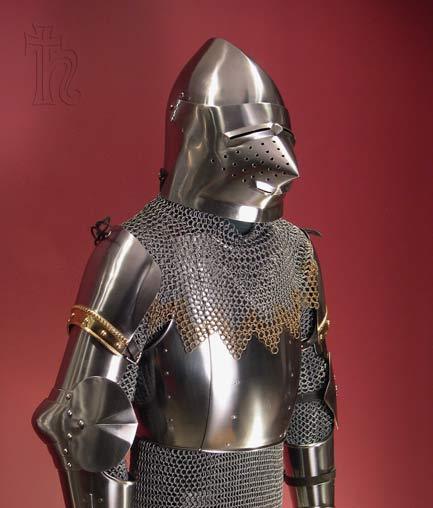
Above: Early plate armor, like that used by knights and above during the later 1300s and early 1400s.
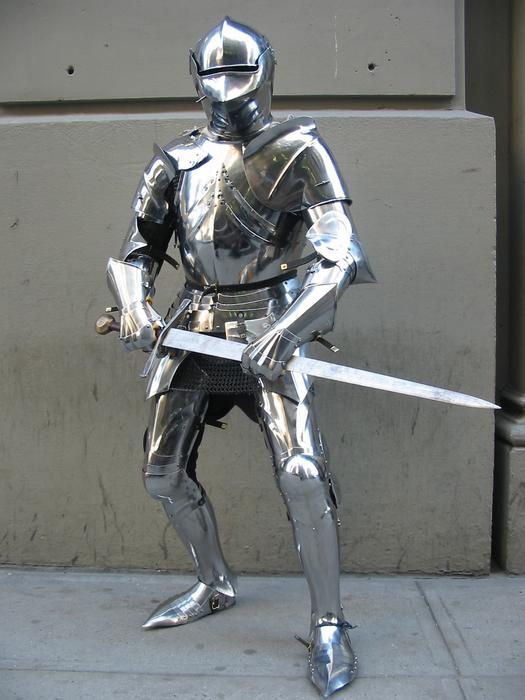
Above: Two examples of what most people mean when they say “full” plate armor, which would have been seen in the mid to late 1400s and early 1500s.
Disclaimer: These are just examples. No two suits of armor were the same because they weren’t mass-produced, and there was not really a year when everybody decided to all switch to the next evolution of plate armor. In fact it would not be improbably to see all three of these suits on the same battlefield, as expensive armor was often passed down from father to son and used for many decades.
Just like any new technology, however, as production methods improved, the product got cheaper.
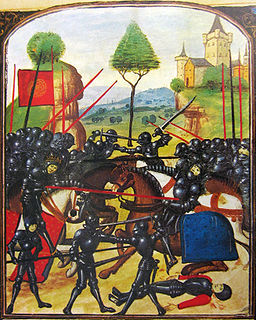
Above: The Battle of Barnet, 1471, in which everybody had plate armor because it’s affordable by then.
So if we’re talking about the mid to late 1400s, which is when our modern image of the “knight in shining armor” sort of comes from, then yes, “full” plate armor is economically efficient. It still wasn’t cheap, but neither are modern day cars, and yet they’re everywhere. Also similar to cars, plate armor is durable enough to be passed down in families for generations, and after the Hundred Years War ended in 1453, there was a lot of used military equipment on sale for cheap.
2. Is it Protective?
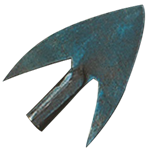
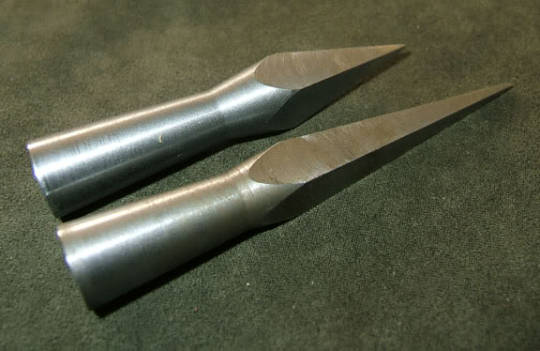
This is a hard question to answer, particularly because no armor is perfect, and as soon as a new, seemingly ‘perfect’ type of armor appears, weapons and techniques adapt to kill the wearer anyway, and the other way around. Early plate armor was invented as a response to the extreme armor-piercing ability of the English longbow, the armor-piercing ability of a new kind of crossbow, and advancements in arrowhead technology.
Above: The old kind of arrowhead, ineffective against most armor.
Above: The new kind of arrowhead, very effective at piercing chainmaille and able to pierce plate armor if launched with enough power.
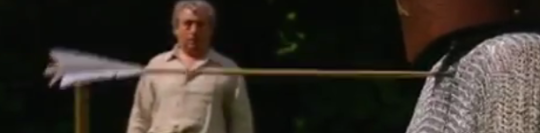
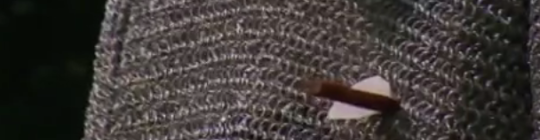
Above: An arrow shot from a “short” bow with the armor-piercing tip(I think it’s called a bodkin tip) piercing a shirt of chainmaille. However, the target likely would have survived since soldiers wore protective layers of padding underneath their armor, so if the arrow penetrated skin at all, it wasn’t deep. That’s Terry Jones in the background.
Above: A crossbow bolt with the armor piercing tip penetrating deep through the same shirt of chainmaille. The target would likely not survive.
Above: A crossbow bolt from the same crossbow glancing off a breastplate, demonstrating that it was in fact an improvement over wearing just chainmaille.
Unfortunately it didn’t help at all against the powerful English longbows at close range, but credit to the French for trying. It did at least help against weaker bows.
Now for melee weapons.
It didn’t take long for weapons to evolve to fight this new armor, but rarely was it by way of piercing through it. It was really more so that the same weapons were now being used in new ways to get around the armor.
Above: It’s a popular myth that Medieval swords were dull, but they still couldn’t cut through plate armor, nor could they thrust through it. Your weapon would break before the armor would. Most straight swords could, however, thrust through chainmaille and anything weaker.
There were three general answers to this problem:
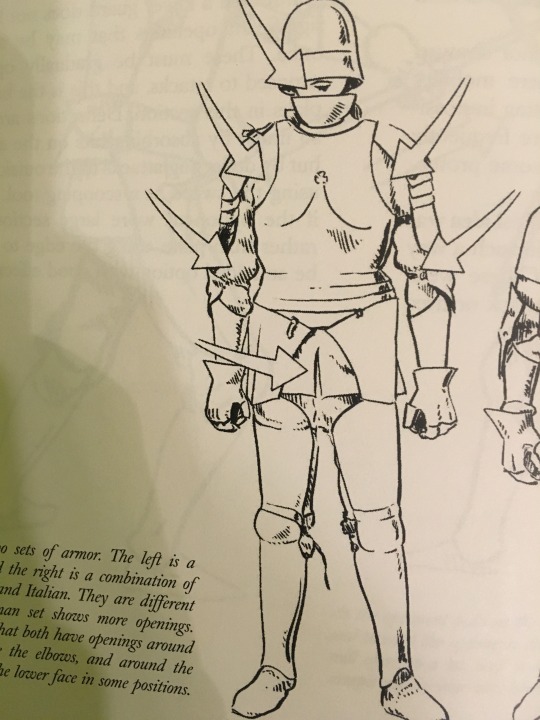
1. Be more precise, and thrust through the weak points.
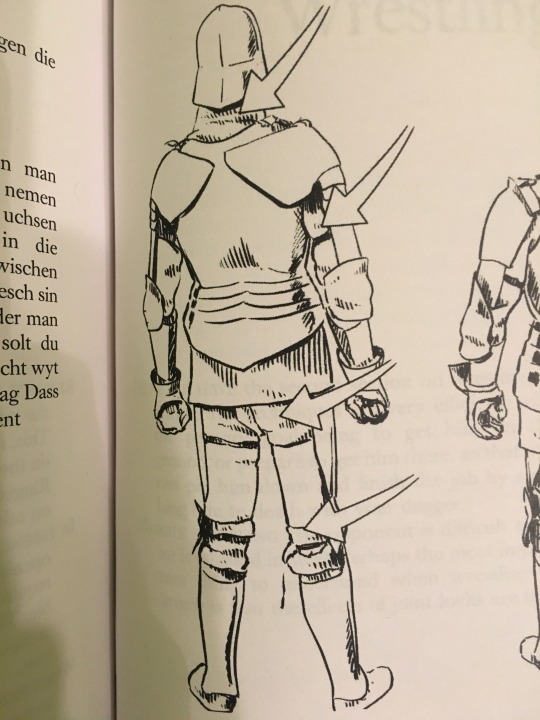
Above: The weak points of a suit of armor. Most of these points would have been covered by chainmaille, leather, thick cloth, or all three, but a sword can thrust through all three so it doesn’t matter.
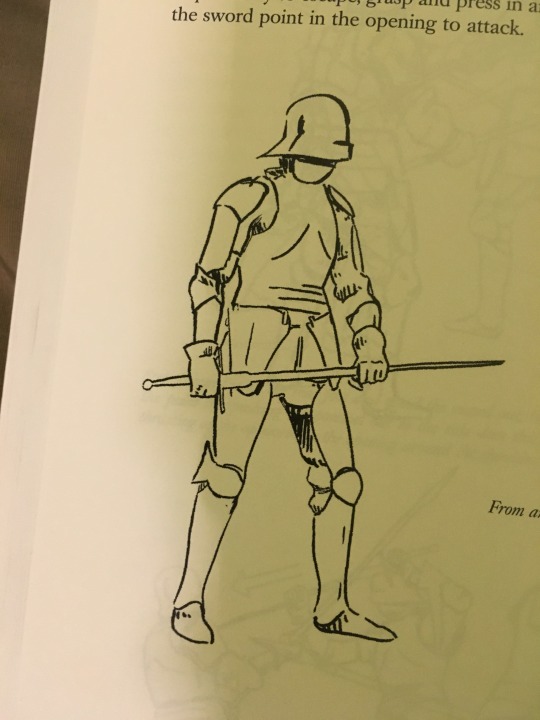
To achieve the kind of thrusting accuracy needed to penetrate these small gaps, knights would often grip the blade of their sword with one hand and keep the other hand on the grip. This technique was called “half-swording”, and you could lose a finger if you don’t do it right, so don’t try it at home unless you have a thick leather glove to protect you, as most knights did, but it can also be done bare-handed.
Above: Examples of half-swording.
2.Just hit the armor so fucking hard that the force carries through and potentially breaks bones underneath.
Specialty weapons were made for this, but we’ll get to them in a minute. For now I’m still focusing on swords because I like how versatile the European longsword is.
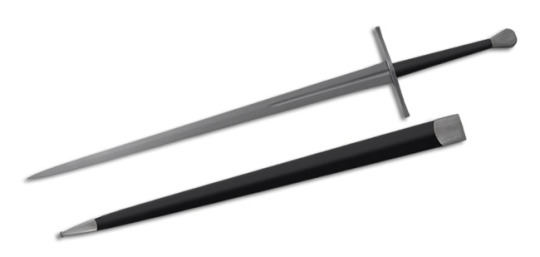
Above: A longsword. They’re made for two-handed use, but they’re light enough to be used effectively in one hand if you’d like to have a shield or your other arm has been injured. Longswords are typically about 75% of the height of their wielders.
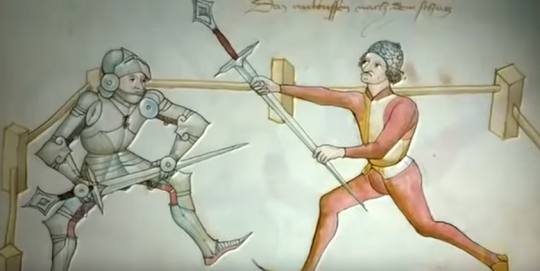
Assuming you’re holding the sword pointing towards the sky, the part just above the grip is called the crossguard, and the part just below the grip is called the pommel. If you hold the sword upside-down by the blade, using the same careful gripping techniques as with half-swording, you can strike with either the crossguard or the pommel, effectively turning the sword into a warhammer. This technique was called the Murder Stroke, and direct hits could easily dent plate armor, and leave the man inside bruised, concussed, or with a broken bone.
Above: The Murder Stroke as seen in a Medieval swordfighting manual.
Regular maces, hammers, and other blunt weapons were equally effective if you could get a hard enough hit in without leaving yourself open, but they all suffered from part of the plate armor’s intelligent design. Nearly every part of it was smooth and/or rounded, meaning that it’s very easy for blows to ‘slide’ off, which wastes a lot of their power. This makes it very hard to get a ‘direct’ hit.
Here come the specialized weapons to save the day.
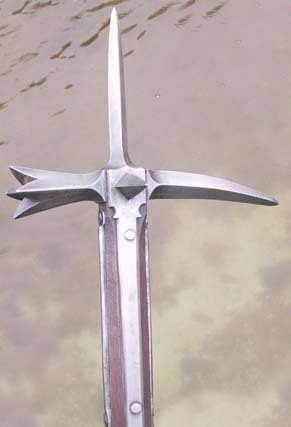
Above: A lucerne, or claw hammer. It’s just one of the specialized weapons, but it encompasses all their shared traits so I’m going to only list it.
These could be one-handed, two-handed, or long polearms, but the general idea was the same. Either crack bones beneath armor with the left part, or penetrate plate armor with the right part. The left part has four ‘prongs’ so that it can ‘grip’ smooth plate armor and keep its force when it hits without glancing off. On the right side it as a super sturdy ‘pick’, which is about the only thing that can penetrate the plate armor itself. On top it has a sharp tip that’s useful for fighting more lightly armored opponents.
3. Force them to the ground and stab them through the visor with a dagger.
This one is pretty self-explanatory. Many conflicts between two armored knights would turn into a wrestling match. Whoever could get the other on the ground had a huge advantage, and could finish his opponent, or force him to surrender, with a dagger.
By now you might be thinking “Dang, full plate armor has a lot of weaknesses, so how can it be called good armor?”
The answer is because, like all armor is supposed to do, it minimizes your target area. If armor is such that your enemy either needs to risk cutting their fingers to target extremely small weak points, bring a specialized weapons designed specifically for your armor, or wrestle you to the ground to defeat you, that’s some damn good armor. So yes, it will protect you pretty well.
Above: The red areas represent the weak points of a man not wearing armor.
Also, before I move on to Mobility, I’m going to talk briefly about a pet-peeve of mine: Boob-plates.
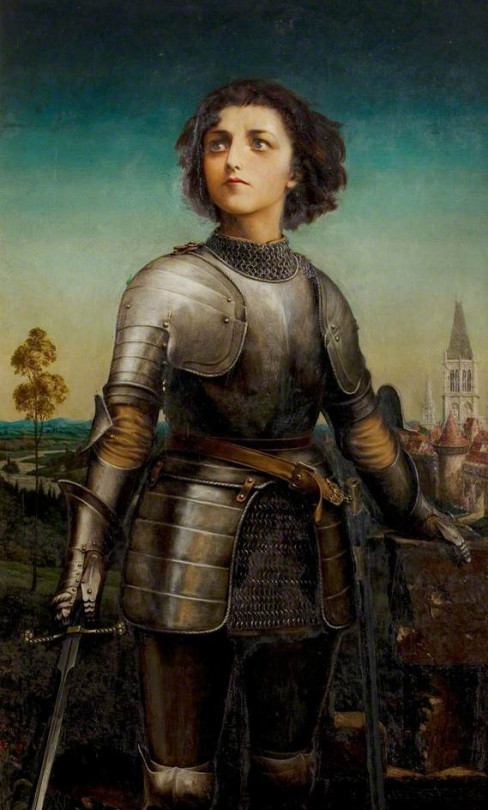
If you’re writing a fantasy book, movie, or video game, and you want it to be realistically themed, don’t give the women boob-shaped armor. It wasn’t done historically even in the few cases when women wore plate armor, and that’s because it isn’t as protective as a smooth, rounded breastplate like you see men wearing. A hit with any weapon between the two ‘boobs’ will hit with its full force rather than glancing off, and that’ll hurt. If you’re not going for a realistic feel, then do whatever you want. Just my advice.
Above: Joan of Arc, wearing properly protective armor.
An exception to this is in ancient times. Female gladiators sometimes wore boob-shaped armor because that was for entertainment and nobody cared if they lived or died. Same with male gladiators. There was also armor shaped like male chests in ancient times, but because men are more flat-chested than women, this caused less of a problem. Smooth, rounded breastplates are still superior, though.
3. Does it allow the wearer to keep his or her freedom of movement?
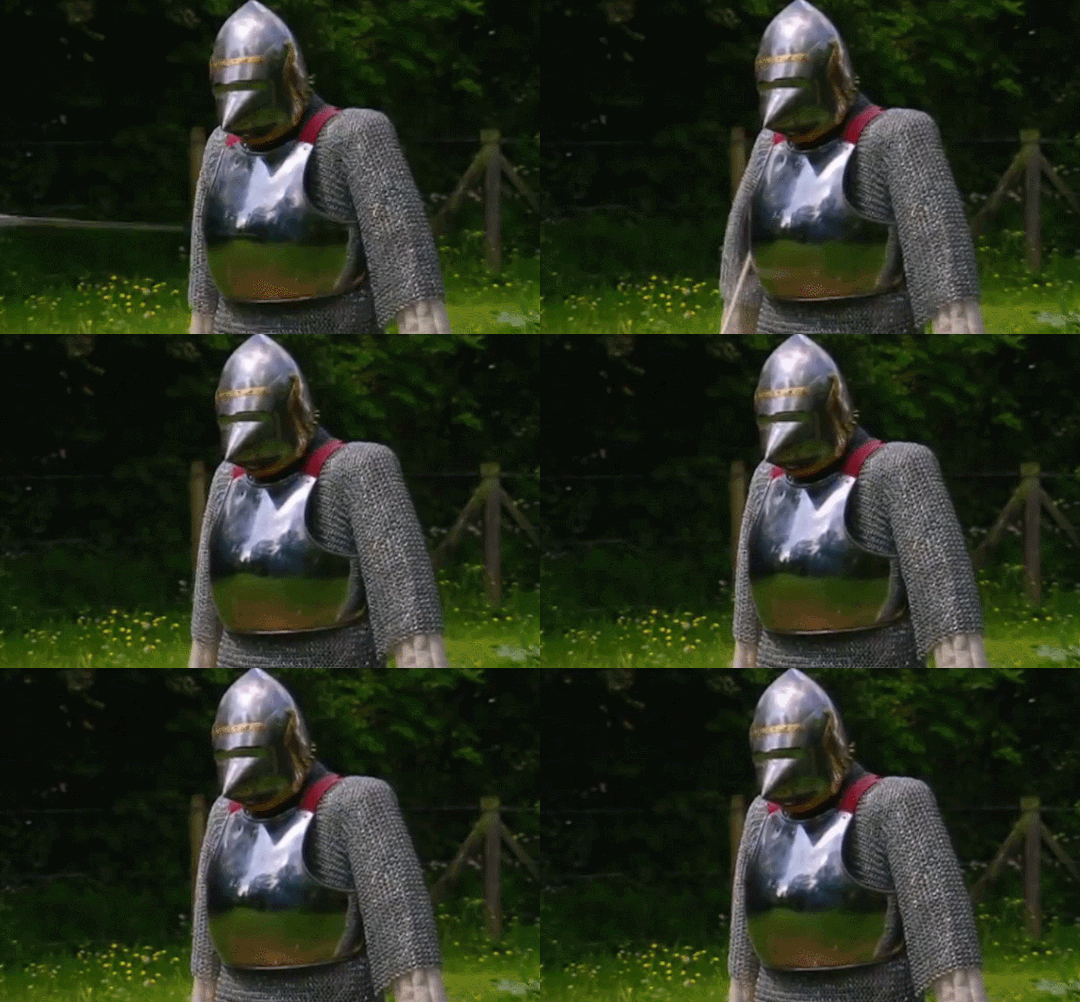
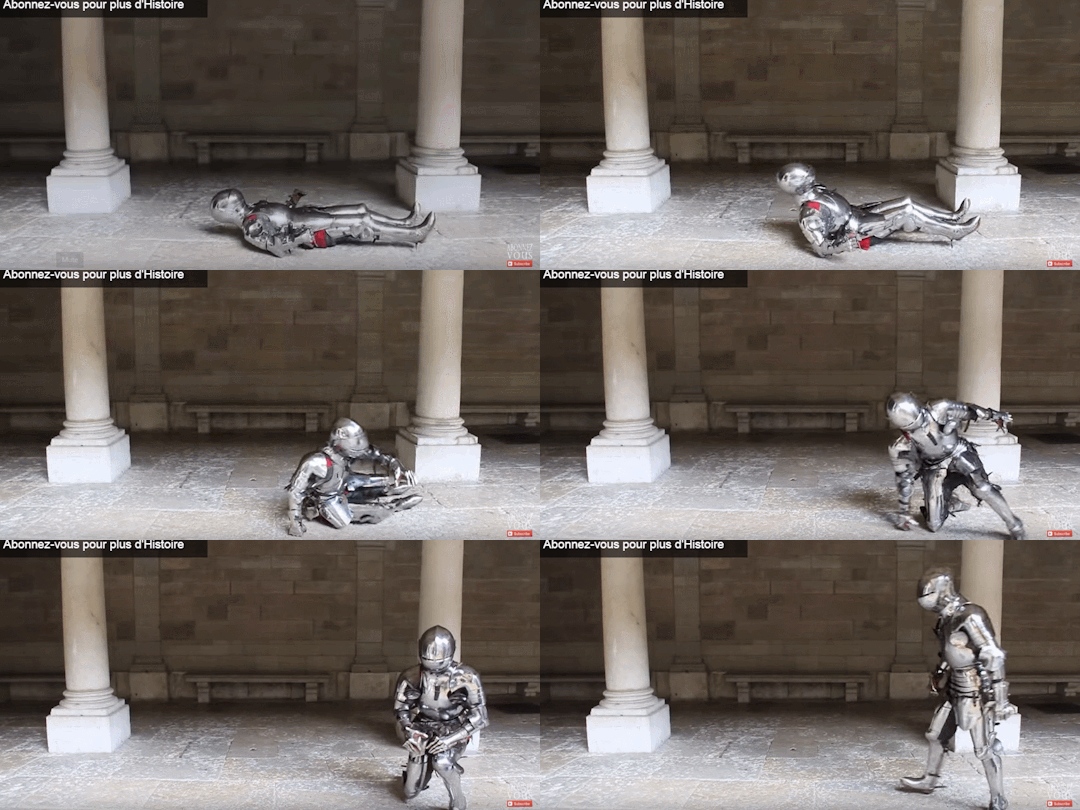
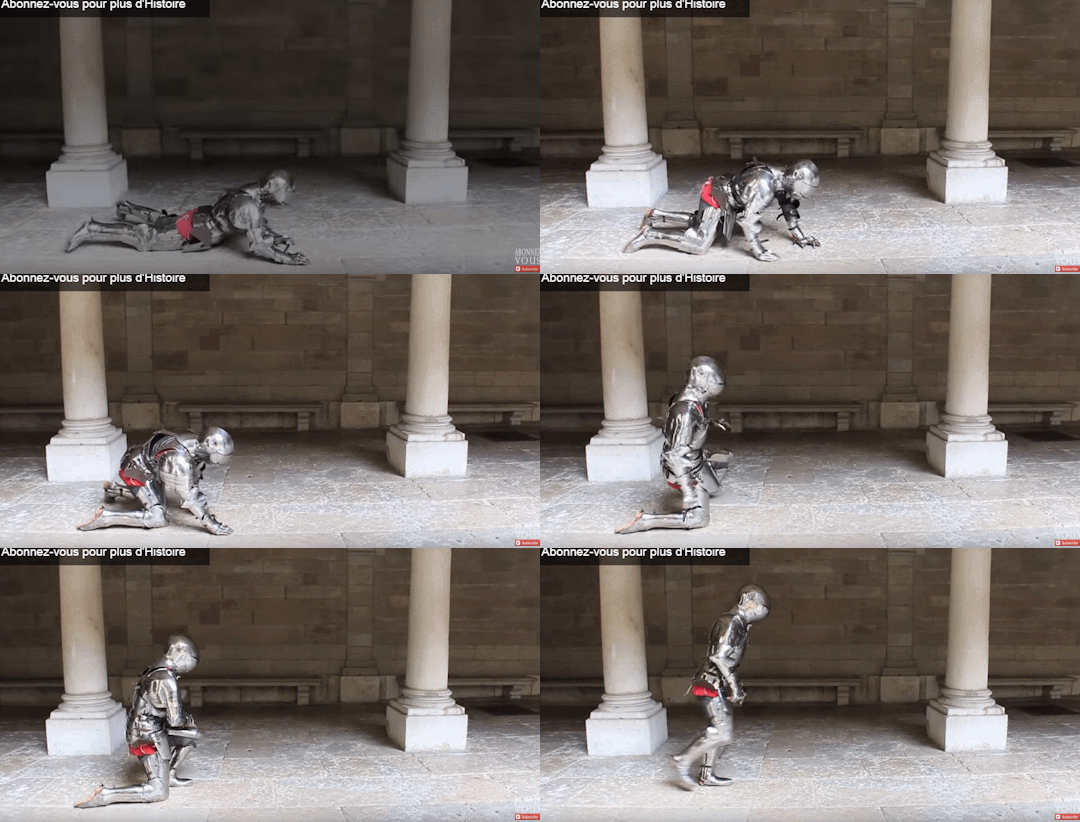
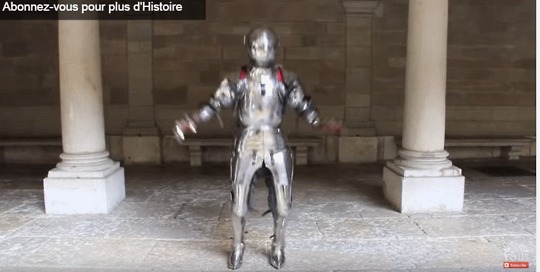
Okay, I’ve been writing this for like four hours, so thankfully this is the simplest question to answer. There’s a modern myth that plate armor weighed like 700 lbs, and that knights could barely move in it at all, but that isn’t true. On a suit of plate armor from the mid to late 1400s or early 1500s, all the joints are hinged in such a way that they don’t impede your movement very much at all.
The whole suit, including every individual plate, the chainmaille underneath the plates, the thick cloth or leather underneath the chainmaille, and your clothes and underwear all together usually weighed about 45-55 lbs, and because the weight was distributed evenly across your whole body, you’d hardly feel the weight at all. Much heavier suits of armor that did effectively ‘lock’ the wearer in place did exist, but they never saw battlefield use. Instead, they were for showing off at parades and for jousting. Jousting armor was always heavier, thicker, and more stiffly jointed than battlefield armor because the knight only needed to move certain parts of his body, plus being thrown off a horse by a lance–even a wooden one that’s not meant to kill–has a very, very high risk of injury.
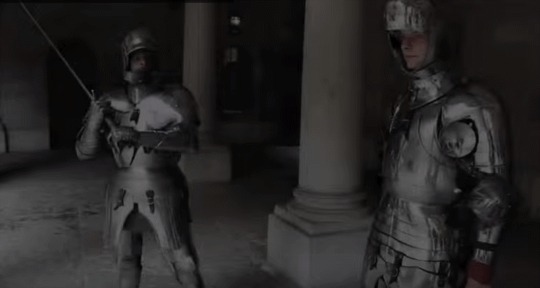
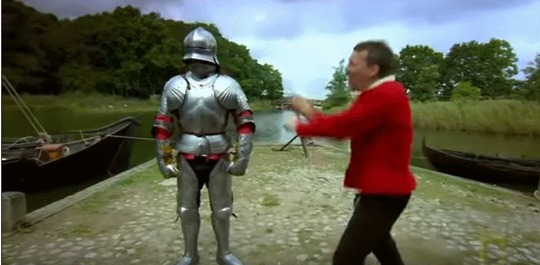
Here’s a bunch of .gifs of a guy demonstrating that you can move pretty freely in plate armor.
Above: Can you move in it? Yes.
Here are links to the videos that I made these .gifs from:
concerning weight and mobility: keep in mind the modern body armor worn by united states army soldiers weighs 30 lbs. even granting that modern soldiers, even the women, are larger than most medieval knights, it’s still significant that the state of the art in 2016 is only ten or fifteen pounds lighter than full plate.
and they march long distances in it, which knights generally did not have to do in their armor. conclusion: plate armor was not too heavy to fight in.
as for mobility, i think the myth that knights couldn’t move in their armor mainly comes from jousting armor, which was designed to lock in place and be absurdly heavy, simply because it was the car in a medieval demolition derby. you weren’t fighting in it, you were simply being carried toward a pointy log at high speeds.
This is such a good post! Also I’m happy to see the murder stroke has shown up in more and more films of late – I think even the Nic Cage film Season of the Witch shows it.
For anyone who went through that reference video masterpost of greatswords and half-swording stuff: this is the other side of the equation, the armor! 🙂
OKAY so in the course of my extensive google-based research for this thread I ran across this forum and I found this particular question to be both relevant and interesting. :3
It’s actually not in any of the book. The name “Mairon was only mentioned once, and in probably the most obscure location (which is why you didn’t find it, and I never would have without some google-fu) – a note on one of the essays published in the journal Parma Eldalamberon:
But this was altered after he was suborned by Melkor. But he continued to call himself Mairon the Admirable, or Tar-mairon ‘King Excellent’, until after Númenor’s downfall.
The specific reference is as follows:
J.R.R. Tolkien, “Words, Phrases and Passages in Various Tongues in The Lord of the Rings”, in Parma Eldalamberon17 (edited by Christopher Gilson), p. 183.
THAT IS A VERY GOOD REFERENCE BUT CAN WE ALL JUST TAKE A MOMENT TO APPRECIATE THE SHEER, MAJESTIC CHUTZPAH OF THE NAME “KING EXCELLENT”




 MisbehavingMaiar: Tumblr Archive