So here’s something
weird: why did Míriel and Pharazôn marry so late? They were 138 and
137 (respectively) at their marriage, however Palantír was 82 when
Míriel was born and Gimilkhâd 74 when Pharazôn was born, which
meant they would have been married when they were no later than 81 or
73 (again respectively).
Looking at
the line of kings from when they changed to having names in Adûnaic,
none of those kings’ first children were born to a king over 100:
Adûnakhôr was 89 when his eldest son was born, Zimrathôn 78,
Sakalthôr 84, and Gimilzôr 75. They all certainly would have been
married by then, so their age at marriage would probably be in their
late 60s to late 70s.
And yet both Míriel
and Pharazôn went unmarried for twice as long. This is particularly
strange considering their expected lifespan: Sakalthôr, Gimilzôr,
and Palantír all died in their early 200s, and Gimilkhâd was 199 at
his death, so Míriel and Pharazôn probably only had another 80
years of life at most when they finally married/were forced to marry.
Míriel’s case in
particular is strange. You could posit that Pharazôn wanted to
postpone his marriage because he planned to marry Míriel and take
over the kingship, as did happen (though it would probably would have
been Gimilkhâd’s idea originally). But Míriel should have married
earlier, for both political and dynastic reasons. Even if she and
Palantír (and Inzilbêth) were worried about a Vanimelde
situation, it’s hard to believe that particular risk would outweigh the benefits. It’s possible that Palantír’s father Gimilzôr
forbade Míriel’s marriage to a suitable candidate during his lifetime, but that shouldn’t
have affected what Míriel did once her father took the throne. And
frankly, Pharazôn not marrying made Míriel’s political future even
more at risk. Perhaps Míriel had a childless first marriage and
was a widow when Pharazôn forced her to marry, but I rather think
that would be mentioned?
Anyways, there was
probably some really interesting politicking going on in Gimilzôr
and Palantír’s courts, and that’s the only conclusion I feel able to draw from this.
The wolf howls. The ravens flee/ The ice mutters in the mouths of the sea.
Ai! laurië lantar lassi súrinen, yéni únótimë ve rámar aldaron! Yéni ve lintë yuldar avánier mi oromardi lissë-miruvóreva Andúnë pella, Vardo tellumar nu luini yassen tintilar i eleni ómaryo airetári-lírinen.
Sí man i yulma nin enquantuva?
An sí Tintallë Varda Oiolossëo ve fanyar máryat Elentári ortanë ar ilyë tier undulávë lumbulë; ar sindanóriello caita mornië i falmalinnar imbë met, ar hísië untúpa Calaciryo míri oialë. Sí vanwa ná, Rómello vanwa, Valimar!
Namárië! Nai hiruvalyë Valimar. Nai elyë hiruva. Namárië!
Ah! like gold fall the leaves in the wind, long years numberless as the wings of trees! The long years have passed like swift draughts of the sweet mead in lofty halls beyond the West, beneath the blue vaults of Varda wherein the stars tremble in the song of her voice, holy and queenly.
Who now shall refill the cup for me?
For now the Kindler, Varda, the Queen of the Stars, from Mount Everwhite has uplifted her hands like clouds, and all paths are drowned deep in shadow; and out of a grey country darkness lies on the foaming waves between us, and mist covers the jewels of Calacirya for ever. Now lost, lost to those from the East is Valimar!
Farewell! Maybe thou shalt find Valimar. Maybe even thou shalt find it. Farewell!
This is truly amazing. To hear Elvish the way it was supposed to be spoken. Absolutely beautiful.
jrrt: And sometimes as a man may cast a dainty to his cat (his cat he calls her, but she owns him not) Sauron would send her prisoners that he had no better uses for: he would have them driven to her hole, and report brought back to him of the play she made.
me, every single time: *delighted chortling*
What I love about this, –aside from the simply delightful image of Sauron petting his cat/spider Shelob–, is that it’s one of the very few things The Lord of the Rings tells us about Sauron’s personality. In most of the trilogy, Sauron’s this dark, mysterious, vast menace hanging in the background yet pressing down upon the heroes, but when Tolkien does decide to mention something about Sauron’s personality, it’s this… The man must really hate cats, mustn’t he?
There is this draft of the Two Towers in which Gandalf uses the Palantír and he basically tells Sauron to fuck off because he’s too busy to talk rn and I think that’s beautiful.
“Then Morgoth recalled the doom of Huan, and he chose one from among the whelps of the race of Draugluin; and he fed him with his own hand upon living flesh, and put his power upon him. Swiftly the wolf grew, until he could creep into no den, but lay huge and hungry before the feet of Morgoth. There the fire and anguish of hell entered into him, and he became filled with a devouring spirit, tormented, terrible, and strong. Carcharoth, the Red Maw, he is named in the tales of those days, and Anfauglir, the Jaws of Thirst. And Morgoth set him to lie unsleeping before the doors of Angband, lest Huan come.”
— J.R.R. Tolkien, The Silmarillion, p.180 (Of Beren and Lúthien)
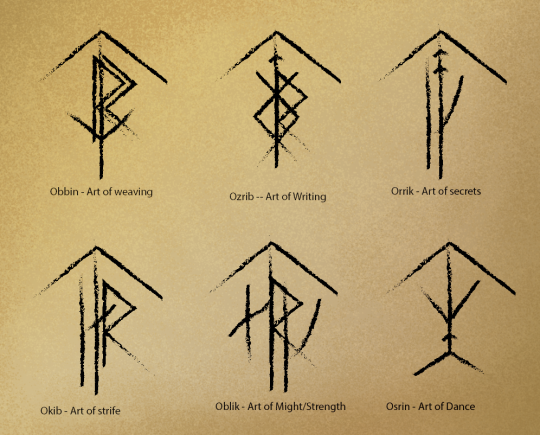
writing system (prior to them adopting runes), yet professor Tolkien never wrote these down, nor do we really know anything beyond the fact that these once were used by the dwarves.
So sadly, I can’t give you any dwarvish symbols at all, let alone regarding specific topics.
More information about this earlier writing system can be found inthis older ASK. This also includes a wonderful attempt by @striving-artist at creating an ideographic system by using Neo-Khuzdul words.
An example of an ideographic writing system made by @striving-artist
My thought is ‘no’ to the first one and ‘yes’ to the second, and here’s why:
1) To the best of my knowledge, the only instance we have of one of the Ainur transforming into a non-living entity is Melkor, when he’s hiding from Tulkas in Valinor, “passing from place to place as a cloud in the hills”, as well as later when he’s fleeing from Valinor, where he’s described as becoming a cloud of Darkness. It’s unclear in these passages whether Tolkien means he became a literal cloud, or if this was a metaphorical way of saying he had disembodied from his physical shape and was running around unseen. We know the Ainur can run around unclad and invisible when they want to, and there are many passages which suggest they can appear to mortals as various mists, ghosts, vapors, wind, clouds, etc. (ex. when Saruman is killed at the end of LotR, and frequent descriptions of third-age Sauron appearing as a sort of nebulous dark cloud).
All the other instances I can think of where one of the Ainur willingly transforms into another shape, it is into a living creature of some kind. (IF I’M MISSING SOMETHING, FEEL FREE TO CORRECT ME, I’m really curious if there IS an instance of this!)
The best Maiar shapeshifting examples we have in text come from Thû/Sauron when he’s doing his little Tam-Lin stint with Huan, where he conspicuously does NOT turn into a red-hot bar of iron, which I think would have aided him tremendously in that situation. This seems to point back to the idea that Maiar shape-shifting is facilitated by some sort of guise, such as the “wolf-hame” or the skins of other creatures, and furthermore something that is limited by circumstance and the relative power of the Maia (which I’ve talked about at length on this blog before because I’m a fucking Metaphysical Mechanics nerd); it’s not necessarily an easy or limitless ability they have to change shape.
So, either because of restrictions on their abilities or maybe just from lack of creativity, I don’t think Ainur can change into non-living shapes, or at least, none of them have been recorded doing it.
2) HOWEVER: can a Maia be forged into a weapon? In so much as a piece of a Maia’s spirit can be bonded with an inanimate object, yes! We KNOW they can do that much, because of the One Ring; heck, Eöl bonded a piece of his soul to Anglachel and Anguirel, so presumably even elves can do this.
Whether or not someone else could do this TO a Maia is uncertain– in fact, I’m going to go ahead and say they can’t, due to Tolkien’s established laws of free will and the spirit. Even Melkor isn’t capable of entirely wresting a person’s mind or will from them unless they “give” him access to their mind in some way (which is why all of Morgoth & Co are so heavily invested in the material world; because the material world lets you have they physical power over people that you need to persuade them to give you the keys to their mind and spirit.) Same with Glaurung; he needs at least your name to have power over you.
I doubt a Maia, or anything else with a spirit, could be bound to an object permanently unless they did it themselves, or allowed it to be done.
–Now, there’s an interesting and incredibly unsettling THIRD option that you could make a case for, which is that a spirit might be cursed to inhabit an object– if the souls of the Men of the White Mountains who broke their oath to Isildur can be cursed to stay in the world, bound to the Stone of Erech whereupon they swore their oath, then….. who knows? Maybe an oathbreaking Maia might forfeit their shape and power over their spirit and be forced to inhabit an object until the terms of their oath are met? That might make an interesting addition to a story. 😉 Let me know if it happens!
Note: By the end of 1914, most of Tolkien’s Oxford friends and fellow TCBS members had enlisted. But as an orphan who had always struggled to stay out of poverty, and being by then engaged to his beloved Edith, Tolkien could not afford to abandon his studies, which were crucial to his future chances of an academic career. And so, despite immense pressure from his extended relations and intense societal scorn, he deferred his enlistment until after finishing his final exams the following summer.
“ Back before war broke out, at the end of the university term, Tolkien had borrowed from the college library Grein and Wülcker’s Bibliotek der angelsächsischen Poesie. This massive work was one of those monuments of German scholarship that had shaped the study of Old English, and it meant Tolkien had the core poetic corpus at hand throughout the long summer vacation. He waded through Crist, by the eighth-century Anglo-Saxon poet Cynewulf, but found it ‘a lamentable bore’, as he wrote later: ‘lamentable, because it is a matter for tears that a man (or men) with talent in word-spinning, who must have heard (or read) so much that is now lost, should spend their time composing such uninspired stuff.’ Boredom could have a paradoxical effect on Tolkien: it set his imagination roaming. Furthermore, the thought of stories lost beyond recall always tantalized him. In the midst of Cynewulf’s pious homily, he encountered the words ‘Eala Earendel! engla beorhtast / ofer middangeard monnum sended, ‘Hail Earendel, brightest of angels, above the middle-earth, sent unto men!’ The name Earendel (or Éarendel) struck him in an extraordinary way. Tolkien later expressed his own reaction […]: ‘ I felt a curious thrill, as if something had stirred in me, half wakened from sleep. There was something very remote and strange and beautiful behind those words, if I could grasp it, far beyond ancient English….I don’t think it any irreverence to say that it might derive its curiously moving quality from some older world.’ But whose name was Éarendel? The question sparked a lifelong answer.
Cynewulf’s lines were about an angelic messenger or herald of Christ. The dictionary suggested it meant ray of light, or the illumination of dawn. Tolkien felt that it must be a survival from before Anglo-Saxon, even from before Christianity. (Cognate names such as Aurvandil and Orendil in other ancient records bear this out. According to the rules of comparative philology, they probably descended from a single name before Germanic split into its offspring languages. But the literal and metaphorical meanings of this name are obscure.) Drawing on the dictionary definitions and Cynwulf’s reference to Éarendel as being above our world, Tolkien was inspired with the idea that Éarendel could be none other than the steersman of Venus, the planet that presages the dawn. At Phoenix Farm [his widowed aunt’s residence in Nottinghamshire], on 24 September 1914, he began, with startling éclat:
Éarendel sprang up from the Ocean’s cup In the gloom of the mid-world’s rim; From the door of Night as a ray of light Leapt over the twilight brim, And launching his bark like a silver spark From the golden-fading sand; Down the sunlit breath of Day’s fiery Death He sped from Westerland.
Tolkien embellished ‘The Voyage of Éarendel the Evening Star’ with a favourite phrase from Beowulf, Ofer ýpa ful, ‘over the cup of the ocean’, ‘over the ocean’s goblet’. A further characteristic of Éarendel may have been suggested to Tolkien by the similarity of his name to the Old English ēar ‘sea’: though his element is the sky, he is a mariner. But these were mere beginnings. He sketched out a character and a cosmology in forty-eight lines of verse that are by turn sublime, vivacious, and sombre. All the heavenly bodies are ships that sail daily through the gates at the East and the West. The action is simple: Éarendel launches his vessel from the sunset Westerland at the world’s rim, skitters past the stars sailing their fixed courses, and escapes the hunting Moon, but dies in the light of the rising Sun.
And Éarendel fled from that Shipman dread Beyond the dark earth’s pale. Back under the rim of the Ocean dim, And behind the world set sail; And he heard the mirth of the folk of earth And hearkened to their tears, As the world dropped back in a cloudy wrack On its journey down the years.
Then he glimmering passed to the starless vast As an isléd lamp at sea, And beyond the ken of mortal men Set his lonely errantry, Tracking the Sun in his galleon And voyaging the skies Till his splendor was shorn by the birth of Morn And he died with the Dawn in his eyes.
It is the kind of myth an ancient people might make to explain celestial phenomena. Tolkien gave the title in Old English too (Scipfæreld Earendeles Æfensteorran), as if the whole poem were a translation. He was imagining the story Cynewulf might have heard, as if a rival Anglo-Saxon poet had troubled to record it.
As he wrote, French and German armies clashed fiercely in the town of Albert, in the region named for the River Somme, which flows through it. But Éarendel’s is a solitary species of daring, driven by an unexplained desire. He is not (as in Cynewulf) monnum sended, ‘sent unto men’ as a messenger or herald; nor is he a warrior. If [this early version of] Éarendel embodies heroism at all, it is the maverick, elemental heroism of individuals such as Sir Ernest Shackleton, who that summer had sailed off on his voyage to traverse the Antarctic continent.
If the shadow of war touches Tolkien’s poem at all, it is in a very oblique way. Though he flies from the mundane world, he listens to its weeping, and while his ship speeds off on its own wayward course, the fixed stars take their appointed places on ‘the gathering tide of darkness’. It is impossible to say whether Tolkien meant this to equate in any way with his own situation at the time of writing; but it is interesting that, while he was under intense pressure to fight for King and Country, and while others were burnishing their martial couplets, he eulogized a ‘wandering spirit’ at odds with the majority course, a fugitive in a lonely pursuit of some elusive ideal.
What is this ideal? Disregarding the later development of his story, we know little more about the Éarendel of this poem than we do the stick figure stepping into space in Tolkien’s drawing The End of the World. Still less do we know what Éarendel is thinking, despite his evident daring, eccentricity, and uncontainable curiosity. We might almost conclude that this is truly ‘an endless quest’ not just without conclusion, but without purpose. If Tolkien had wanted to analyze the heart and mind of his mariner, he might have instead turned to the great Old English meditations on exile, The Wanderer and The Seafarer. Instead he turned to Romance, the quest’s native mode, in which motivation is either self-evident (love, ambition, greed) or supernatural. Éarendel’s motivation is both: after all, he is both a man and a celestial object. Supernaturally, this is an astronomy myth explaining planetary motions, but on a human scale it is also a paean to imagination. ‘His heart afire with bright desire’, Éarendel is like Francis Thompson (in Tolkien’s Stapeldon Society paper), filled with ‘a burning enthusiasm for the ethereally fair’.It is tempting to see analogies with Tolkien the writer bursting into creativity. The mariner’s quest is that of the Romantic individual who has ‘too much imagination’, who is not content with the Enlightenment project of examining the known world in ever greater detail. Éarendel overleaps all conventional barriers in a search for self-realization in the face of the natural sublime. In an unspoken religious sense, he seeks to see the face of God. ”
Eärendel the Wanderer who beat about the Oceans of the World in his white ship Wingelot sat long while in his old age upon the Isle of Seabirds in the Northern Waters ere he set forth upon a last voyage.
He passed Taniquetil and even Valinor, and drew his bark over the bar at the margin of the world, and launched it on the Oceans of the Firmament. Of his ventures there no man has told, save that hunted by the orbed Moon he fled back to Valinor, and mounting the towers of Kôr upon the rocks of Eglamar he gazed back upon the Oceans of the World…
From the notes [preface to The Shores of Faëry] of J.R.R. Tolkien, The Book of Lost Tales Part II, “The Tale of Eärendel”
“…she was the wife of one of the ship-kings of Pelargir. She loathed the smell of the sea, and fish, and the gulls.” and “Well, Berúthiel went back to live in the inland city….” (1966 interview with JRRT)
“Berúthiel lived in the King’s House in Osgiliath, hating the sounds and smells of the sea….” (Unfinished Tales, Part 4, Ch 2, The Istari: Notes, Note 7)
Throughout Tolkien’s works, there are some trends which recur. Physical beauty is associated with goodness, and the loss of that beauty (in Sauron’s case, for example) with corruption. Cats are demonized. (Tevildo, Berúthiel herself, who’s a villainous figure in the canon. And the sea/water is associated with the Valar, the music of creation, and, by implication, moral uprightness or goodness. (Yes, I’m simplifying greatly; no, I’m not providing sources on these points, but they exist. Anyway.)
In the “choosing not to oversimplify the canon” department, I’ve always considered these few quotes about Berúthiel and her hatred of the sea. She’s stated by JRR to return back to “the inland city” and when last sighted, her ship was “flying past Umbar.” The clear implication is that she was from, originally, an inland city of the southern continent of Harad, which is probably roughly analogous in location/ climate to Africa. (Gondor being roughly northern Mediterranean….) In my writing, I’ve chosen to locate her city as inland of the Haven of Umbar, though still within the wider region also known Umbar, and at the edge of a large desert roughly analogous to the Sahara.
So she’s from an entirely different climate, a different ecosystem than that of Gondor. She’s put on a ship and sent to marry a man who is the hereditary enemy of her people; and, to make it better, a man who’s named himself Falastur – translated as shore-lord or Lord of the Coast, the first of the Ship Kings of Gondor. A man who has literally made his very name by the sea.
And have you ever smelled the sea? The docks, or the beaches at low tide? There’s a lot to romanticize in the salty freshness of the air, perhaps, but it also smells heavy and rotten and fishy and unpleasant. Dead fish and crustaceans and strange plants heaped in the sand, baking under the sun. Thick dark mud caked around the pilings in the brackish wash of the river where it empties into the sea. The detritus of ships and of human occupation, wastewater and bilge and tar. It’s not at all a nice smell even if you don’t mind the scent of the sea itself, minus those other elements.
And even that ‘cleaner’ scent was strange enough to her… and it only pointed out to her how foreign she had now become, how much of an outsider, how very out of place. The foreign queen, the enemy queen, whose clothing and whose art were strange, whose tastes were strange; and strange was all too easily translated into dangerous, menacing, nefarious. They were afraid of her; and they loved the sea. She hated them, and hated her ship-building shore-lord husband (to whom she would not even give an heir), and she hated it. The ocean represented to her not goodness, but the very opposite.
“Manwë summoned the Valar for a council [- maybe he had asked Eru for counsel -] at which it was resolved to send out three emissaries to Middle-earth and he asked who would go. They would have to lose might and clothe themselves in flesh to win the trust of Elves and Men but this would also imperil them, diminish their wisdom and knowledge and bring upon them fear, the care and weariness of the flesh. Only two came forward; Curumo [Saruman] and Alatar. Curumo was chosen by Aulë among “his” Maiar, and Alatar was sent by Oromë. Manwë asked where Olórin [Gandalf] was, and Olórin, just returning from a journey and coming to the meeting, asked what he wanted from him. Manwë said that he wished him to go as the third to Middle-earth. Olórin answered that he thought himself too weak for such a task, and added that he feared Sauron. Then Manwë said that that was all the more reason why he should go, and he commanded him to go as the third. There Varda broke in and said “Not as the third,” and Curumo remembered that.“
– Unfinished Tales
1: Olorin is late to the council of the Valar because he was out wandering around; he sure doesn’t change much.
2: He doesn’t want to join this mad expedition because he thinks he’s not up to it and also he’s afraid of Sauron. Suddenly I’m thinking that he sees a good deal of himself in Bilbo Baggins; I expect he spent much of his early years in Middle-Earth wishing he was back in Irmo’s gardens with the Valinorean equivalent of a nice cup of tea.
Can we talk about that infinite fucking shade Varda threw at Curumo tho




 MisbehavingMaiar: Tumblr Archive