Unlike the Sindarin name Celduin – which simply means “large flowing river” from “cell” (adj. “running, flowing”) + “duin” (“big and large river”), a meaning we also see used in “river Running”, the word for the river Running in Dwarvish is “Aklah’ân”, meaning “Source River”.
Stunning art “The Front Gate” by Alan Lee (In which we see the river Running)..
It is likely the word here finds its origin in the fact that Halls of Erebor were built upon, around and even far beneath the source of the river, to eventually pour out of the Front Gate of the Lonely Mountain. The river source thus was so prominent in Erebor, that it simply became known as “The Source River”.
This electrum hekte, struck in 521-479 BC, at the ancient city of Phokaia in Ionia features the front facing head of Silenos (Silenus) with wide eyes, beard and mustache. The reverse is a quadripartite incuse square. A very rare coin, only 10 examples are known, five of which are in museums.
In Greek mythology, Silenus was the old rustic god of wine making and drunkenness. He was Dionysus’ foster father and tutor. Dionysus was nursed by the Nysiad nymphs and raised by Silenus in a cave on Mount Nysa. He was usually depicted as a bearded, balding old man with a pot belly and stubby nose, with the ears and tail of a donkey.
More lineart previews for my Beleriand Numismatics project! This time, Khazad coins from Belegost and Nogrod, featuring a grimacing battle mask and a profile of Azaghal.
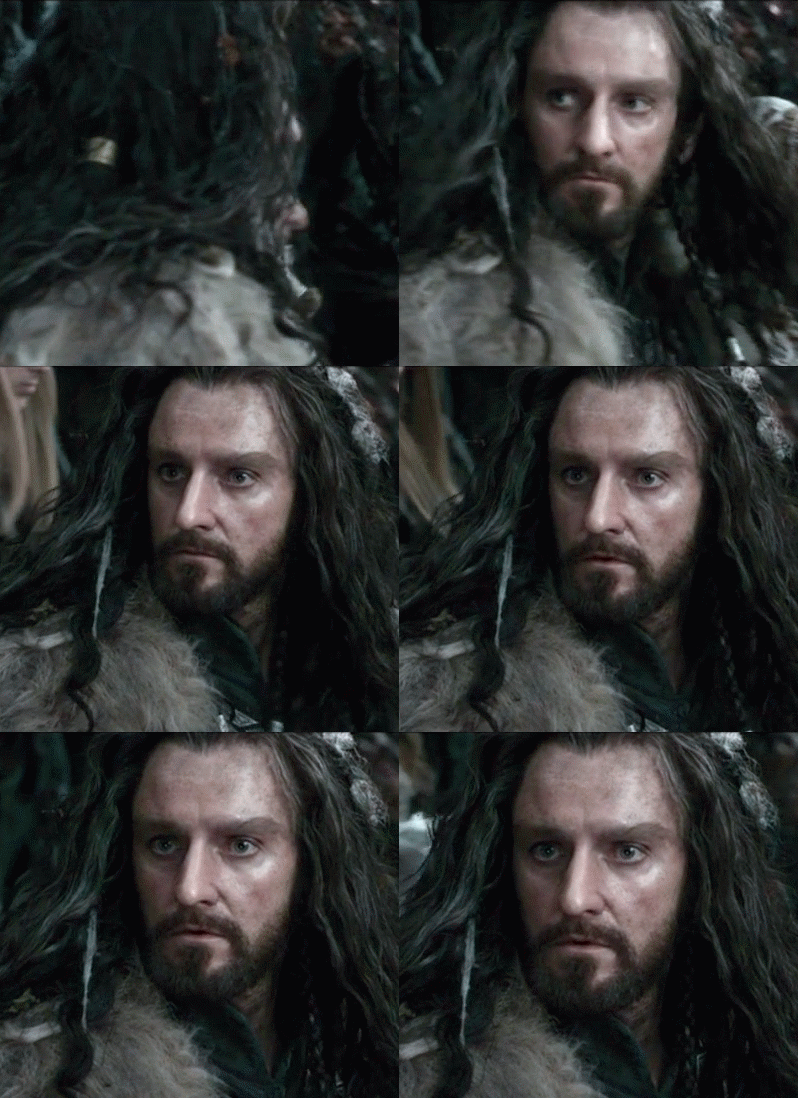
But have you considered: Thorin might be nearsighted?
Case in point:
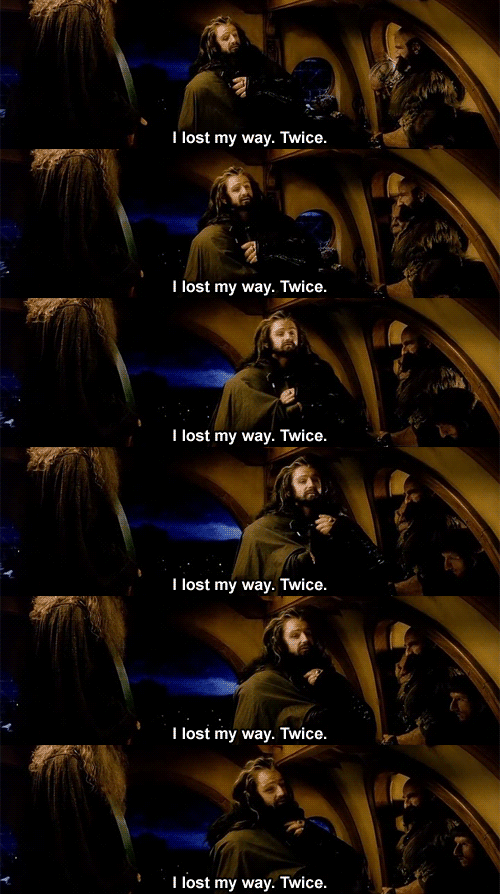
Exhibit 2
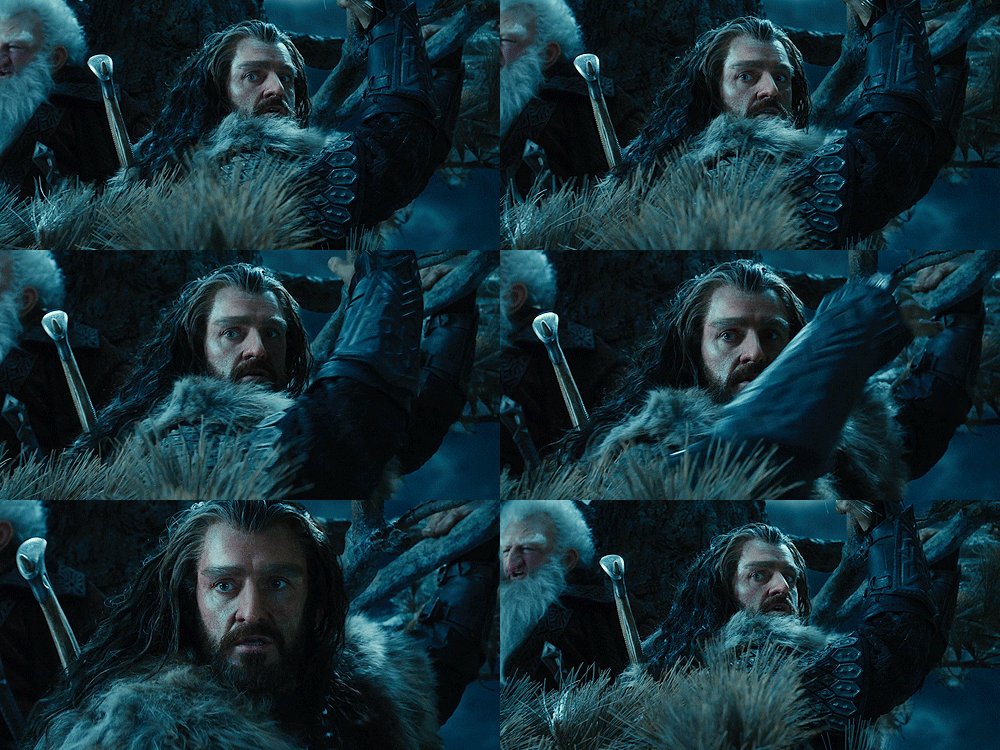
“It cannot be.”aka Doesn’t actually recognize Azog until he starts talking…
This needs no explanation:
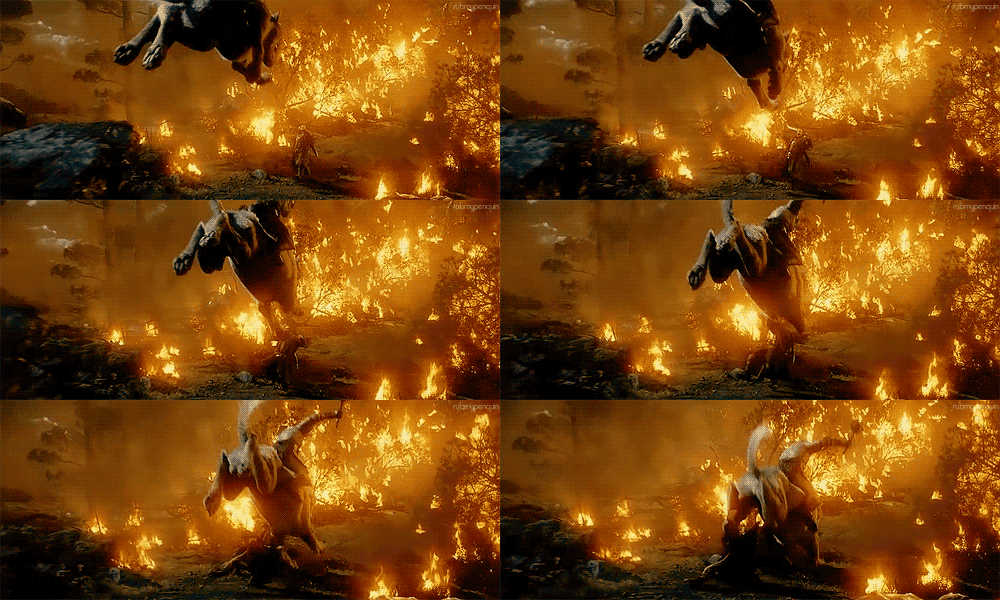
*BOOM*
Exhibit 3:
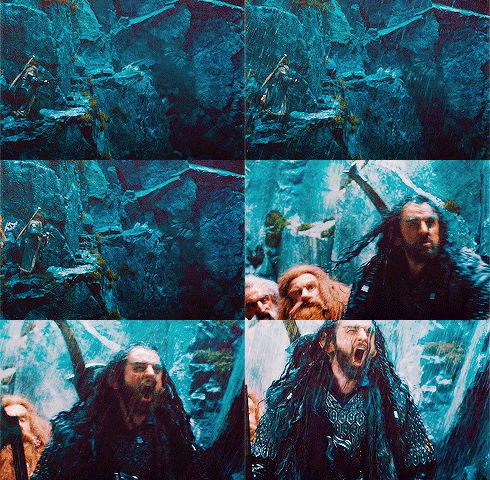
Not subtitled, but Thorin shouts for Kili when actually Fili is the one who was almost crushed >.<
Exhibit 4
Not pictured because I couldn’t find a gif, but Thorin prompting Balin to lead them out of Rivendell because he “can see knows these paths”
Exhibit 5
Cut off Azog’s arm, was probably aiming for something slightly more fatal, couldn’t tell he was alive when dragged back inside Moria…
Exhibit 6
WHERE’S BILBO?
(”I have no idea because I can’t see for shit.”)
Conclusion:
Since wearing glass in front of your eyes is slightly more of a liability for a fighter than people’s faces being slightly blurry, I’m just gonna throw this out there as a possible explanation for fandom to run with 😉
Ok but I think this is my favorite post of mine that’s done well because
1) it give a humorous explanation for Thorin’s random moments of fail that’s cracky and funny
2) it actually kinda makes sense and it gives Thorin a minor (or not so minor for his life and world) disability that he works around and actually kinda explains said moments of fail realistically and honestly guys the more I think about it and replay the movies in my head the fewer contradictions I can find for this headcanon???
There is a fanfic in here somewhere
Convincing arguments!
Thorin has suddenly become more human and more pleasant (short-sighted person speaking here)
You are not wrong OP, Thorin IS nearsighted. In the book, it was even canon:
“How far away do you think it is?” asked Thorin, for by now they knew Bilbo had the sharpest eyes among them. “Not far at all. I shouldn’t think above twelve yards.” “Twelve yards! I should have thought it was thirty at least, but my eyes don’t see as well as they used a hundred years ago-” (From the chapter, ‘Flies and Spiders’
of The Hobbit, by JRR Tolkien
)
Thorin isn’t just slightly nearsighted either, he thought a large object at across-the-street distance was three-quarters of the length of a football field away. By modern standards he would be legally, coke-bottle-glasses-or-we-don’t-let-you-drive, blind.
In the movie Thorin’s nearsightedness is never actually stated, but I love the clever ways in which they worked it into the acting (as avelera highlighted very well), and also into the costume and set design (implying that Dwarves tend to be nearsighted in general): Dwarven ornamentation is always three-dimensional, be it stamped leather, cut runes, thickly-embroidered brocade, or cast-metal beads. There are no purely painted or smooth-inlaid designs anywhere that would require sight, let alone 20/20 vision.
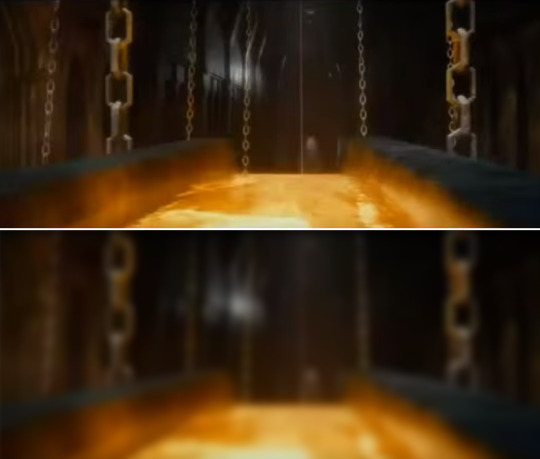
Dwarven cities too, are violently three-dimensional and ornamented with a lot of straight-lined geometry and gigantic statues. Perhaps most telling of all, the terrifyingly high stone bridges found in both Erebor AND Moria are treated as perfectly ordinary sidewalks… which would make sense for a race that couldn’t even SEE the ground below.
Hello there! Well met! No need to beg for assistance, happy to aid when I can.
I would translate these lines as:
“Iziz Tumunzaharul ra Gabilgatholul.”
“Gunrû ‘Urstarâg ra Fantnuhûb.”
“Mahal maharuma.”
“Iziz” – I’m using the nominative form here as I’ve added “-ul” to both place names. The -ul form is used here because we want to indicate descriptive origins (like: “from the iron” (“Zirnul”) – indicating origins of an element. There are other options, using the constructive for instance, but I believe this would fit best.
Incidentally, the “-az”-form I no longer included in the current Neo-Khuzdul grammar, what I referred to in the documentation as “Classical Khuzdul” (CK). It however would still be present in the “Blue Mountains Khuzdul” (BMK). And seeing that we are talking about just these halls, it is indeed still a valid option for your translation (if you want to give it that local touch). In that case, this part of your translation would be perfectly fine.
Usage of “ra” instead of “/”: I used “ra” (meaning “and”), as I do not believe the “/”-sign would be present in Khuzdul runic writing. Note though that “ra” does have its own rune, which you could use (if you are writing this in runes of course). More on that HERE.
I also translated “property of” literally to “Gunrû” (using the construct form), which means the clan names would not need to be modified to include a possessive genitive marker.
The last line “Mahal be praised”, is translated perfectly. One could be tempted to use the passive imperative (”maihrim” here, but seeing we are not “commanding” Mahal to be praised, but merely suggesting others should praise him, your choice of the passive subjunctive is absolutely spot on! “Mahal Maharuma”, literally meaning “Mahal, let him be praised” fits perfectly.
Please do show me those coins when you are done, I would love to see them.
Ever at your service,
The Dwarrow Scholar
I am swooning. You’ve swooned me. I am disproportionately gleeful to have conjugated a verb correctly. This is an excellent night.
The “/” sign I blame on tumblr’s character limit and my own hubris… I’d meant to have two separate sentences whose only differences were the proper nouns; “Coin from Tumunzahar property of the Firebeards” and “Coin from Gabilgathol property of the Broadbeams”. My theory is that each hall has their own mint, and would wish to differentiate their own coins from their neighbor’s, even if the value was the same.
Would the same construction apply? Making it “Izizaz Tumuzaharul gunrû ‘Urstârag” and “Izizaz Gabilgatholul gunrû Fantnuhûb”, respectively?
…And if I can sneak in a separate topic: I’ve done my best to coin (hah) some words for “electrum” and “nickel”, but I’m at a loss as to how to shorten them into the terms for coinage such as “Kibil” –> “Kabl” or “Mikil” –> “Makl”. For electrum, I compounded words for “containing gold and silver” with the same ending as the other coins, and got “Barkadzurl”, (or “Zurl” but I am less confident that would be recognizable on its own). For nickel I tried “yellow-tin” or “tahfazimil”, and shortened it to “tahfl”. Again, I am not confident that holds together.
Thank you so much for lending me your expertise and time, and for the truly epic undertaking that is your Neo Khuzdul lexicon. 🙂 Hobnobbing with you linguists is the coolest part of being a Tolkien fan. It will be my pleasure to show off the coin designs when they’re done! I’ll be sure to tag you in it and give all due credit for the translation assist.



 MisbehavingMaiar: Tumblr Archive